



Philadelphia Proposed Taxes On Robotic Travel Are Surprisingly Huge
A draft bill before the city council of Philadelphia proposes new taxes for delivery robots, robotaxi rides and self-driving freight in the city. Some have lauded them as finally a way for cities to get some control over self-driving vehicles, the regulation of which is usually the jurisdiction of the states or federal government, not cities. The proposed taxes don’t seem that high, but they actually could be ruinous for the future of this industry, because people don’t know how low-cost these services can be.
While the tax on deliveries and rides is listed as just 5%, it includes a minimum tax of 50 cents on robotic delivery and $1 on robotaxi rides. I’ve worked in both fields. I helped build Starship, the leading robotic delivery company. Observers should not be confused by the current cost of those deliveries, which is based on comparison with competition. Over the long term, the cost of such deliveries can easily get under $1. A 50 cent tax on that is immense, and game-changing, and would severely disrupt such plans.
Today’s robotaxi rides are priced similarly to Uber and Lyft, and so it’s a rare ride that is much under $10. But future plans see a retail cost of rides similar to the cost of driving your own car, which is 60 cents/mile. Today, almost all rides also have a “flag drop” base charge which makes a one mile ride cost $7 or more, but that’s an artifact of the human driven taxi industry, not inherent to robotaxis.
A taxi rider often looks at their fare as a price per mile. The flag drop helps pay for the human who had to sit around waiting, and their costs in driving to pick you up, or to get into the area where ride requests are likely to appear. It is often said that Uber doesn’t pay its drivers when they wait, but that’s not reality. The base fare pays for that, and humans would not sit around waiting for nothing. Robots, on the other hand, are not bothered by waiting--only the fleet manager’s spreadsheet considers the cost of asset utilization. The robot itself only has costs while it is moving (plus a very low cost for “parking.”)
Today, that means that a short half-mile Uber ride is not economical. The raw cost of delivering that ride is very low, but is dwarfed by the cost of waiting and “deadheading.” This makes certain services uneconomical. If you want to take a taxi or Uber home from the train station, it’s likely you will pay more for that “last mile” trip than your whole train fare. That’s true even though the cost of running an electric car per passenger-mile is usually lower than the cost of running the train. (The train has many more people at rush hour, but its average load divided into the cost of running it is quite high.)
Group transportation, like trains, doesn’t go door-to-door, but those who don’t live next to the station want it, but they can’t get it. While short robotaxi rides do have to bear their deadheading costs, the ratio isn’t nearly so extreme, and it’s entirely possible to offer such “first/last mile” connection at a much more reasonable price than services where a human has to sit around waiting. So a $1 minimum tax/ride could easily double that cost.
I’ve outlined a 21st century form of transit based very much on the idea of the cheap short ride. Services like UberPool faced problems because to handle multiple riders, everybody else had to detour to their pickup and drop-off points. With short-haul robotaxis, you can make a system with no detours and no delays that offers almost private car style service with the trip-sharing economies of transit. But this is one of many things that becomes much harder if you throw on a giant minimum tax because you didn’t realize it was giant, because you only looked at how costs work today.
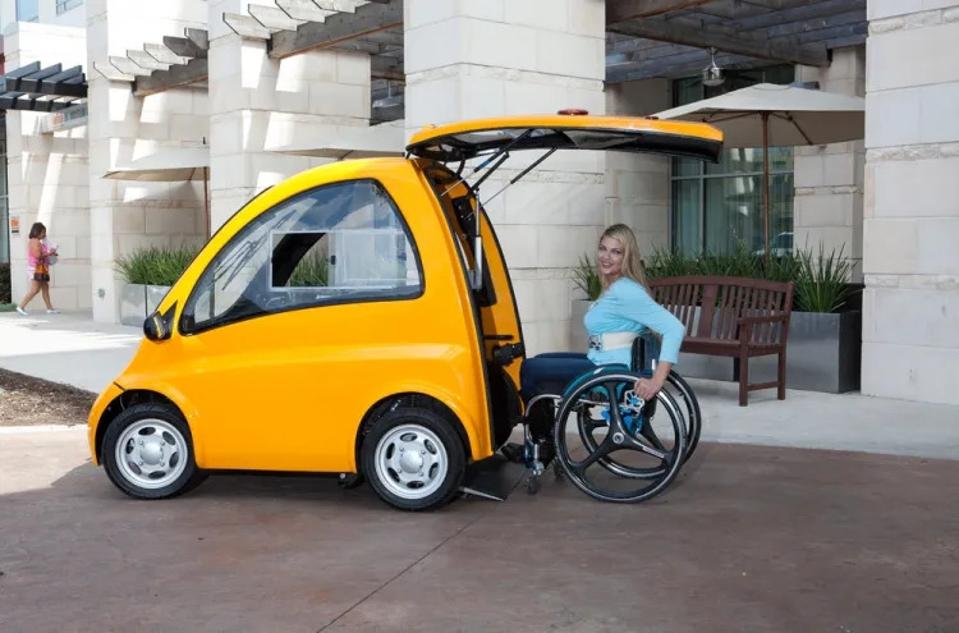
The law does exempt Paratransit, which is a transit alternative (with horrible service levels, including requiring 24 hour advanced booking and 60 minute pickup windows) that cities are required to provide under the Americans with Disabilities Act. Hopefully other services for the disabled would also be exempted but it’s not clear. Robotaxis with low prices for a short ride will be a great boon for the disabled. Robotaxi companies, once they grow to large sizes, will be required to provide accessible service--I expect that to include small hollow “roll right in” vehicles that wheelchair users will love--but these will not be Paratransit. Those with mobility limits will need the short rides even more than the able-bodied ambulatory.
Is Taxing The Right Approach?
It’s clear that having a minimum tax on a new innovation that people don’t yet know the economics of is a poor idea. Even though a poor tax can be corrected, that’s only in theory. In practice, taxes rarely go down.
But what about the percentage based tax? Are these vehicles putting a larger burden on city resources than existing delivery and taxi vehicles? What is the reasoning for taxing them more than the traditional modes. There’s even an argument that these vehicles should be taxed less than the traditional modes. They tend to be all-electric, with far less emissions and noise. If you make regulations for them, they will obey them like robots, something humans are notoriously bad at doing. We hardly want to especially discourage the cleanest, best-behaved actors on the streets. If curb use should be charged for, then all should pay that cost equally, including Ubers and private drivers. It is true that sidewalk delivery robots are a new creature. In their case, if they put a new cost burden on the city, it is reasonable to tax them to pay for that cost. At the same time, it should be considered that sidewalk deliveries are removing a vehicle from the street. Chances are a sidewalk robot delivering a food order consumes fewer city resources than a person in a car on the regular road, parking at the curb. That’s not what you want to tax and punish.
There is some speculation that the city is using a tax because it has power to tax, and the power to directly regulate driving on its streets is reserved to the states. This frustrates the cities but it was done for a reason. There are over 10,000 decent sized municipalities in the USA, and it would be untenable to have them all make their own conflicting regulations over vehicles driving their roads. There’s a reason their laws have been preempted, even though they might not like it.
Originally published at Forbes.com in Philadelphia Proposed Taxes On Robotic Travel Are Surprisingly Huge. Copyright © 2026 by Brad Templeton.


Add new comment