



Mercedes "Automated Valet Parking" disappoints
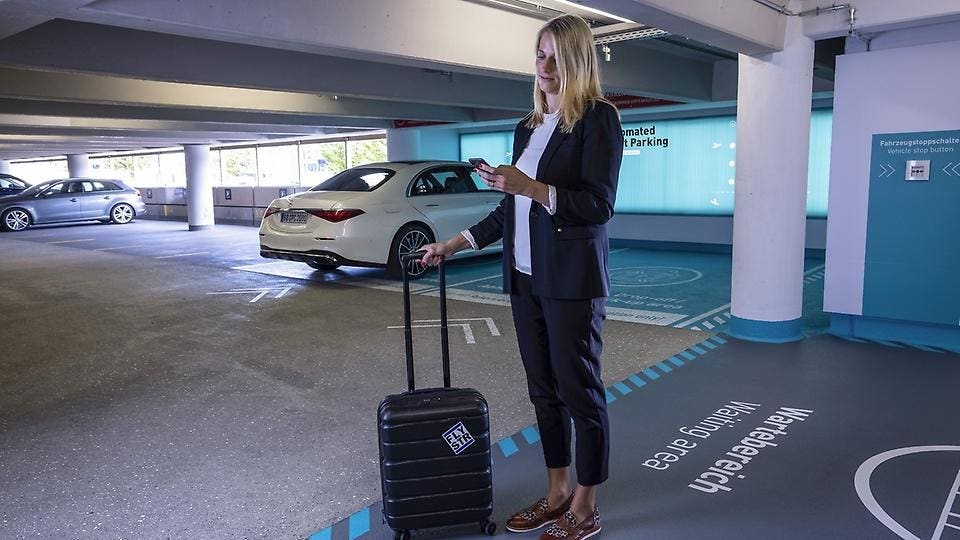
Several years ago, Bosch and Daimler teased an “automated valet parking” feature for Mercedes cars. Now, the 2021 S-Class will be able to use the feature in a special parking lot at the Stuttgart airport. Drivers will be able to drive to a special area at the lot entrance and signal the car to park. The car will be given instructions on where to park in the lot and how to get there, and park itself there. When the driver returns, they can signal as they walk off the plane, and the car will return to the staging area for pick-up by the driver.
This all seems nice, and saves the driver a couple of minutes of walking. The lot in question is reasonably close to the terminal, though not the most expensive. But in reality this shows the slow progress of the car OEMs and “tier one” suppliers in providing automation to customers. A year after Waymo demonstrated full unmanned robocars wandering a city, one wonders just where the car OEMs are.
Robotic valet is easy enough that it’s one of the earliest applications people worked on. I saw it at Stanford in 2009, and several carmakers have done demonstrations of it in the years since. Travel at slow speeds in a controlled environment is effectively in the “solved problem” column, and can even be done today without LIDAR. Back before the founding of Cruise, founder Kyle Vogt’s first plan was to build an add-on valet parking tool. It wasn’t too hard to talk him out of it.
On top of all this, the Daimler demo fails to even show the real value of robotic valet parking. The car simply move to an empty space in the lot in a valet area. It only saves the driver a small amount of time. Future cars will move to a valet area and park densely, almost touching one another, the way human valets park cars, but even more tightly. When one car needs to leave, it will move just an inch, letting the car in its way know to also move an inch, and so on, until the cars in its way move together and let it out. No communication is needed between the cars or even the lot to do this, though a smart lot might tell cars to park in a good pattern based on predicted return, the way human valets do. This would stick the cars in the back of the lot, taking up half the space — and allowing the driver to pay only half as much for parking.
Indeed, it should go much further than that at an airport. The drop-off and pick-up should be right at the curb, in the taxi area, and cars should move slowly to a remote lot that is much too far to walk, and thus even cheaper. Paying only 1/3rd the price for parking and doing drop off at the curb would be a very attractive parking offering. Maybe even attractive enough to compete with what most people do today, which is take a Taxi or Uber rather than pay Stuttgart’s 28 euros/day. They key to all of this is low speed — as long as you have a controlled area where low speeds are acceptable, one can make this sort of operation safe even without requiring a closed-off road. If you can get as slow as a 5mph parking lot speed, a car can stop in just 2 feet thanks to the high speed of cheap short-range sensors.
Of course, full robocars able to drive the roads will also be able to park, and be able to valet park in any lot for which they can download a map and currently policy instructions about where to park. This ability will provide a great boon. It’s already the case that robotaxis need much less parking because they go pick up other passengers rather than park, but even those that do need to wait for extended periods (and the cars of private owners) can park vastly more efficiently. They can park in many places you would never let ordinary cars park, such as in front of fire hydrants and driveways, or even in spare lanes of the road during low traffic, because they can always move if the need arises — they never actually park, they “stand.” When they do park they can do it it valet style, densely packed.
The result is we’re going to need vastly less parking in our cities than we used to, offering a great opportunity to repurpose land away from car use. During Covid, restaurants have all wanted to create more outdoor dining, including taking over parking spaces. (In Europe this has always been the norm.) Now, as people seek to do it long term, robocars will help free up more of those spaces permanently. You can even let them use those spaces outside of mealtime, because they will be assured to leave when the time is right.
The Mercedes gives us a taste of that, but we’re ready for much more than a taste already, particularly one with actual value. Parking lots are not known as innovating early adopters of course. There is a chicken and egg problem. Unless there are lots of cars ready to use a function, a lot is not motivated to install it. Being in Daimler’s hometown probably increases the number of S class owners not taking an Uber or nicely located S-Bahn to the facility.
Originally published at Forbes.com in Mercedes ‘Automated Valet Parking’ Is So Disappointing. Copyright © 2020 by Brad Templeton.


Comments
Parkopedia
Wed, 2020-11-25 10:17
Permalink
AVP Update
We cannot agree that Autonomous Valet Parking was in the "solved problems" column ten years ago. There is a drastic difference between an academic demo and production ready technology. The academic demo must work 1% of the time, however in production, 99% is not enough.
There is also a question of cost, demos from years ago use lidars, sensors that are prohibitively expensive, and, as the narrator in the Stanford demo video admits, have the back of the car lined with computers. Even cheaper camera based solutions available today, still command high increased costs in sensors and computational resources, which are only acceptable for top end vehicles with larger profit margins. While true that Waymo and other self-driving car companies have solutions in a very advanced stage, this does not automatically present a viable business model to accelerate the technology.
The legal side must also be taken into consideration, things are only now starting to get clearer, but laws regarding this technology still vary drastically in each country. Even in the confines of Stuttgart's airport, there are circulation and safety rules, not to mention deals in place with parking providers and taxi companies that must be adhered to.
To conclude, we agree with the author that the greater the technology, the greater the advantages. The difference between Mercedes/Bosch demo and the more useful drop off at the curb, is mainly due to regulation and current infrastructure. What is stopping widespread use is the relatively high cost of a reliable solution, which is what Parkopedia is aiming to resolve. Parkopedia is creating high-resolution indoor parking maps that can be used by autonomous vehicles without a lidar to localise and navigate indoors without a GPS signal and do so at a fraction of the cost of Bosch’s solution which requires a significant capital investment for every parking facility. You can find a demonstration of autonomous parking using Parkopedia’s indoor maps on https://avp-project.uk/ and https://business.parkopedia.com/
brad
Wed, 2020-11-25 14:21
Permalink
Not solved in 2009
I don't put it in the solved column in 2009! However, it's possible to do a lot more than the Mercedes does. It's possible to need no special hardware in the garage, just a map is enough, to show where the valet section is and how to get there, maybe a server that counts the cars going in and out to tell you it's full.
The law is much less of a barrier on private land. There it's mostly a question of safety and liability.
My disappointment is they could have released a product that actually did something useful, like giving you parking for 1/2 price or increasing the capacity of a parking garage (important at an airport this weekend.) Instead they did what you might be correct to call a demonstration, rather than a product as they are calling it. But a demonstration was possible some time ago (not 2009.)
Add new comment