



NTSB holds hearing on Uber Fatality -- pedestrian out of crosswalk issue didn't play a role.
The National Transportation Safety Board presented its findings today on the fatal crash involving an Uber test robocar and Elaine Herzberg. Not unexpectedly, they placed blame on the safety culture at Uber, the safety driver’s watching of a streaming video show, and to some degree, on the impaired state of the pedestrian.
Most notably, a correction is required on earlier reports that the Uber system could not identify pedestrians outside of crosswalks. That was not the case, and while there were flaws related to that issue, they played no role in this accident.
The inappropriate actions of both the automatic driving system as implemented and the vehicle's human operator were symptoms of a deeper problem. The ineffective safety culture that existed at the time of Uber ATG
I wrote extensive coverage earlier on the report. The hearing revealed a few extra snippets of detail not highlighted in the written report.
Probable Cause Report
The NTSB’s final determination of probable cause put primary blame on the safety driver’s inattention. Contributory causes where Uber’s lack of safety culture, poor monitoring of safety drivers, and lack of countermeasures for automation complacency. They put tertiary blame on the pedestrian’s impaired crossing of the road, and the lack of good regulations at the Arizona and Federal levels.
Most notably, they do not attribute the technology failures as causes of the crash. This is a correct cause ruling – all tested vehicles, while generally better than Uber’s, have flaws which would lead to a crash with a negligent safety driver, and to blame those flaws would be to blame the idea of testing this way at all.
Human errors
When it comes to human fault, the report noted that Herzberg had a “high concentration of methamphetamine” (more than 10 times the medicinal dose) in her blood which would alter her perception. She also had some marijuana residue. She did not look to her right at the oncoming vehicle until 1 second before the crash.
There was also confirmation that the safety driver had indeed pulled out a cell phone and was streaming a TV show on it, looking down at it 34% of the time during her driving session, with a full 5 second “glance” from 6 to 1 seconds prior to the impact.
While Uber recorded videos of safety drivers, they never reviewed those of this driver to learn that she was violating the policy against cell phone use. She had received no reprimands, and driven this stretch of road 73 times before.
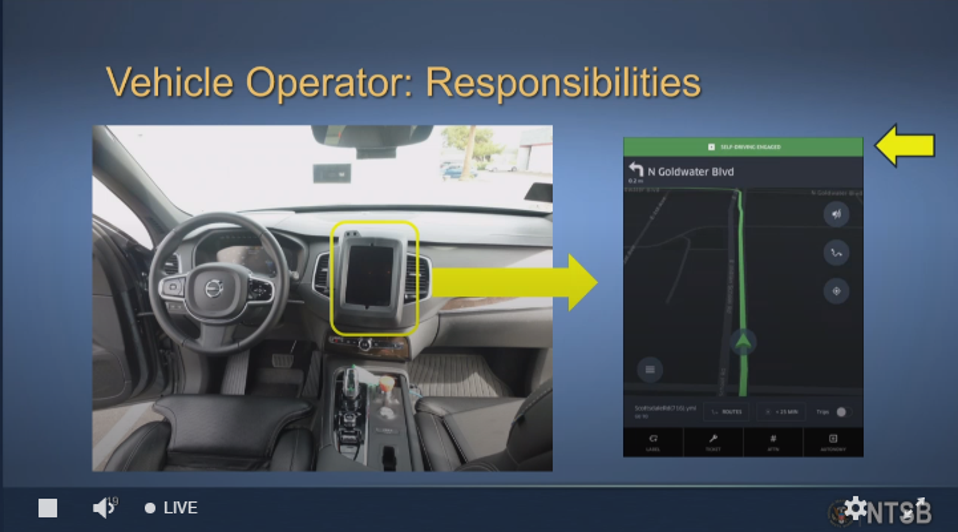
While there is also a small tablet computer in each car for the operator, it is very simple, and just shows the navigation route like other navigation computers, and had very few inputs. NTSB attributed none of the distraction to this tablet. Uber claims it designed the tablet UX in accordance with NHTSA guidelines for in-car driver UX. Some teams use a voice system rather than a touch system to avoid distraction when reporting anomalies.
Machine errors
More detail was revealed about how Uber’s system dealt with pedestrians. Earlier reports (including my own) stated that the system was unable to classify an obstacle as a pedestrian outside of crosswalks. This is not true, though the truth is somewhat more confusing. It simply never classified her as a pedestrian, probably because she was walking a bicycle. What confused writers about the accident was a mention of potential failure (which did not actually occur) in the system’s goal-assignment modules.
When a robocar system identifies an obstacle, it tries to predict where it may move, and to do so estimates a “goal” for it. For example, a pedestrian in a crosswalk will probably have the goal of crossing the road. A car or bicycle in a lane will have the likely goal of continuing to drive down that lane (with some chance of changing lanes.)
A flaw – which played no role in this crash – was that Uber’s system would not assign “crossing the road” as a goal to a pedestrian not in a crosswalk. If they had identified her has a pedestrian then they would have not viewed it as likely she was crossing the road.
Instead, she was classified as things like a vehicle, cyclist or unknown obstacle. The goal guesses for those objects are different, and in many cases are based on the past history of movement of the object. That’s why the flaw of forgetting the past history after reclassification was the real technical error here. Each time it reclassified her, it had to predict her motion with no past history, and thus it was not able to understand that, whatever she was, she was crossing the road and going to enter their lane.
This lack of “object persistence” remains the greater error than the classification errors. Classification errors happen all the time in robocar systems, but that is supposed to be mitigated by the fact that the systems track and object as it moves without knowing exactly what it is. Uber failed to do that.
More detail was revealed about the disabling of the Volvo standard automatic emergency braking system that comes with the SUV. The Volvo system had its own radar on the same frequency as Uber’s radar and thus could not be used at the same time. Later, they were able to re-tune one of the radars so that both systems can be active.
Automation Complacency
Some focus was placed on the issue of how well humans do at monitoring automated systems, and the tendency for people to become complacent and not diligent. This is a common factor in transportation modes that have some amount of automation. Uber never reviewed videos of the safety driver (and rarely viewed those of others) but now, has a third party do spot-checks on safety drivers to look for problems like this. Now Uber, and other companies use automated systems that track driver gaze to make sure eyes are kept on the road and even alert if they are off the road too much. Uber has returned to having two safety drivers.
An interesting statistic was revealed, that Uber had 40 test vehicles in Tempe and 254 operators on staff. This makes it baffling that they wanted to switch to having one safety driver instead of two. They seem to have had more than enough staff to keep two in each vehicle.
While generally two safety drivers are better than one, and would prevent an accident of this sort, I now believe that computerized monitoring of one safety driver is actually probably enough. The record of Tesla autopilot drivers, who are not trained and usually drive alone, suggests that having a single person doing oversight of a decent automated system results in an adequate safety record. A trained safety driver with automated monitoring should do even better.
Policy issues
Uber ATG’s poor safety culture – or in some cases, lack of safety culture, saw much criticism, as has been reported before. According to the report by Robert Fox, they did not have a proper framework for risk mitigation, they had bad policies and procedures, and bad oversight of vehicle operators. Uber, it is reported, has fixed many of these things, and at present is only doing very limited testing – just a one mile loop around their HQ limited to 25mph.
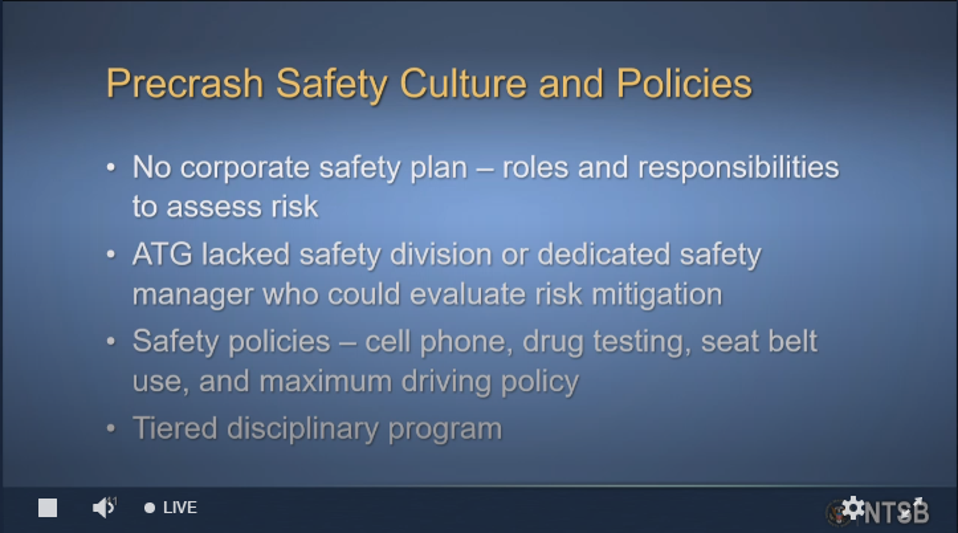
Enzar Becic of NTSB reported on the fairly basic rules currently applied to companies testing robocars, particularly in Arizona, which puts no requirements on teams testing with safety drivers. The NHTSA regulations request an optional safety assessment, but only 16 companies have filed one (over 64 companies are registered in California.)
Chairman Sumwalt praised Uber for its cooperation with their investigation, and made some strong digs against Tesla for the way it had not helped and had to be forced out of one of their investigations. Sumwalt said he liked that Uber’s CEO “did not hang up on me,” strongly implying that Elon Musk might have hung up on him during conversations.
More notes on the technical faults
In my earlier report on the Uber fatality, I included a lot of discussion on two new technical details, namely (incorrectly) the Uber system’s configuration to not identify pedestrians who were in the middle of the road outside of crosswalks, and more importantly, the flaw in their object tracking system which had it forget any past learnings every time it reclassified an object. Many other press also made reports on these issues, most of them putting a strong focus on the problem with the identification of pedestrians.
Even though I made it very clear that these technical problems, while a sign of poor system design and coding, were not the cause of the accident, it has been natural for readers to take it that way. As such it is important to reiterate that all robocar teams, to my knowledge, have issues where there system does not properly classify things in its view, and which have made it necessary, from time to time, for a safety driver to take over to prevent an accident. With brand new projects, this can be a very frequent event, and there is nothing wrong with that, as long as a trained and attentive safety driver is there to do just that. While we can and should be critical of the poor quality of Uber’s software, I doubt any project out there hasn’t gone through a very early period where their system was immature and prone to problems like this, which were handled correctly by a safety driver. If any of these teams had deployed one of their early cars with a safety driver who sat watching a video, as is alleged here, those cars probably would have gotten into an accident, and possibly a fatal one if circumstances were wrong.
It does not excuse Uber, but they also had some bad luck here. Normally, a pedestrian crossing a high speed street outside a crosswalk would exercise some minimal caution, starting with “look both ways before crossing the street” as we are all taught as children. By all appearances, the crash took place late on a Sunday night on a largely empty road, exactly the sort of situation where a person would normally hear any approaching car well in advance, and check regularly to the right for oncoming traffic, which would be very obvious because of its headlights – obvious even in peripheral vision. Herzberg crossed obliviously, looking over just one second before impact. NTSB investigators attributed this to the meth in her system. They did not know if the concentration in her blood was going up (due to recently taken doses) and altering perception, or coming down (causing unusual moods.)
It was also reported that pedestrian crossings at this location are rare (though were more common that night due to a concert) and there is no recollection of another pedestrian incident in this location.
This does not mean that robocars and safety drivers need not be be ready for oblivious pedestrians outside of crosswalks, of course. These exist, even if most pedestrians are more prudent. In fact, 71% of pedestrian hits in Arizona took place outside of intersections.
What about the cameras?
Questions remain about the role of computer vision and cameras in the Uber fatality. The NTSB report says almost nothing about the camera systems in the car, other than to note that the close-range cameras, which would not have come into play in this incident, were not in use.
Most self-driving car designs make use of 3 different systems to detect something like a pedestrian on the road ahead. The LIDAR is the most reliable, and is used by all major players except Tesla. The radar is also very good but does not work as well on a pedestrian who is not moving towards you or away from you. In this case, Herzberg was crossing the street and thus moving perpendicular to the car. Radar did still see her but provides much less information. Because Uber’s software kept reclassifying her and forgetting what it learned before, and radar is not good at providing a detailed horizontal position, it was not so useful for noticing that she was walking across the road.
Cameras should have played a useful role here. While computer vision doesn’t have the 100% certain knowledge of distance you get from LIDAR and radar, it can be quite good at figuring out what something is, and all teams train their systems to identify pedestrians, and one presumes, people walking bicycles. Uber’s system never did that. But while it’s hard for a LIDAR to identify something like a pedestrian walking a bicycle as specifically that at a long distance – it’s just a diffuse blob of dots until you get close – this is something cameras should have had a better shot at. Yet, the NTSB report discusses nothing about what the vision perception system saw.
Was it off? Is it simply not very functional? Like all the other technical issues, they take second place to the issue of bad safety driving, but they are still interesting for all of us who want to understand what sort of mistakes programmers can make and how to avoid them.
One issue with vision systems is how they operate at night. An ordinary camera will not simultaneously get good images of both bright things (such as car headlamps and things lit by streetlamps and headlamps) and things in the shadow. Herzberg went in and out of pools of light. The frequently shown dashcam video of the crash reveals the poor performance of an ordinary camera.
That’s why robocar teams have been actively developing “high dynamic range” camera approaches to improve vision results. One way to do that is to have 2 or more cameras, each one set at a different exposure level to get a good image of the shadows and the well lit areas. A cheaper way to do that is just have one camera that alternates between taking bright and dark exposures every other frame. These techniques should have allowed the many cameras on the Uber car to get a good image of the road and Herzberg even though it was night.
Slide decks and video are available on the NTSB site.
Board member Jennifer Homendy was highly critical of the (lack of) regulation around testing, and feels there should be more federal and state regulations on the testing of these vehicles. She expressed concern over the NHTSA regulations which are currently fairly minimal. They are minimal because NHTSA and the states have realized they do not have the skills yet to regulate a technology which is still in development and is constantly changing. Nonetheless, NTSB believes NHTSA should make submission of the safety plan reports be mandatory.
Report’s Findings
Here are the final findings (from the final report)
- 1. None of the following were factors in the crash: (1) driver licensing, experience, or knowledge of the automated driving system operation; (2) vehicle operator substance impairment or fatigue; or (3) mechanical condition of the vehicle.
- 2. The emergency response to the crash was timely and adequate.
- 3. The pedestrian’s unsafe behavior in crossing the street in front of the approaching vehicle at night and at a location without a crosswalk violated Arizona statutes and was possibly due to diminished perception and judgment resulting from drug use.
- 4. The Uber Advanced Technologies Group did not adequately manage the anticipated safety risk of its automated driving system’s functional limitations, including the system’s inability in this crash to correctly classify and predict the path of the pedestrian crossing the road midblock.
- 5. The aspect of the automated driving system’s design that precluded braking in emergency situations only when a crash was unavoidable increased the safety risks associated with testing automated driving systems on public roads.
- 6. Because the Uber Advanced Technologies Group’s automated driving system was developmental, with associated limitations and expectations of failure, the extent to which those limitations pose a safety risk depends on safety redundancies and 3 mitigation strategies designed to reduce the safety risk associated with testing automated driving systems on public roads.
- 7. The Uber Advanced Technologies Group’s deactivation of the Volvo forward collision warning and automatic emergency braking systems without replacing their full capabilities removed a layer of safety redundancy and increased the risks associated with testing automated driving systems on public roads.
- 8. Postcrash changes by the Uber Advanced Technologies Group, such as making Volvo’s forward collision warning and automatic emergency braking available during operation of the automated driving system (ADS), added a layer of safety redundancy that reduces the safety risks associated with testing ADSs on public roads.
- 9. Had the vehicle operator been attentive, she would likely have had sufficient time to detect and react to the crossing pedestrian to avoid the crash or mitigate the impact.
- 10. The vehicle operator’s prolonged visual distraction, a typical effect of automation complacency, led to her failure to detect the pedestrian in time to avoid the collision.
- 11. The Uber Advanced Technologies Group did not adequately recognize the risk of automation complacency and develop effective countermeasures to control the risk of vehicle operator disengagement, which contributed to the crash.
- 12. Although the installation of a human-machine interface in the Uber Advanced Technologies Group test vehicles reduced the complexity of the automation-monitoring task, the decision to remove the second vehicle operator increased the task demands on the sole operator and also reduced the safety redundancies that would have minimized the risks associated with testing automated driving systems on public roads.
- 13. Although the Uber Advanced Technologies Group had the means to retroactively monitor the behavior of vehicle operators and their adherence to operational procedures, it rarely did so; and the detrimental effect of the company’s ineffective oversight was exacerbated by its decision to remove the second vehicle operator during testing of the automated driving system.
- 14. The Uber Advanced Technologies Group’s postcrash inclusion of a second vehicle operator during testing of the automated driving system, along with real-time monitoring of operator attentiveness, begins to address the oversight deficiencies that contributed to the crash.
- 15. The Uber Advanced Technologies Group’s inadequate safety culture created conditions—including inadequate oversight of vehicle operators—that contributed to the circumstances of the crash and specifically to the vehicle operator’s extended distraction during the crash trip.
- 16. The Uber Advanced Technologies Group’s plan for implementing a safety management system, as well as postcrash changes in the company’s oversight of vehicle operators, begins to address the deficiencies in safety risk management that contributed to the crash.
- 17. Mandatory submission of safety self-assessment reports—which are currently voluntary—and their evaluation by the National Highway Traffic Safety 4 Administration would provide a uniform, minimal level of assessment that could aid states with legislation pertaining to the testing of automated vehicles.
- 18. Arizona’s lack of a safety-focused application-approval process for automated driving system (ADS) testing at the time of the crash, and its inaction in developing such a process since the crash, demonstrate the state’s shortcomings in improving the safety of ADS testing and safeguarding the public.
- 19. Considering the lack of federal safety standards and assessment protocols for automated driving systems, as well as the National Highway Traffic Safety Administration’s inadequate safety self-assessment process, states that have no, or only minimal, requirements related to automated vehicle testing can improve the safety of such testing by implementing a thorough application and review process before granting testing permits.
Originally published at Forbes.com in NTSB Hearing Blames Humans, Software And Policy For Fatal Uber Robocar Crash - But Mostly Humans. Copyright © 2019 by Brad Templeton.


Comments
vroom
Tue, 2019-11-19 18:55
Permalink
untrustworthy reporting
Firstly, a significant portion of the article is dedicated to an explanation of shoddy reporting on Uber’s ‘failure to do jaywalker detection.’ Even the author admits to shoddy reporting, despite the key facts now being available for a year. This outcome and admission underscore how ‘former experts’ like the author are trying to continue to make money and personal legacy off this lucrative (yet so far largely fruitless) field by emplacing themself as a semantic translator for systems that the engineers themselves have difficultly explaining. The public needs the facts and independent review, if not for truth for the preservation of public safety.
Facts available since 2018 (BI article):
* Lidar saw her 6 seconds before impact and recognized her as potentially motile.
* Uber ATG struggled with trees and braking for these phantoms made the ride too jerky for the Dara/Softbank demo.
* Email evidence shows Meyhofer et al crippled the car’s braking ability, despite internal concerns about safety.
* The Dara/Softbank demo would mean over $10m to Meyhofer and big payouts to engineers.
The crash happened because the software was crap and Uber harbored a culture of greed over safety. Yes the safety driver failed too, but putting the driver in that situation was as negligent as Uber executives allowing in their network criminals with not just priors but on-the-job assaults and crimes.
“all tested vehicles, while generally better than Uber’s, have flaws which would lead to a crash with a negligent safety driver, and to blame those flaws would be to blame the idea of testing this way at all“
Yes!! It is *unquestionably unsafe and negligent* to drive at 45mph with a forecasting and planning system that can’t predict pedestrians at those speeds!! This testing was done brazenly without interest for the public, and the NTSB has failed us.
The author here fails us even more, effectively trying to protect brazenly unsafe testing that resulted in a fatality.
https://www.businessinsider.com/sources-describe-questionable-decisions-and-dysfunction-inside-ubers-self-driving-unit-before-one-of-its-cars-killed-a-pedestrian-2018-10
https://eandt.theiet.org/content/articles/2019/09/uber-allegedly-discourages-staff-from-disclosing-crime-reports-to-police/
FKA
Wed, 2019-11-20 07:01
Permalink
Sounds like a colossal waste of time and money
The three causes identified by the ntsb were pretty obvious very early on. I'd like to see more focus on the abysmal design flaws in both the product and the testing process (Uber shouldn't have been doing that type of testing on public roadways at all in its abysmal state). But ntsb isn't the organization to do that. Let the private organizations work on best practices and let the states figure out what to do with companies like Uber. Arizona has thrown them out (with regard to Uber ATG), right? Other states should ban them as well. I'm fine with self-regulation. But self-regulation comes along with consequences when your failure to self-regulate kills someone.
brad
Wed, 2019-11-20 11:11
Permalink
Yes, a bit wasteful
NTSB has a pattern of looking into everything. They have to because in their world, saying, "We didn't really look into all those things because they were not what made this crash interesting" is not an answer. What if they're wrong?
NTSB did rule that Uber has fixed the things they identified, which will make it much harder for other states to throw them out.
In the end, two things will come from this tragedy, and yes, they were known before the investigation. Namely, have gaze monitoring on your safety drivers, and get more safety oriented in designing your testing procedures in general.
What I don't know is how many teams have done that. Right after the crash -- literally a week after -- some academics released a gaze monitoring tool open source. It may take a little time to toss in a camera but one hopes that most have done this by now.
I don't think it has to be that fancy. Its very presence will stop things like fiddling with a phone, because you know you will get caught. But it will also do things like saying, "You seem to be getting fatigued, time to take a break"
As I wrote, I think Tesla's numbers suggest a solo safety driver can be OK with this (Tesla doesn't have this but has wheel torque warnings) and while two is better, it's not vital.
Uber's software was crappy for something that had received so much work. But everybody's software was that crappy once.
FKA
Wed, 2019-11-20 17:30
Permalink
Throw them out
I'm not sure why other states can't throw them out. If you kill someone by driving recklessly in one state, can't all the other states revoke your license there too?
Uber's actions (not just the safety driver's actions, but the decision to put the car on the road in the first place) were, in my opinion, reckless. Perhaps all the other companies were just as reckless at one time. I doubt it, but maybe. The other companies didn't kill someone due to their recklessness, though. Maybe they were lucky, but that's the way driving regulations tend to work. It's easy to get a license, and if you get lucky, you can drive recklessly for quite some time and get away with it. But if your reckless driving kills someone, you're probably going to lose your license. And when you lose your license in one state, you're probably going to lose it in all the others too.
If the only two things that come from this tragedy are to have better safety drivers and monitor them better, it is a travesty. The design of the software was fundamentally flawed. Furthermore, it was so bad at recognition and prediction that it must have been known ahead of time that this sort of incident was inevitable.
I know, you think safety driver testing is the only way to improve recognition and prediction. I completely disagree. Shadow testing is just as effective at this. It's only once you think you have a finished product with regard to recognition and prediction that you need to do testing with safety drivers. Uber was obviously not at that level yet. Perhaps no one is, though Waymo seems to be there in limited driving situations, like where they're testing with no humans in the car.
You say Uber has fixed the problem. Apoarent Uber doesn't even agree with that, as they're still not doing the kinds of extensive testing they were doing before. (So in that sense I guess they did fix the problem. They're not testing that way any more. Are they doing shadow driving? I don't know.)
brad
Wed, 2019-11-20 17:56
Permalink
Safety driver testing
I don't say it's the only way to improve recognition and prediction. I do think it's the most effective way, though, but the bigger reason is to encounter more and more unusual situations and test how the car handles them in the real world, not in shadow or simulation.
I don't know Uber has fixed the problem, but they convinced the NTSB they fixed or are fixing the problems NTSB pointed out.
But the NTSB did not say, and I agree, that having a flawed perception system is a blocking factor here. I don't understand the suggestion that you can only road test once you no longer need to road test.
FKA
Thu, 2019-11-21 07:13
Permalink
Testing? Or development?
I don't understand the suggestion that you can only road test once you no longer need to road test either.
Testing is what you do when you think you've finished developing, at least in some definable circumstances, though. Its not testing if you know you're going to fail. It's not testing if the only variable is whether or not someone is going to cross the road in front of you.
Furthermore, shadow testing is testing. You can tell just as much about how good you are at recognition and prediction by shadow testing. And if you were going to have two humans in the car while safety driver testing, instead you can have the second human looking at the "tape" and scoring the car on how good its recognition and prediction is.
Beyond that, what do you gain from safety driver testing? If the car does something dangerous, then you get the knowledge that it would do something dangerous. But presumably you aren't trying to let the car do something dangerous. Or are you? It doesn't make sense.
I should change my criterion though. The car should be in charge when you think it's safer for the car to be in charge. Uber wasn't there yet. Maybe it is now. Multiple companies are there in limited situations. Even then it's a cost to society if the driving wouldn't be done anyway. That's likely how Google got a lot of its pre-safety-driver data. Recording data while it was on the roads with a human driver doing mapping anyway. Uber has skipped that step, and it was deadly. Odd that they wouldn't utilize the obvious source for data collection: their vast network of rideshare drivers. They'd have to provide modifications or even provide whole cars cars to select Uber drivers, but it'd be more cost effective than hiring safety drivers.
One of the implicit corollaries to my the above paragraph is that you build features for testing that you don't plan to use in production. Driver gaze tracking might be one. Automatic emergency braking (with a simple system separate from the autonomous one) might be one. Notifications to the driver to take over whenever safety-critical things are unclear (like if a car changes into a bike changes into an unknown object with only seconds before impact) should absolutely be one.
The first two of those is already something Uber has discovered, which is good, and the ntsb did recognize it. I didn't see any mention of the latter.
To build a level 4 car, you should first build a good level 2 car. I know, you'll fight against that, but it's true.
(It's also clear, I think, that Uber was using lidar as a crutch. Their computer vision sucked, and their sucky computer vision was most likely the primary technical cause of the crash. Lidar hid that problem. With that said, they could have used lidar much more effectively, as a safety backup system rather than as the primary recognition and prediction system. They could have alerted the driver to take over whenever the lidar detected something that the cameras couldn't categorize within x seconds before potential impact, for instance.)
brad
Thu, 2019-11-21 11:38
Permalink
Testing everything
You can test perception with shadow testing, yes, though it makes the problem harder, because it is much harder to tell when it made an error. You can compare what the system decided to what the test driver did and see very gross things, but not subtle things which can just be the differences in driving style between the test driver and the system. So you make it harder and more expensive and slower -- and it's already, as can be told from the many billions spent, pretty hard and expensive and slow.
And you don't get to test the full system response. If the vehicle evades due to perception errors (or correct perception) then we test how it perceives the new scene not encountered in the shadow testing, and the new situation. You can do this in sim but it's not the same.
BTW, independent AEB is something I know has been considered early on -- I proposed it -- and it turns out that the main reason Uber did not do it was that their radar and Volvo's where the same band.
I do think Uber could use their rideshare fleet, I have aid that years ago.
As for building level 2 first, I agree you end up doing that, but not deliberately. What I have said is that the technologies you get from having level 2 as an endgoal are a distraction from a real robocar. In building a real robocar, you will get a level 2 car out of it, but not built the way anybody builds a level 2 car.
The role of the vision vs. the lidar is not yet revealed, though I have some hints. The problem was in their object persistence, triggered by poor quality perception. Had they had good object persistence, the perception errors would not have been enough to crash on their own.
FKA
Fri, 2019-11-22 05:31
Permalink
Eventually
Surely these companies are not detecting errors in perception solely by whether or not the vehicle does something so dangerous that a safety driver is forced to take over. That simplistic approach can work for games, but it's too dangerous and too time consuming for building a self-driving vehicle.
There are numerous ways to detect errors in perception, both with human review and automatically. Both human and automatic review can be live or on logs. As one example, when the classification of an object is constantly changing, that's a perception error. As another, when you make a drastic prediction error, often you can roll back the logs and see that a perception error caused it.
Yes, you can also compare what the test driver did to what the car would have done. A simplistic comparison wouldn't be very useful, but over time you can develop a sophisticated system that understands the expected deviations vs. the deviations that are caused by perception errors.
You can do all of these things at once by building a neural network that detects errors in perception at one point in the logs based on what happens later in the logs (both the sensor logs and the logs of the driver inputs).
While building a level 4 car, you also build a lot of other things that don't go into the level 4 car itself. One of them, probably, is a level 2 car.
Uber should use their rideshare fleet. And they should ditch lidar in order to use much much more of that fleet. (They can always add lidar back into the final product.) And they should ditch safety driver testing until they have a much better prototype. Which, fortunately, they already seem to have mostly done, although I fear this awful NTSB report might embolden them to prematurely ramp it up again.
brad
Fri, 2019-11-22 10:51
Permalink
Detecting errors of all kinds
You detect errors many ways. You will start off the road as you say, until you get a decent quality. Even so, in the early years of a project, it seems that going out and driving produces pretty frequent disengagements -- you have seen the numbers in the California reports -- that are frequent enough to keep the software teams busy just fixing the tickets caused by the disengagements that come from software and hardware issues and not safety driver caution.
So yes, during a time, you are finding problems at such a rate that it can be your prime source of trouble tickets. Today, there are better techniques, including simulation, to also generate more trouble tickets more easily, but there is a limit to them.
I am not sure too many would agree with you that "you can always add LIDAR back into the final product." If you do this test driving without LIDAR, you are going to get lots of events where there was a perception error but it's clear that error would not have happened with a LIDAR. You are going to spend a great deal of time trying to identify those (and of course a huge amount of time if you fix them) when you don't need to if you're going to have a LIDAR. LIDAR doesn't make mistakes on the distance of targets. It doesn't make errors due to varying lighting or it being night. It doesn't "not see" an object just because it doesn't match something in the neural networks. Its errors are around not classifying well enough because of its low resolution, or missing very small things that only return a few points. They are quite different.
FKA
Fri, 2019-11-22 13:23
Permalink
I think it's pretty clear
I think it's pretty clear that you can always add lidar later. If nothing else, you can add it as a backup system, as a form of AEB.
Your argument seems to be that this is wasteful, because without lidar you will have to fix flaws in the vision system that you otherwise wouldn't have had to fix.
I actually agree with you that avoiding lidar during development has a cost (in that more miles of training data are needed if you don't have lidar). On the flip side, without lidar you can get that training data much more cheaply. It's still unclear how the two balance out, but as time goes on without any lidar-using team releasing a production quality level 4 robocar that can drive in most places where people drive (and unless they're being very quiet about it, not even being anywhere close), I think it becomes more clear that the cost of lidar is higher than the cost of no-lidar (in terms of building a level 4 robocar that can drive in most places where people drive). I think almost all of the teams working on building a self-driving car are grossly underestimating, by orders of magnitude, the number of miles of training they're going to need.
Yes, you detect errors in many ways. I don't think Uber's bottleneck was in the error detection area. I think their bottleneck was (and is) in the error fixing area.
Simulation is fairly useless unless you have a good simulator. I doubt Uber had (or has) a very good simulator. If they did, they'd have a good robocar. As I'm sure you know, it's relatively easy to train a car to perform extremely well in a simulator.
You need lots of miles of data to build a good simulator. Perhaps it's easier to see that these miles can be ones where a human does the driving?
brad
Fri, 2019-11-22 14:18
Permalink
Fix the flaws you don't have to
You act like fixing "flaws" you don't have to is a good thing. It's a misdirection of energy and resources.
For example, radar tells you how fast things are moving. Thus once you fuse a target, you don't need to have a vision system that can tell how fast things are moving. That your vision system makes mistakes in estimating speed is no longer a "flaw" because you are not intending for it to do that.
With LIDAR, you have fully reliable information on how far away a target is. Because you can merge the pixels of LIDAR and camera, now you can use the camera for the thing its higher resolution is good at, things like classifying targets, figuring out the body language or facial expressions of pedestrians. That you may not have reliable distance figures is no longer a flaw, and thus the wrong place to put energy.
FKA
Fri, 2019-11-22 16:09
Permalink
Fixing flaws you don't "have to"
Fixing flaws you don't "have to" might be a good thing. But I admitted it can be a waste. The question is whether it's more of a waste than lidar. I doubt it.
(Incidentally, I don't think you can merge data from lidar with pixels, at a different resolution and different number of frames per second, from cameras, as perfectly as you imply. That process in itself is a lot of work and introduces additional errors. Merging data from cameras with data from lidar loses information, and potentially loses critical information.)
Walt French
Wed, 2019-11-20 16:01
Permalink
Assumptions
“While generally two safety drivers are better than one…”
I doubt this, because at many times, each driver might assume the other is acting; they are highly likely to collaborate in defeating any safety mechanisms that are enforced.
But nobody should take my, OR YOUR assumptions without testing them. That's not how to do Safety!
brad
Thu, 2019-11-21 11:42
Permalink
The two drivers have two different roles
The primary safety driver is behind the wheel and is to watch the road as much as any full time driver. The second driver tends to monitor the software and do anything that needs to be done without eyes on the road. However, they don't do that 100% of the time, so they are often looking at the road. Having no access to the pedals, their role there would be to shout "watch out." There is thus little chance one might assume the other is acting.
The other role is to enforce discipline. You won't watch a video if you have somebody in the car with you. Or if, somehow you did it would be much more safe. For example, I could see the main driver saying, "I am going to take my coat off, watch the road" and that would still be pretty safe, though not ideal.
Jan Tångring
Wed, 2019-11-20 17:16
Permalink
Good reporting on the whole
Contrary to mr Vroom I would judge Brad Templetons two recent Forbes reports to be probably the best reading out there on the NTSB investigation, that I have seen.
About the jaywalking classification, there were some wordings in the report that even left board member Jennifer Homendy confused about what the Uber ATG ADS could and could not detect or what it would presume after assigning a label to the object. You can watch her interviewing staff member Ensar Becic about this issue at 1:31:58. And again she returns to the subject once more at 1:46:50 still unsatisfied on what to make of the explanations. Brad Templeton first report was clear, I think, that the reclassifications followed by history resets was the bigger issue.
The meeting: http://ntsb.windrosemedia.com/11052019/
About jaywalking, where I live, as a driver you are not expected to yield for them. Has Uber ATG now reprogrammed its ADS to yield for jaywalkers? If yes, I think that could backfire.
One detail, Brad T wrote: ”It was also reported that pedestrian crossings at this location are rare (though were more common that night due to a concert) and there is no recollection of another pedestrian incident in this location.”
The concert was not at the night of the accident in March, but in in June when NTSB was conducting a study that found 66 pedestrians and 12 bikes passing during 24 hours. This is talked about at 1:27:34 in the meeting.
The lack of a discussion around the cameras is really the big remaining mystery!
brad
Thu, 2019-11-21 11:48
Permalink
Crossings
Will fix about the concert, but the reason I mis-heard is there was also a party down by the river on the night of the incident, where she got high, and she was leaving it, so there might have been extra ped traffic that night. Nobody really recorded that.
FKA
Sat, 2019-11-23 05:26
Permalink
Who reported that crossings are rare?
I don't think it's right that there was not much pedestrian traffic there. Governments don't put up a "no pedestrians" sign in a random spot where people rarely cross anyway.
"Whenever there's a concert or a party by the river" is not rare. In fact it's likely frequent.
I think "you are not expected to yield to jaywalkers" was the defense used by the murderer in the Charlottesville car attack.
brad
Sat, 2019-11-23 10:59
Permalink
Yield to jaywalkers
You are not required to yield to jaywalkers, but you have a duty to avoid them if it is practical to do so. The victim crossed in violation of the law. The Uber hit her in violation of the law, but in the latter case, police decided not to prosecute, with the judgment that "she came out of nowhere" -- even though later it became clear that this was not the case. Of course the victim was not ticketed for her violation of the law.
FKA
Sun, 2019-11-24 16:35
Permalink
Four points
You are expected to yield to jaywalkers who are in the middle of a roadway and trying to cross.
Police don't prosecute.
Police often do not issue a citation when there is a fatal crash, because issuing a citation can interfere with a successful prosecution (for a more serious crime such as manslaughter) by the office that does prosecutions.
The police issued a report recommending that Vasquez be charged with manslaughter.
brad
Mon, 2019-11-25 00:47
Permalink
Yield
Been a while since I looked at the law, but I don't believe it is a requirement to yield, but a perhaps subtly different requirement to always take steps to avoid an accident if you can do so. This is not just true of jaywalkers but of cars in your ROW. If somebody cuts in front of you, you are not allowed to say, "ha, ha, I have ROW I am going to hit him." That does not mean you have the duty to yield in the sense of not having ROW.
Yes, I mean the states attorney, which was handed this case, decided not to prosecute.
FKA
Mon, 2019-11-25 06:18
Permalink
Yield
I'm not talking about a statute. You are expected to yield. Period.
It's misleading to say the "states attorney" decided not to prosecute. The Maricopa County attorney recused itself because it was biased in favor of Uber. It then went to the Yavapai County attorney, who declined to prosecute Uber but referred Vasquez back to Maricopa County.
Maricopa County hasn't acted on that referral, and I believe the statute of limitations might have run out. So Vasquez got lucky. If it wasn't for the confusion over what to do when a self-driving car kills someone, and possibly if it wasn't for the Maricopa County attorney not wanting to drag Uber's name further through the mud than necessary, she would have surely been prosecuted or forced to make a plea deal.
Her best defense against manslaughter would have been that Uber had not trained her properly, and she thought the car could just drive itself. I'm not sure if it would have succeeded.
By the way, the NTSB found that Vasquez was the primary at-fault party. Then Uber. Then Herzberg. I'd have swapped Uber and Vasquez. Uber was the primary at-fault party, in my opinion. Then Vasquez, then Herzberg. Then Arizona for really poor design of that intersection (non-intersection?). It looks like an intersection, but then there's a sign saying not to cross there.
(You know what common law is, right? The law is not just statutes. That's one reason why it's an extremely difficult AI problem in itself just to describe the law in computer code.)
brad
Mon, 2019-11-25 11:01
Permalink
Right
Sorry, yes it was the Yavapai county prosecutors. I recalled they had taken the case out of Maricopa and for some reason thought it had gone to the state. In any event, my main point remains, that there was no prosecution and it seemed unlikely at this point. I read the section of the Arizona vehicle code on this back at the time, it's a different section than about right-of-way.
FKA
Mon, 2019-11-25 15:22
Permalink
Prosecution
Yes, there was no prosecution, and it seems unlikely at this point.
The vehicle code is completely irrelevant to all of this. Arizona doesn't have a statute in the vehicle code for vehicular homicide. A driver who kills someone by driving recklessly in Arizona is charged with regular old manslaughter.
Add new comment