



Can An Electric Car World Handle Thanksgiving Travel?
Each Thanksgiving season, stories abound on travel. It isn’t actually anywhere near the top air travel period, in spite of the stories, but there is a fair bit of long distance road travel compared to other periods outside the summer. Regardless of whether Thanksgiving is the peak, there is a peak, and people have asked, “How could electric vehicles get enough charging to handle tons of people all taking a long road trip at once?” They also ask this question for things like evacuations.
AAA reports that around 50 million will take a road trip of more than 50 miles this holiday, though because it’s family travel, that means not nearly so many cars. For modern electric cars with over 200 miles of range, the more important question involves how many are taking a trip of more than that distance, thus requiring charging along the way just to get there, plus possibly a bit more at the destination.
DC Fast charging sessions run at anywhere from 50kw (200mph) for typical CCS/Chademo chargers to up to 250kw (1000mph) for Tesla’s newest superchargers. Even faster chargers are in the works and there are claims of even faster charging for newer generations of batteries. The full charging rate typically is only used when going from empty up to about 50% charged, after that most systems taper down. As a result, a typical visit to a Tesla Supercharger runs 50-70 minutes when fairly low, and 90 minutes or more for cars like the Chevy Bolt. This means that when handling cars doing long haul, each charging station can only handle 0.5 to 1.2 such cars per hour. A 2-lane freeway, however, may be passing 4,000 cars per hour in each direction.
Fast charging stations are expensive and require high current power connections. For now they can be sited where the power lines can be found. As EV adoption grows, the charge network will grow. The question is, what pays for the installation of the set of chargers that only get used on the peak demand days. With gasoline, when demand exceeds the number of pumps, people line up, but the wait is rarely very long. With chargers, a line can easily mean an unacceptable wait.
(Below, a large line of Teslas forms over Thanksgiving at one of their most notoriously under-provisioned supercharger stations. The closure of highways due to rare snow may also have exacerbated this.)
Of course, there is no such thing as “the one” charger which is used only on the peak day. Instead, providers build a bank of chargers, and can build a small bank that fills up frequently (giving up business) or a larger bank that’s much more expensive to build but rarely full. The sweet spot still will fill up on peak days unless there is a lot of competition for charging that causes a bit of overbuilding.
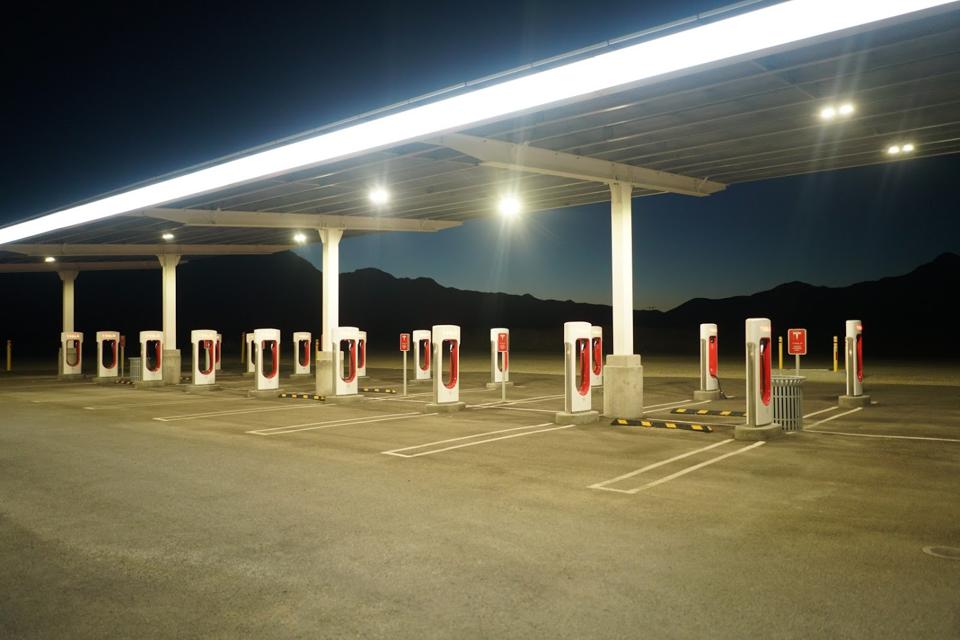
Here, proprietary charging networks like Tesla’s can have an advantage. Tesla doesn’t treat charging as a profit center. It builds chargers so that Teslas are more attractive cars because you know you can road trip in them. It can be motivated to build surplus chargers just to promise buyers they will not be stranded at Thanksgiving. Generic charging networks do not have that incentive, though EV vendors could do contracts with such charging networks to give priority or reservations to their particular EV at these high demand times.
One option might be to limit people to only charging from zero to 50% on peak days. As noted, most chargers slow down above 50%, reducing the efficiency of the charging. That Tesla V3 charger is able to put 120 extra miles in an empty car in just 7.2 minutes, allowing 7 cars per hour for these partial charges, significantly improving throughput. As a result, those doing very long trips would need to make two 7 minute stops instead of one 30 minute stop – less convenient, but less chance of a line. Those on the road could also get (and need to get) reserved slots. Reservations would have a large window when booked but narrow once you are on the road. Those who can’t get a reservation may need to make other plans or use a gasoline car that one day.
Charging companies could also sell “Thanksgiving fast passes” which provide short-wait Thanksgiving supercharging. The money from those sales could build extra charging facilities, which would be dedicated only to people with passes. (They could also specify some regular chargers as only for those with the fast pass.) The passes could come with a planned time window. They might be quite expensive, but something has to pay for capacity that is only used a few days a year.
A 240 mile Tesla with a 120 mile 8 minute recharge could then take you over 350 miles, which probably covers a very large fraction of the Thanksgiving drive, if you time it right. In this future mostly-EV world, you can time it right because there will be charging stations at most off-ramps in that world.
Tesla has built a special trailer which carries 8 superchargers and enough on-board batteries (known as a megapack) to charge 100 cars. They deployed that charger to the station with the line in the video above. This solution doesn’t work if every station is overloaded by a peak travel day, but it can be used to bolster the stations with the most overloading, and for special-case overloading such as around events. They could also swap out these stations and send them somewhere to plug in, swapping them back and forth.
Some imagine battery swap might be a solution, though that has generally been a failure. Since it’s unlikely to happen or be useful in the general situation, it’s unlikely it could be used just for the rare peaks services. This article on robocars and battery swap details why battery swap is a terrible idea, except perhaps for robocars. In addition, since you have to still have vast numbers of charging facilities to charge the swapped out batteries on a peak day, they actually gain you very little extra capacity.
Here is another new article on managing the line at a supercharger.
Evacuations
Evacuation is a different matter. It is unlikely the charging infrastructure can handle truly major evacuations. Fortunately, truly major evacuations don’t tend to involve more than 200 miles of travel, though there are some that do. At least at present, most EV owners charge at home. When you charge at home, you usually top up every night, which means your vehicle is always close to full, and will be in that state when any evacuation is called. This is quite unlike how gasoline car drivers operate, not caring too much about how high the tank is because they can refill at any corner. In fact, in many evacuation cases, gasoline car owners face long lines or closed gas stations with near empty tanks, which EV owners should almost never face.
This may be more of a problem for those who buy EVs but don’t have home charging, and thus may not keep their car as fully charged. Those owners will need the fast charging network, but if they are a minority that can work.
If an evacuation requires travel of more than 200 miles, other solutions will be needed, including carpooling or buses from points 200 miles away from the center of the evacuation zone. Until gasoline cars go away entirely, that will fortunately be possible. Even so, more study and planning is needed on the question of evacuation for certain types of hurricanes, as well as for military attacks, which may require that level of travel.
Originally published at Forbes.com in Can An Electric Car World Handle Thanksgiving Travel?. Copyright © 2019 by Brad Templeton.


Comments
FKA
Fri, 2019-11-29 06:48
Permalink
Something I've never considered
That is very interesting. I don't think it'd be reasonable to have so many fast charging stations that it could handle the current travel habits of people on peak travel days like Thanksgiving, if all cars were electric.
That said, I'm not sure this will be a huge problem, because the travel habits of people might significantly change by the time that's an issue. In fact, I wonder if the travel habits of people already have changed over the past several years, as it is already much more feasible to use mass transit to travel for the holidays, as you can now just take an Uber everywhere you need to go once you reach your destination. Robotaxis will make that option even more feasible, either because it makes mass transit more feasible in much the same way as Uber (only even moreso) or even because it opens up the feasibility to take the robotaxi all the way (and just transfer to a new one whenever the one you're using is close to running out of battery).
The latter solution would require a lot of idle robotaxis most of the year. But I believe there will likely be a lot of idle robotaxis most of the year anyway, in order to handle the morning and evening commutes without a whole lot of dead miles backtracking from the places where people work to the places where people live.
(Where I've said robotaxi above, it could also be a rented robocar, which is essentially the same thing as a robotaxi, except maybe that a robocar comes with a steering wheel and can maybe go places where the robotaxi can't go.)
Edit: It looks like the proportion of people using vehicle-based mass transit is actually decreasing, though the proportion of people using airplanes is increasing. I'm not sure quite what to think about that. People definitely don't consider vehicle expenses other than gas when looking at the price of a road trip. I'm still not sure if that's a big mistake, though.
Edit 2: Maybe we'll have 10-minute charging by then. That'll basically solve the problem.
Martin Winlow
Fri, 2019-11-29 07:50
Permalink
Hmmm...
In my experience, average Tesla Supercharger visits are no-where near '50-70 minuets', at least not now that the network has been (reasonably) 'fully-fleshed' (this is a UK perspective, mind). 30 minutes would be more accurate and even in my 60kWh Model S (the smallest pack Tesla has ever done), if started from 10% full, this charging time would give a good 100 miles+ of range out of my max range of about 180 miles.
brad
Fri, 2019-11-29 10:15
Permalink
Full charge visits
Yes, when you want a fast visit, you don't charge to a high percentage, but on certain road trips you want to do that. But the biggest factor that makes me do an hour charge at the supercharger is because I go to a restaurant to eat, and between the walking to the restaurant and back, ordering, eating etc. it runs about 50 minutes so I want it to take that long. 70 minutes is what I suspect you see with those 100kwh battery packs.
spc737
Fri, 2019-11-29 09:44
Permalink
Thanks for this
Very interesting analysis. The problem is that converting to electric based transportation is not optional and we need to figure it out. It looks like we're on a typical development curve here where the technology will start to keep pace with the demand, at least I hope so for the planet's sake.
Add new comment