



Will Covid-19 sound the death knell for old school public transit?
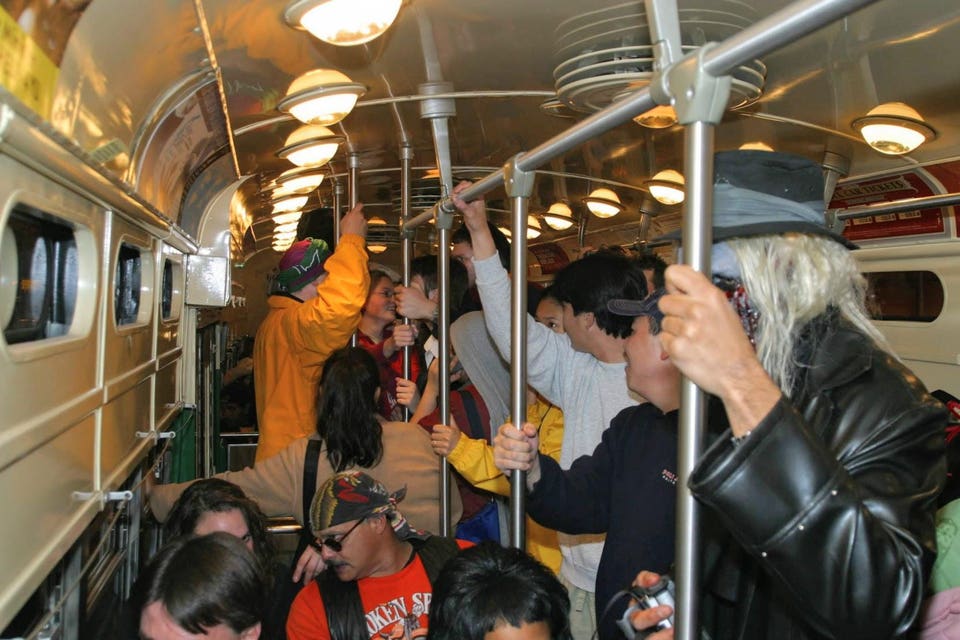
During the virus crisis, ridership and service in both public transit and taxis (including Uber/Lyft) has fallen off a cliff. Scooter micromobility has plunged, too. People don’t want to get into a vehicle with others, or where unknown others just were. Of course, far few people are travelling. If they have access to a private car, that’s what they’re using. Because travel is so low, that works fine, as roads are empty and parking is plentiful. Green Bay Metro shut down entirely.
What happens when travel is restored? It won’t happen overnight — many people were restricting travel well before the lockdowns, and many companies had switched to work-from-home in advance as well. In time, it will increase, though some wonder if work-from-home will become a new normal that permanently dents traffic. Many doubt that — traffic finds a way to expand to fill the capacity available.
Even so, much of the fear of shared vehicles will remain. We’ll know that the virus is still out there, just beaten back for a while. We’ll be keeping it in check not with a lockdown, but with masks, social distancing and good hygiene, at least until a vaccine or treatment. The at-risk: Those over 55 or with pre-existing conditions, will remain just as cautious. To a large extent, those taking public transit will be those without much of a choice. (That’s partly true already in many towns, but the factor will be multiplied.) Public transportation has been on its way to a crisis and revolution, and the pandemic lockdown will hasten that and put it into sharp relief.
America will awake to a harsh reality that all transit advocates will still deny — public transit is broken in most of North American and even lots of Europe. It’s not pleasant, convenient or quick unless it gets its own dedicated tracks and lanes, and shocking to most, in almost all cities it’s not even energy efficient, using more energy per passenger mile than efficient gasoline cars and way more than electric cars, according to the U.S. Dept. of Energy. Transit accounts for only about 8% of passenger-miles in the USA (and around 18% in Europe,) so it’s not a big part of transportation. And group transportation that goes from station to station on its own schedule, with occasional long transfers will always have trouble competing with anywhere-to-anywhere, comfortable seated transportation that goes on your schedule. We have it because in spite of that disadvantage it meets some other valuable goals. The problem is, it’s ability to meet those goals is changing fast due to technology.
- Cost: Through the use of huge subsidies (and sometimes even without them) it can provide lower cost transportation, sometimes essential to people of lower income.
- Capacity: Some transit lines (but not all) can increase passenger capacity in places where there isn’t enough road capacity for all to travel in cars.
- Past Efficiency: Prior to the arrival of the low cost electric car, it was more practical to provide electric transit, with its lower emissions.
- Dedicated ROW: It has, in the past, been more practical to created dedicated rights-of-way for transit that can give it superior travel results over shared and crowded roads. It has been possible as well to use tunnels, removing the noise and other issues of big machines from the surface.
- Theoretical Efficiency: In very dense cities with well built transit lines, electric transit can match electric cars in energy efficiency, and sometimes beat them (particularly in Europe and Asia.) This is also possible on very limited service lines which only run at commute hours.
- Emotion: Many have an emotional attachment to it, believing that which is shared and public is intrinsicly superior to that which is private, even when it’s not true.
- Bailiwick: Public transit projects satisfy a need of local officials to assert their domain and importance.
- Pleasant: Streets which are congested with cars and traffic are less pleasant for living and walking, and some transit, particularly underground is seen as fixing that problem.
Transit and cars, of course, are not goals. They are means towards our actual goals for transportation. How well each mode meets the goals is changing.
20th Century Thinking
Many of our ideas about transit emerged in the 20th century, and even the 19th. Several of the factors above are being changed, or will be changed, by new technology. Even though they don’t all change, radical rethinking is called for, regardless. Among the new technologies are ones that are already here, like smartphones on every person and in every vehicle, sensors and communications networks which enable digital management of vehicles, and lanes, and low cost electric powertrains. Coming soon are self-driving vehicles. Coming perhaps are low-cost tunnels and electric vertical take-off “flying cars.”
Cost: Almost all public transit is heavily subsidized more than car travel, recovering an average of 1/3rd of the cost from fares. My own forecasts, and those of others, suggest “minicar” robotaxi service can be sold profitably for around 30 cents/mile, beating the price of transit tickets for most urban trips with no subsidy. Robotic shared van service can do even better.
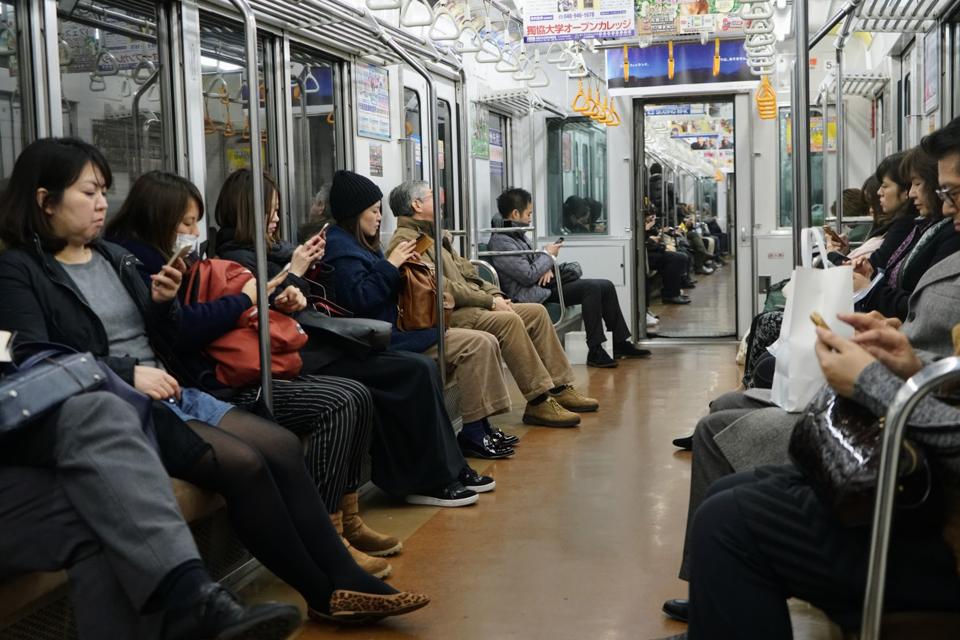
Efficiency and emissions: As noted, the idea that U.S. public transit is energy efficient is simply false, with a few exceptions in places like New York. To the shock of many, the average transit bus burns more fuel per passenger-mile than the average car. Some electric trains burn less fuel than gasoline cars, but more than electric cars. While these vehicles have barely improved, small vehicles are undergoing an efficiency revolution due to companies like Tesla. In the past, electric transit was found frequently, electric cars were rare. This will flip.
Dedicated ROW: Obviously if one gets a dedicated lane or tunnel, one can beat vehicles on congested roads. But there’s no reason that only transit could or should get access to this ability. In the past, we haven’t had the technologies to control roads, lanes and tunnels while giving access to the public. While most train lines only do a train every 5 minutes, or worse, sitting empty most of the time, road lanes can carry vehicles of all sizes (including buses almost as large as train cars) on a 2 second headway, and a 1 second headway with computer driving.
Theoretical Efficiency: Most transit thinking has revolved around the full capacity of transit vehicles, not their actual load factor, which is much lower. The efficiency of transportation is based on how many people it carries, not how many empty seats. High efficiency is found only at rush hour in dense cities, but you can’t offer service only a few hours a day. To the surprise of many, the instinct that “bigger is better” when it comes to efficiency is wrong. The demise of the A380 showed that.
As a simple example, consider a bus line with one large 60 person bus per hour. Replace it with vans every 10 minutes, as you can if you don’t have to pay drivers. Riders would clearly vastly prefer the every 10 minute service, and ridership on that line would greatly increase. Even though 6 vans with 6 people each seems less efficient than one bus with 36 people, 6 vans with 10 people each is much more efficient than one bus with 36 people. The larger a transit vehicle is, the more people must combine their travels, and the less optimal it is for each passenger. While we don’t know where the “sweet spot” is, it’s clearly much smaller than today’s large vehicles.
Capacity: At rush hour, a packed train with most passengers standing can attain, rarely, 30,000 uncomfortable passengers/hour, while highway lanes only do about 3,000 comfortable ones. If you wanted to fill a lane (or subway) tube with 15 passenger vans, though, you get 30,000 seated passengers per hour at today’s headways and over 50,000 at future ones. Unlike the trains, though, the vans would be going non-stop most of the time, with no stops at stations or transfers between lines, for much faster trips. (The vans would operate like modern elevators, in that you would indicate your destination stop, on any line, and get told which van and seat to get into for a journey with few or no stops.)
And while a single road lane can in theory beat a single transit lane, we actually have quite a few roadway lanes already in existence. But the real future technique coming down the pike is lane management for private cars. Today, managed lanes are in their very early stages and barely make use of our modern digital infrastructure. The simple fact is that if a lane has a capacity, and you don’t exceed that capacity, congestion can be seriously mitigated. Today, if a lane can handle 2,000 cars and 3,000 want to use it, we just let all 3,000 fight it out, which was all we could think of doing in the past. Even on today’s roads, as cars whiz by with 3-4 empty seats each, there is a vast amount of unused passenger capacity which can be filled with carpooling apps and shared ride vehicles.
Pleasant cities: One still valid argument revolves around the character of our streets and cities. Transitophiles hate the car, and one of their most spoken catchphrases is “Cities are for people, not cars.” That cities are for people is undeniably true, but it misses the fact that those cars have people in them. The wishes of the people in the cars are as valid as anybody else. Indeed, the users of the cars may resent what the cars do to the streets when they are a pedestrian on them, but realize it’s a trade-off for the time they want to be in one of the cars.
Even so, people would rather walk down a street that has everybody else in a large vehicle every minute than a private car every second — but they would rather be in the private car when taking a vehicle down the street. The Onion summed it up when when they wrote “Report: 98 Percent Of U.S. Commuters Favor Public Transportation For Others.” This conflict will never have an easy resolution, though some improvement is coming from the arrival of quiet and non polluting small electric cars, flying cars, and possibly cheap tunnels.
Getting into shared vehicles
With transit at a precipice, the new fear of getting into shared vehicles presents a particular challenge, and it’s one we’re not ready to handle. While future technology might handle the travel needs of the people without as much transit, today its capacity is needed. It will take decades to replace it, more in some places.
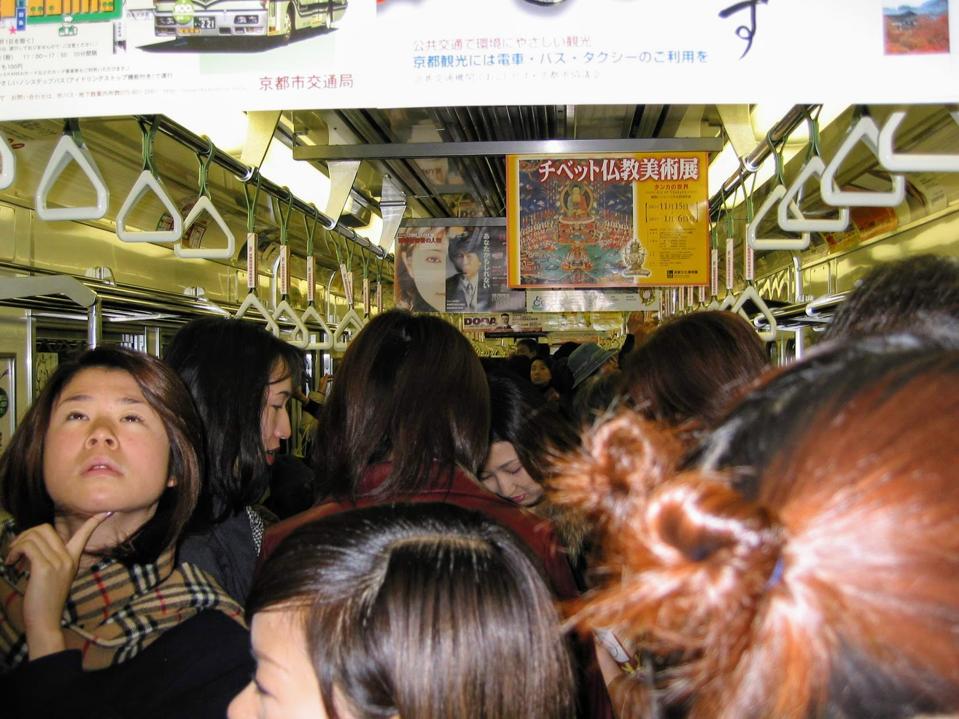
The private taxis, particularly the robotaxis, have an expensive but possible option: They can be cleaned very frequently, even after each rider. In particular, they can be designed to make that cleaning easy, quick and cheaper. Interiors can be replaced with easy to clean, virus destroying surfaces (as will also happen in public transit if it has the budget for it) and passengers can wipe down seats on their own if they have to, with a supply of wipes. This is much harder on a bus or train, which can’t wait for you to clean it, and may only offer you a pole or loop to grasp rather than a seat. Capacity of transit vehicles is greatly reduced if people can’t pack tightly together — and they don’t want to pack tightly together.
There is a potential for taxis to put a barrier between the driver and passenger (this is there for security reasons in many places already) and group vehicles can even be redesigned and rebuilt with individual closed passenger compartments. For smaller road vehicles, it’s more practical to have compartments which each have a door to the outside — this is possible with some forms of buses but not with most trains which are boarded from only one side.
Group vehicles can’t be sent for cleaning after every ride, but they can be practical if they are small enough for group journeys over a popular common route. For example, passengers can ride a short distance to a common point in a private vehicle, arrive in synchrony, and all board a van with say 5 rows of 2 compartments, boarded from each side. This van could then take them into town in morning rush hour, where it drops them at cleaned solo vehicles to complete their journey, then goes for disinfection.
Some disinfection approaches may help all modes. For example, 220nm UV light can destroy virus particles in the air and on some surfaces. Compartments and vehicles can be equipped with these lights for use at all times and between rides. This might allow a compartmented subway to exist, but with much lower capacity.
Fortunately, the early post-lockdown days will still see much reduced travel. This both means roads will have capacity, and transit vehicles will not be very full.
Some day we’ll get back to being comfortable being on a train like the Tokyo subway car above. Perhaps after a highly effective vaccine is available. But in that time, progress will move on better, more comfortable, more efficient forms of transport, which combined with management of road lanes can handle the load. At the same time, more futuristic approaches, like cheap tunnels and electric flight will develop, though they won’t be in wide use for years to come. They offer the potential though, for a city that’s very pleasant for pedestrians and residents, and very walkable — if we can solve the problem of the death of the local retail that gives most city neighborhoods their walkability, that is.
Originally published at Forbes.com in Will COVID-19 Sound The Permanent Death Knell For Public Transit?. Copyright © 2020 by Brad Templeton.


Comments
Ken Pyle
Tue, 2020-04-28 12:56
Permalink
20th Century TDM - 21st Century Packet
Great article, Brad. My analogy has been the evolution of data from Time Division Multiplexing to packet networks in the communications realm. Ultimately, the packet approach won because of improved efficiency.
brad
Wed, 2020-04-29 00:34
Permalink
Not just efficiency
The big draw of packet switched was its flexibility. But what people don't understand is that in networks -- and transportation -- flexibility is efficiency. Because to be efficient in transportation by grouping people together you have to get them to want to group together, and to do it in groups that match the size of your vehicles.
Ken Pyle
Wed, 2020-04-29 09:17
Permalink
Agreed - matching load to capacity is efficiency
Agree with you 100%, Brad. Nothing more frustrating than seeing oversize vehicles running with virtually no passengers and only getting 5 or 6 MPG.
FKA
Wed, 2020-04-29 06:27
Permalink
No real alternative
I think it's more likely to spell the death knell for densely packed cities.
It'll be a gradual death, but I think it's already started, as many people of means have already fled, and the exodus will only grow as less populated areas reopen while cities are forced to stay closed, possibly for many more months.
The leaders of New York (especially the governor and mayor) caused a lot of deaths by keeping the subways and buses running. Cuomo has said that they had to keep the subways open in order for essential workers to get to work. I think they could have figured out a better solution that utilized the empty streets and empty parking lots, but only because most of the workers were staying home.
I'd be interested in seeing the breakdown of who had antibodies vs whether or not they used the subway system. I wouldn't be surprised if it's over 75% among people who regularly used the subway. How is NYC going to reopen before we have a vaccine? Not fully, unless they're going to accept a quadrupling of the number of total deaths.
Mark Donaghy
Wed, 2020-04-29 06:56
Permalink
It seems your reasoning that
It seems your reasoning that fear of crowds is hastening transit's demise is also a requirement for your futuristic alternatives to be competitive with it, such as 15 passenger vans fully loaded (ever ridden in one?) zipping through "low cost" tunnels never stopping at stations because we suppose that all 15 passengers get on and off in the same locations. Not sure it would actually work that way. Transit is evolving and as an industry we see that a network of options for people including those you speak of will be required to meet tomorrow's needs, but they will include high capacity transit in corridors where demand exists. Perhaps your next article should be on (the lack of) land use planning in this country and the crushing financial impacts that the maintaining the infrastructure of sprawl will have on our grandchildren.
brad
Wed, 2020-04-29 11:31
Permalink
Group vehicle
All group vehicles will face a challenge, as I wrote. Smaller vehicles doing non-stop trips have a greater opportunity to be cleaned between every passenger trip than a train or bus does. But it's tough either way. Right now anybody who can afford it is scared of a group vehicle and tries to use a private car. And they will continue to do so where there is capacity to handle all those. The question is, what about places where you need the extra capacity.
Have you been in a modern office building in the last decade or so? They are all switching to a different style of elevator. No buttons in the elevators, you specify your floor before you get on. They group a bunch of people going to the same floor or a small collection and the elevator becomes non-stop or just a few stops. It greatly increases elevator capacity over regular elevators, which greatly increased it over stopping at every floor.
This is a taste of where it could go. Right now you go onto a subway platform and you get on a big long train, which stops at every stop. But yes, there is a group of people who all got on at your station and who are all getting off at the same station. So yes, if you all get in a small vehicle and go nonstop to that station (even if it's on a different line) you get not just a vastly superior and faster trip with no stops, you also get more capacity.
Except you don't need to do this in a dedicated tunnel. It's just that of course you prefer to have one if you can for yourself.
KM
Wed, 2020-04-29 07:00
Permalink
DC metro perspective
In DC, more would use public transit if it ran on time, were clean, and didn't kill people (yellow line fire, red line crash), and if riders treated each other with respect. The ones left using the system heavily are those without any choice -- people who can't afford to own a car or park it downtown, people with disabilities that prevent them from driving, the latter being a lot more people than you might expect and not just the elderly. I'm one of them, and in my 30s. I have no choice but to use the train to get from the suburbs to my downtown job. I have to live in the suburbs to afford the price of housing ("afford" is probably not the right term). I use a cane and have lost track of how many times other metro riders have kicked it out from under me while they are rushing to get on or off the train. I would love to have other options, but they would have to be affordable options to make a real difference. Because of my health, I may soon have to rely on paratransit for people with disabilities but dread that, as I've heard from friends who use it that it's even more unreliable that regular public transit. Example: if you have one medical appointment, the pickup and drop off windows are so unreliable that you essentially have to reserve the entire day, even if your appointment only lasts half an hour. I hope any overhauls of public transit take into account the unique needs of different populations.
Viviane Couto
Wed, 2020-04-29 12:15
Permalink
Ways to Stay Safe While Taking Public Transportation
There are ways do stay safe while taking public transportation. Watch the video for tips for self-protection from COVID-19 in Public Transportation and measures to make the transit industry safer and convenient for riders before, during, and after a health crisis. https://www.youtube.com/watch?v=TfJ_-UM6aQA
brad
Wed, 2020-04-29 21:21
Permalink
"Avoid crowded buses"
In the end, this is the same ordinary advice to stay safer, not safe, but when it says avoid crowded buses, it is saying "avoid efficient transit." The transit makes no sense if it can't be crowded, that's the problem.
Lee J. Nelson
Wed, 2020-04-29 13:59
Permalink
From the Perspective of a Life Scientist
The concept of carrying capacity, in textbook terms, defines the maximum population that can be sustained by the finite resources of a given biome (a defined area). Usually, food--or access to it--is the most significant, and therefore, potentially limiting commodity.
Today, food remains a key determinant of survivability and its availability is directly proportional to one's capacity to pay for it. By the transitive property of congruence, the opportunity to earn a living equates to dinner on the table. Of course, one needs to be transported to the workplace to hold down a job.
The associative property clarifies: mechanized transportation extends the range over which a defined population can secure work. By extending access to life-assuring nutrition, public transit affordably increases carrying capacity and expands the number of individuals that can occupy a given niche.
brad
Wed, 2020-04-29 21:22
Permalink
What transit does
The point is, that's what transit used to be good at. It isn't any more -- stopped a long time ago. It's more expensive and uses more energy than electric cars will in the future.
FKA
Fri, 2020-05-01 06:14
Permalink
Ditto with crowded cities
You could replace "transit" with "crowded cities" and "electric cars" with "suburbs" and it'd be equally valid.
I'm not sure how it'd be possible to replace transit with cars without decreasing population density, though. Maybe if you went underground with the roadways (or with the buildings!).
Murray Bennie
Wed, 2020-04-29 15:57
Permalink
Public transport
I have been saying for a long time that paid carparking should be provided close to the congested parts of cities. Included in the parking fees should be free mini shuttle buses radiating from this to all parts of the city centers with frequent stops as required something like the Uber model. No other vehicles in the city would then allow for autonomous vehicles and in most cases short walks to where the passenger needs to go.
Add new comment