



Zoox shows an hour live driving video, impressive and unimpressive
Zoox has released a video showing an hour long drive through Las Vegas, a follow-up to their video of an hour-long drive in San Francisco. The video is sped up 2x to make it a little more interesting. The car does an hour long drive, including driving through the pickup areas of two hotels, along various Las Vegas streets and through the airport. It needs no interventions and handles a number of complex road situations.
What this video tells us is that Zoox has a high quality project, ahead of many other teams, but at the same time, it doesn’t tell us that it’s anywhere close to being ready for release, and in fact shows ways that suggest this could be some time in the future.
Demo rides and videos for robocars are tricky. It is hard to do an hour of complex driving with no interventions. Many less mature teams can’t pull that off at all. But it’s still very far from doing 2,500 hours (around 100,000 mixed miles at an average of 40mph) with only a minor intervention needed, or 6,000 hours without a major one, which is what it takes to be around the same as an average human. To be better than human, even more hours are required. (This number is a rough one, and varies based on the driving circumstances. It’s longer on the highway and less hours on city streets.)
This is why I often don’t even bother with demo drives these days, which tend to last 10-15 minutes. If your car can’t pull that off reliably, it’s a very nascent project, and even if it can it doesn’t say much. If I see a problem on a 15 minute ride, or even an hour ride, you’re still deep in the woods.
Worse, when a company releases a demo video, it’s possible that you might actually be getting interventions every 10 minutes, but if you test drive for long enough, you will eventually get a stretch of an hour you can publish when you find it. I am not suggesting that Zoox did this, I am just saying that a video doesn’t prove that its source didn’t. In the much deprecated California disengagement reports, Zoox declared it has one every 1,600 miles (roughly 40 hours.)
It’s hard to track these numbers. To give credit to Zoox, normally interventions are much more common than necessary, as they are done on a cautionary basis — any problem, don’t let the computer take the risk. Find out later if the problem was real. So an hour without even the desire for an intervention is a strong accomplishment — but it’s not 2,500 hours.
Recently Waymo posted a reminder. When I joined Waymo’s predecessor, known as Google Chauffeur, they were completing a challenge set by project founder Larry Page to do 1,000 different miles and 100,000 total miles. They did this, though the intervention interval wasn’t as good as the Zoox video. But they did it in 2009, with a team of 16 engineers and less than 2 years of work. And now it’s 2020, and they’ve grown to a team of thousands, and spent billions and only they have only a very limited “passengers only” service in operation. Waymo recently released their early videos to remind people how far it is from demo video to production product.
The Zoox route:
The Las Vegas strip is a very car-based area. The roads are wide and simple, but there is lots of traffic and there can be left-turns that are 2 and 3 lanes wide. There’s tons of pedestrian traffic but it is isolated from the road. The hotel pick-up/drop-off areas are congested and full of pedestrians going this way and that. It’s not Boston, and it’s also not San Francisco or Chandler or Mountain View.
Zoox goes through the hotel pick-up areas but just drives through. It never gets in the taxi/Uber lines or attempts to interact with passengers, which would be a must in any real service, and a challenge. In fact, I suspect that doing a complex pick-up zone is going to be one of the few places where cars will need to communicate, not with other cars but with a server representing the hotel or other building. First, you’ll want to meter cars coming in, so they don’t come in if there isn’t room for them. You’ll want a computer that tells them when to come, provides a map of the current pick-up area and all its special rules, and tells the car what place to go to pick-up, drop-off or pause. The car will handle the details of queues etc. but it will learn the rules by requesting them (from it’s own HQ, which will communicate with the system managing the hotel lot — the car should certainly never talk directly with an unknown system like the one in the hotel or other cars.)
This will go double for airports. In fact, even Uber pickup is becoming regimented in this way at many airports. Many airports have numbered pick-up spots and the passenger and the car are directed to them at the right time. Some use PIN numbers to duplicate the taxi line style used when taxis were all the same. The same will apply to robocars. So I’m not sure Zoox’s car could actually handle a pick-up — at least they don’t show that. Zoox’s car is also quite hesitant in the airport.
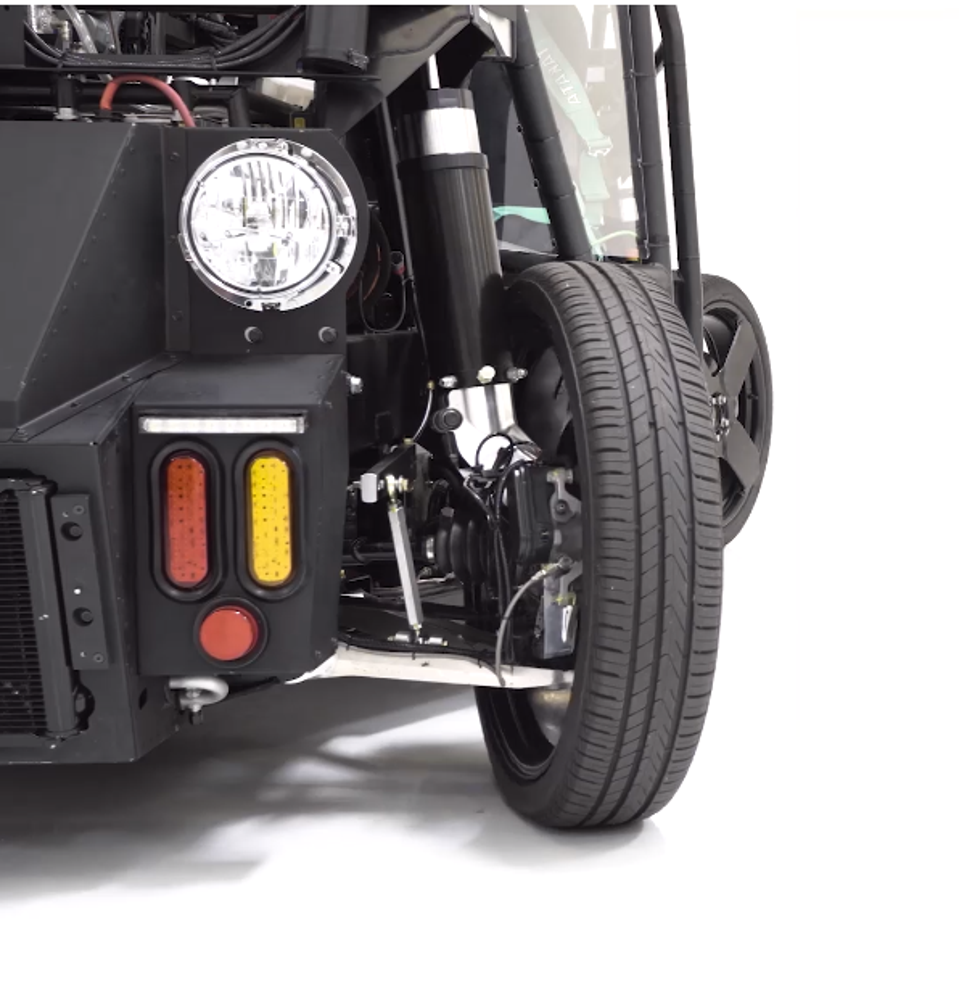
Zoox does like to point out that their eventual vehicle, which will feature 4 wheel independent steering, will be able to go sideways and turn in place. This will make it much more nimble in these complex situations, sliding into parallel pick-up spots and even having an easier time with perpendicular ones. It never has to turn around. That’s good, though frankly I think you can attain almost all those benefits with good software planning of the operational rules for the lot, and knowing in advance where you need to go.
One obvious thing in the video is the Zoox vehicle is going very slowly. It’s is constantly being passed, sometimes at high speed, even on the right side. It’s very rare to see it pass another car. They’re not ready to drive at the real speed of traffic, or perhaps they were going at a speed limit that other drivers ignore. I have written before that it is dangerous, rather than safe, to force robocars to keep to a speed limit nobody else obeys. (One extra surprising danger in mixed-autonomous cars with steering wheels is that forcing cars to stay at the limit will encourage people in a hurry to want to take over and drive themselves at the faster speed — and with greater risk than if we had let the robot drive at the speed of traffic.)
Zoox’s narrators take pride in many decisions the car makes, and in many cases this is justified. The vehicle correctly avoids lane changes into empty lanes (as eager humans will often do) to avoid immediately changing back. It has also come to understand that Las Vegas does construction at night and leaves all the cones by the side of the road during the day. It understands those cones don’t really signal a construction zone with all the caution that calls for.
It makes the odd perception mistake, including things like identifying a palm tree as a pedestrian. Zoox’s team feels it’s better to occasionally be extra cautious about a tree than to miss being cautious about a pedestrian. That’s true — up to a point. You must not miss any vulnerable road users, but if you brake for ghosts too much, your product is not commercially useful.
One curious example happens when the Zoox vehicle brakes for some birds on the road. Zoox’s engineers say, “we like birds” as though the car deliberately stopped for birds. I find that doubtful, and in fact any human driver knows to never brake for most varieties of bird on the road, and in some areas, a car that brakes for birds is again, not commercially useful, and even a bit dangerous to the cars behind it. This is one of the areas where the fusion of LIDAR and cameras is needed, to reliably identify that the obstacle on the road ahead is a bird that is just going to fly away at the last second as you approach it. Proper bird identification also is better when you see the birds are moving rather than still on the road. You need to tell them from pets crossing the road, as well. Zoox’s demo suggests they haven’t even approached this problem yet.
I do agree with Zoox’s statement that Las Vegas is a prime city for robotaxi service. There is a huge taxi service there, though it also has one of the most powerful lobbies that might get in the way. The strip is all tourists, mostly without rental cars, all wanting to get around in a city too sprawled to make it easy to walk. The airport is close by, and the huge convention facilities are not walking distance from many hotels. It’s a lucrative market if you can get it, and whoever opens up there first will probably get it to themselves for a while, as other companies elect to deploy in virgin territory rather than get into head to head competition in the early days. We’ll see if Zoox gets to do that.
As a plus, this video is in 4K, and shows several cameras and their perception visualization, so if you want to watch it, put it on a 4K TV or monitor so you can really see what the cameras show.
Originally published at Forbes.com in Zoox Shows An Hour Long Driving Video, Impressive And Unimpressive. Copyright © 2020 by Brad Templeton.


Comments
FKA
Tue, 2020-05-05 05:51
Permalink
Average human
It's not enough to drive as well as the average human. We need these cars to drive at least as well as the median human.
brad
Tue, 2020-05-05 10:48
Permalink
Median human
I would not disagree, but I have not seen a great deal of research into data on the median human record. Do you have any figures?
If I had to guess, I would suspect the median human has 1 accident in a lifetime perhaps 2. It is of course a very discrete number. A lifetime of driving is around 500,000 miles, so in fact depending on the type of accident we're talking about, it's not too far off the average. The average human has a police reportable accident every 500,000 miles, but a general accident every 250K and a small ding every 100K, according to study of US drivers.
FKA
Wed, 2020-05-06 15:31
Permalink
A small number of really bad drivers make the averages worse
No direct figures, but 28% of vehicle fatalities are caused by drunk drivers, and I don’t think the median driver ever drives drunk, while the average driver would of course drive drunk some percentage of the time. Add in other types of reckless driving that are done by a minority of drivers and cause a disproportionate number of crashes, and it seems clear that the median driver is much safer than the average driver.
On the flip side, I’m not sure that the best drivers are all that much better than the median.
In any case, I don’t think this is something that can or should be measured. It’s just a theoretical goal.
Meny Benady
Sun, 2020-06-07 02:09
Permalink
Driving at night
Interesting review that picks on a lot of non-obvious challenges. Another one of those is night performance. The camera is probably the leading sensor in autonomous perception, but at night they are more or less limited to the coverage area of the headlights (besides detecting other car's tail-lights). Has any AD developer shared significant night footage?
brad
Mon, 2020-06-08 19:27
Permalink
At night
Well, urban driving actually will have most of your main driving areas lit with streetlights, but not all of them. HDR cameras are becoming the norm to be sure you can perceive well at night. The nice thing is the other cars are super obvious at night. The pedestrians are another story. LIDAR of course is great a night, slightly better than it is in the day.
Note as well that when obstacles are lit by your own headlights, the illumination doesn't vary nearly as much as objects in the day which have the sun in all sorts of places, and shadows etc. it's easier to classify something in your headlights -- but only to the distance limit of those lights.
Add new comment