



Self driving cars a boon for those with disabilities
A new study has begun in Pittsburgh to study the impact of self-driving cars on those with disabilities. I’m going to skip to the end and predict that the result will be overwhelmingly positive.
While I was working on the Google Car (now Waymo) I pushed that we begin with a service for the disabled. That did not happen, but the first big public demonstration involved allowing a local advocate for the blind to run his errands in Google’s first prototype. Steve Mahan, the rider, found it incredibly liberating, a taste of being able to go out on his own again with the freedom of a car for the first time since he lost his sight.
Mahan returned later to ride completely alone in Google’s 3rd generation vehicle. Sergey Brin, in charge of the project at the time, was keen to show this capability.
It’s not just the vision impaired who gain something here, there are a large number of disabilities that affect mobility, including of course, the inability to walk. Today, transportation in a wheelchair is quite challenging for many. Due to the small market, specially adapted cars and vans can often be quite expensive, particularly for a population where income is often lower. Many are left with transit, which often has many issues.
In the United States, the ADA requires that any city with a transit system operate a “paratransit” system to serve those who can use or get to the existing transit system. The result isn’t great. In the USA, the average paratransit ride costs around $30 to deliver, but the agencies can charge no more than twice a transit fare. In some cities the cost is almost $60. At the same time, the service can be terrible — to keep costs down (!) you have to book rides a day in advance, and there is an hour window for when your pickup will happen. In some cities, realizing how costly it is to send out their wheelchair vans, they allow disabled folks to use taxis or Uber/Lyft at a subsidized price if they can ride in one. It saves money and provides better service. However, they still have to restrict it because $4 Uber is too good and would face over-use if unrestricted.
One interesting option comes from the ability to have a robotaxi fleet with many different custom vehicles. Already it makes sense to fill the fleet with vehicles of different sizes to fit the number of passengers. If there is one passenger, send a small, efficient one passenger car. If you have 6, then send the big minivan. Avoid moving empty seats and extra iron. The fleets can also include (and will presumably by law have to include) accessible vehicles.
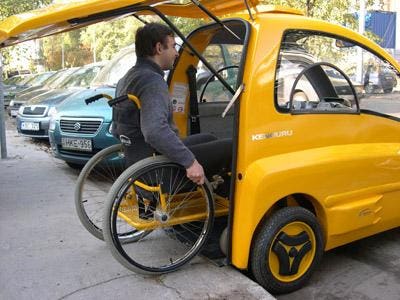
My favorite accessible vehicle design is the Kenguru, which originated in Hungary. This is a small, one-person city vehicle that is hollow. Wheelchair users (including the woman who bought the company) can just roll right into it even more easily than a walking person can get into a car. Clamp the chair down, belt up and be on your way. This is hugely more convenient than both vans with lifts or cars with regular seats and hand controls. By all reports, wheelchair users love it, but the market for specialty wheelchair vehicles is too small in today’s world. It won’t be in the future because in a taxi fleet, these vehicles can be shared among all those who need them.
With electric power and self-drive, it’s very easy to make a car with a flat floor and hollow shell. It’s also easy to put spaces in vans and group transport for chairs to roll into.
Another part of access is cost. Today, car ownership is expensive at around $7,500 per year, and Taxis/Uber/Lyft cost $2/mile or more. Everybody developing robotaxi fleet service hopes to bring that way down. Today, when worked out per mile, the all-in cost of private car ownership is 40-60 cents/mile. That’s with all profit and fuel, but not including parking. However, low cost single-person city cars can be made to cost less than 15 cents/mile, so it’s not out of reason to predict that profitable rides can be sold — once the field is more mature — as low as 30 cents/mile. Even though that’s unsubsidized, it’s cheaper than a bus ticket for most urban trips. Rides in shared vehicles will be even cheaper. If cities decide to subsidize service for people in need, the cost could be remarkably low. (Today, most transit lines in the USA collect only 35% of their operating costs in the farebox, and that doesn’t include their capital costs.) Almost nobody would suffer from lack of mobility due to lack of income.
There are some disabilities that are hard to solve, such as severe dementia. People in that situation will continue to need an assistant. But most disabilities should discover much much mobility at a much better price.
The coming world of low-cost on-demand delivery will also be a boon for those who have access problems going on a shopping trip from their home. A raft of solutions (the author has invested in one in the sidewalk delivery space) will provide faster and cheaper delivery to the home.
This is not the only new technology promising a boon. While most of us have felt cabin-fever doing all our travel with Zoom, those who already had difficulty moving are seeing a different world where every meeting participant is in the same situation. There will be fewer virtual meetings after the pandemic, to be sure, but that technology is now here to stay, and it has enabling possibilities. While there are downsides to all these technologies in other areas of life, the picture for access looks very good.
Originally published at Forbes.com in Self-Driving Cars Can Be A Boon For Those With Disabilities. Copyright © 2020 by Brad Templeton.


Comments
FKA
Thu, 2020-08-06 03:51
Permalink
robotaxis
An area where it definitely makes sense to own a robocar customized for your needs rather than to hire out a robotaxi.
At least in a free market. Mandates for robotaxi companies to subsidize robotaxi rides for people with disabilities might instead make for a situation similar to the current one.
Hopefully instead the subsidies (and insurance benefits and lawsuit settlement funds) will come in the form of assistance adapting a robocar to fit the needs of the disabled individual. This is already done with regular cars, for people who have disabilities where they can drive if their car has special adaptations. I assume it'll be extended for privately-owned robocars, and the self-driving part will mean a whole lot more types of disabilities can be accommodated.
https://www.nhtsa.gov/road-safety/adapted-vehicles
brad
Thu, 2020-08-06 14:35
Permalink
Own your own
The problem is that people with disabilities have low earning power, and as such can barely afford cars, let alone customized ones. It is more efficient to have vehicles designed for the different disabilities which can move from user to user. That way they can afford it (even without subsidy) or subsidy can be given.
If somebody has a rare disability that needs a truly custom design not good for anybody else, that's when it's worth having your own.
But a design like the Kenguru, a hollow box with a back that lifts up that almost any wheelchair can roll into is going to support a lot of people. It has some clamps to lock your chair down. I think you need to install a belt in the chair but maybe it has a way to belt you while in your chair. For the vision impaired, the vehicle can be standard, it just needs some tools to make it easy for them to find it, authenticate and get in. (Most vision impaired are not totally blind, they see shapes and more.) They mostly just need a UI they can use. The hearing impaired need all-visual UIs Some people just need automated doors and maybe some sort of automated seatbelt/restraint system.
However, many societies have decided that they wish to subsidize those who have been dealt a physical disadvantage, to bring them up to the same mobility level as everybody else, and it's going to be fairly cheap to do it with robocars.
FKA
Fri, 2020-08-07 05:49
Permalink
wow, really?
People with disabilities have low earning power? Wow, I think a lot of people I know with disabilities would be extremely offended by that. Self-driving cars will be a boon for people with disabilities who have just as much earning power as anyone else so long as they are given needed accomodations - people who can live independently but need help with mobility. For those with severe disabilities where they don't have much earning power even with accomodations, I'm not sure self-driving cars are going to help much at all.
And earning power or government subsidies aren't the only ways to pay for the special needs of people with disabilities. Many have coverage for adaptive equipment though insurance (health, car, workers comp, disability), or have received a payout from a lawsuit related to their injury, or through an AD&D policy. Maybe they're getting veterans benefits to pay for adaptive equipment. Maybe they have friends or family helping them, or maybe they have a trust fund.
Sure, some people with disabilities are poor. Maybe they'll have to resort to crappy public transportation, just like many poor people without disabilities do.
A Kenguru is nice. It apparently costs $25,000. At that price, why not own it?
brad
Fri, 2020-08-07 13:30
Permalink
Offended
I didn't say ALL people with disabilities have lower earning power. But nobody would deny as a group that it's true. Sometimes it's because they can't do certain jobs easily. Sometimes it's discrimination or lack of accessibility in the workplace. But it's reality, and it's why products for the disabled aren't giant sellers even though a surprising fraction of the population has some sort of disability.
But yes, if you are a low income wheelchair person, who can't afford a car and finds using the bus a pain, being able to ride in a Kenguru type vehicle (which you can't because the product never took off) for 40 cents/mile is going to be a great enabler.
FKA
Fri, 2020-08-07 16:40
Permalink
no
I don't think it's true, at least not among people who would benefit from this.
I don't think someone who can't afford a car can afford 40 cents a mile.
And I don't think the unsubsidized cost would be that low.
brad
Sat, 2020-08-08 21:07
Permalink
Afford a car
Car ownership costs about $7-8K per year plus parking according to most estimates. A bit less if you car is old. So no, you can't afford 12,000 miles of driving at 40 cents/mile if you can't afford that, but you can readily afford a few thousand miles of driving, and move some segment of the rest to shared rides of various sorts. Not just traditional transit.
And of course there is already a huge subsidy for paratransit, in fact in many cities paratransit costs are a major fraction of total transit costs. So even if you don't think the ride will be 40 cents/mile it will probably be made available for less to the disabled.
FKA
Sun, 2020-08-09 06:48
Permalink
On average?
I personally have never spent anywhere near $7-8K in a year on car ownership.
You can get a used car for well under $7,000 that will last you several years. And can be shared with multiple people, especially if you only need it on occasion (not for your daily commute).
Maybe robotaxi rides for the disabled will be subsidized by the government, but we'd be better off spending government subsidy money on adapting individually-owned vehicles for the disabled.
brad
Sun, 2020-08-09 13:06
Permalink
Cost of car
Yes, that's just an average number. Some people spend less, some more. And of course to be fair, the poor will be on the lower side. Still cheaper to be on the lower side of hiring a robotic taxi.
Adapting the individually owned vehicles only works for those who have parking spaces available to them. And it's not nearly as efficient to adapt 1000 vehicles when you can adapt 200 and have them wander around to those who need them.
FKA
Sun, 2020-08-09 16:28
Permalink
cheap
Robotic taxis will not be cheap, especially not ones customized for the disabled.
Having vehicles wander around to those who want them is not cheap, nor is it convenient.
Parking, in most places, is cheap. Yes there are places where this is not the case. And lots of people are wising up and leaving these sorts of places. Robocars will contribute greatly to this exodus, I think. Not as big of a deal living in the sticks when you can sleep or work while you travel. Not a big deal if the nearest grocery store is 10 miles away if robot delivery is cheap.
brad
Sun, 2020-08-09 20:03
Permalink
Parking
Parking is fairly cheap but not a dedicated space, which in many place is $200 to $500 a month. It's cheaper for robots which don't need a dedicated space. Parking on the street is of course subsidized.
I believe the robocar package will make a car eventually cheaper, not more expensive. While the sensor pack will cost about $2K, maybe less in quality, all the things you take out of a car cost more than that today.
The Kenguru is "customized for the disabled" but what that means is it doesn't have seats or doors on the sides, saving quite a bit. The one expensive add on is a motorized liftgate, which many cars today have, and the main add-on, a hinge-out ramp under the liftgate with a motor to lower and raise it. With just a hollow shell (except for clamps to restraint the chair) and no wheel or other controls, no dashboard etc. it would be quite cheap in quantity, and even cheaper shared among many users and recharging itself.
FKA
Mon, 2020-08-10 04:36
Permalink
maybe
These are all good reasons why owning your own robocar will be affordable.
Bill Jones
Sat, 2020-08-08 11:55
Permalink
Self Driving for Hearing Impaired
At 56, and suffering from a diminished capacity to drive due to periodic loss of balance in my inner ear, and also loss of hearing, I look forward to self driving technology. Driving has become more a chore than the pleasant experience it use to be. As a US Army veteran, I can imagine other vets also suffering from hearing loss, TBI, and PTSD who would benefit greatly for this technology. IMHO this tech needs the dedication of government and business to move it into reality and everyday living as quickly as possible. Self driving automobiles will be a game changing life experience for so many.
Add new comment