



New Waymo data shows superhuman safety -- they're ready
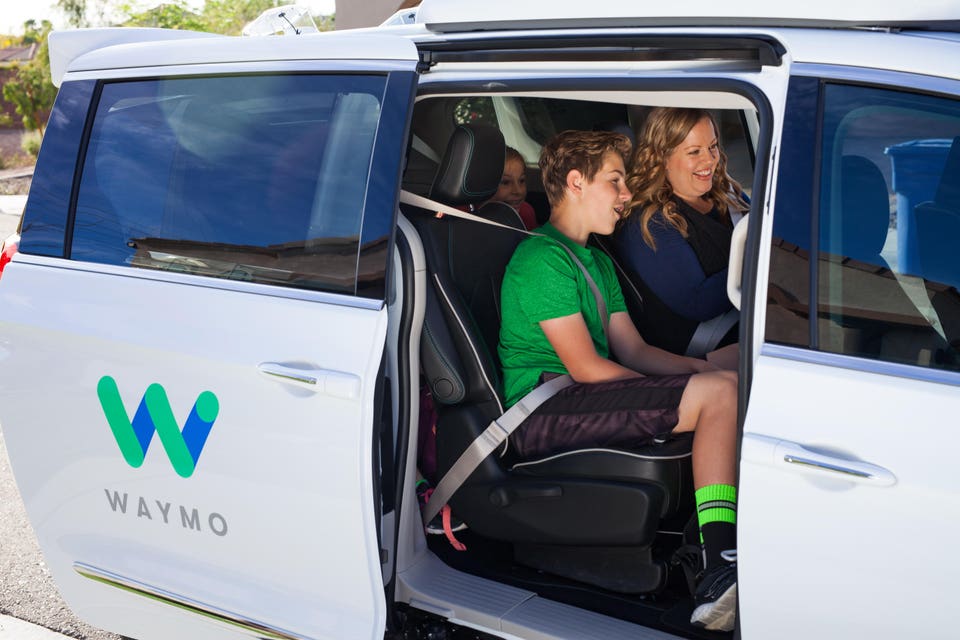
Waymo (The Google self-driving car) has released a detailed incident report for all their operations around Phoenix, Arizona over the past several years and over 6 million miles. The report shows an incredible, superhuman safety record and suggests it is past time for them to deploy a service at scale, at least in simpler low-urban/suburban zones like Chandler, Arizona.
The report is notable for several reasons:
- There is incredible transparency, of a sort we have seen from no other team. Indeed, a gauntlet is now thrown in front of all other teams — if you’re not this transparent, we will presume you are not doing so well.
- They have the ability to be that transparent because the numbers are good. In 6.1 million miles they report 30 “dings” with no injury expected, 9 with 10% chance of injury and 8 with airbag deployment but still 10% chance of injury, suggesting less than 2 modest injuries. Human drivers would have had about 6.
- All the events had the other driver/road user at fault in some way under the vehicle code, according to Waymo.
- There were no incidents of single vehicle incidents (ie. driving off the road) which are pretty common with human drivers.
- Nationally, 6.1 million miles of driving by a good driver should result in about 40-60 events, most of which are small dings, 22-27 or which would involve an insurance claim, 12 which would get reported to police and 6 injury crashes. With no at-fault events in 8 lifetimes of human driving, Waymo’s performance is significantly superior to a human, even in an easy place like Chandler.
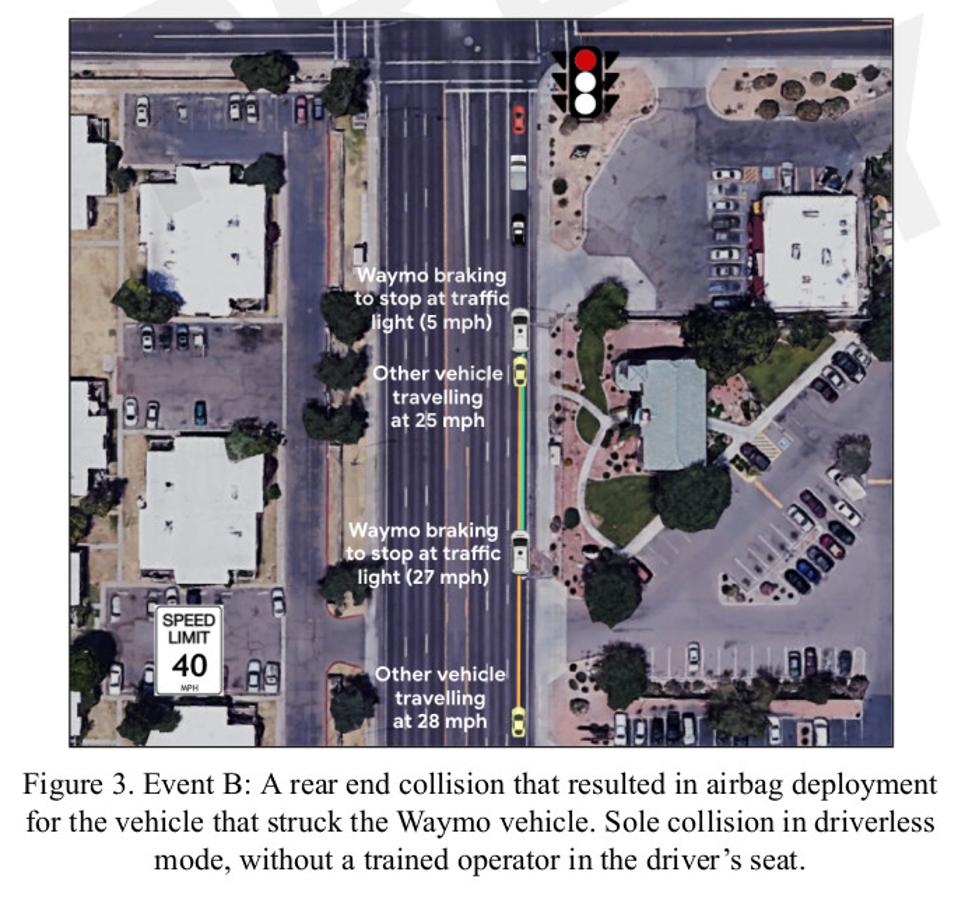
Note that 62% of the events described did not actually happen. Rather, a safety driver intervened, and careful replay of the event in simulator concluded some “contact” would have happened without that intervention. They play out all potential contacts to find the total crashes the vehicle would have had with no safety driver aboard. (65,000 of Waymo’s miles were with no safety driver. One of the incidents took place in this vehicle, which was rear-ended while it was decelerating.) 18 of the contacts were real, 29 showed up in simulation.
47 contacts in 6.1M miles, or 130,000 miles per contact, is slightly better than the estimated level for humans when you track every single contact, including those that cause no damage and never get reported to insurance or police. Waymo included things like a pedestrian walking into their stopped vehicle and even an impact with somebody who appears to have deliberately cut in front of their vehicle to test it. The pure number of 47 would be slightly better than human if half of them were the fault of the Waymo, rather than none.
That’s not quite correct, because we don’t have numbers for the reasonably serene suburban environs of Phoenix. Driving there is easier — that’s why they chose it as their first step— but even if the rate is 1/2 or even 1/3rd of tougher places, the number still impresses.
Below, I’ll get into some of the specific incidences and claims. Waymo also released a new document describing their safety processes and thinking. It’s a more evolutionary document without grand new revelations, but is another example of good transparency which may be suitable for a later article.
Were they really never at fault?
Waymo believes that every contact involved improper action by the other party. Most of these were not handled by police with a formal declaration of fault. Reading Waymo’s descriptions, it’s possible some blame might be attributed to Waymo on a couple of them, so Waymo in their formal claims says “nearly every contact.” For example, they did hit a vehicle which cut in front of them and braked for no reason, but they believe the driver did it deliberately.
Nonetheless there are two key possible factors of fault. First, in the 29 simulated contacts, the human safety driver was able to avoid the accident, even though fault lay with the other driver. And indeed, on the road it’s quite common for a person to be the one who prevents an accident somebody else would have triggered. Clearly the Waymo software can still improve — it’s not as good as the safety drivers. Waymo responds that their safety drivers are trained to a level well above the typical driver. I did Waymo safety driver training 8 years ago, and it involved a special defensive driving and accident avoidance program and more, and one presumes it’s even better today.
That’s good, and a worthwhile bar to aim for, but it isn’t a bar you have to make in version 1.0. The Waymo safety drivers (two of them) are not driving, they are doing nothing but preparing to intervene. They are watching the road (and software console) to be ready for potential dangerous situations in a way regular human drivers don’t. The software will, hopefully, learn from every simulated contact what the safety drivers did to be able to avoid the accident, so that the software becomes as good as that trained driver.
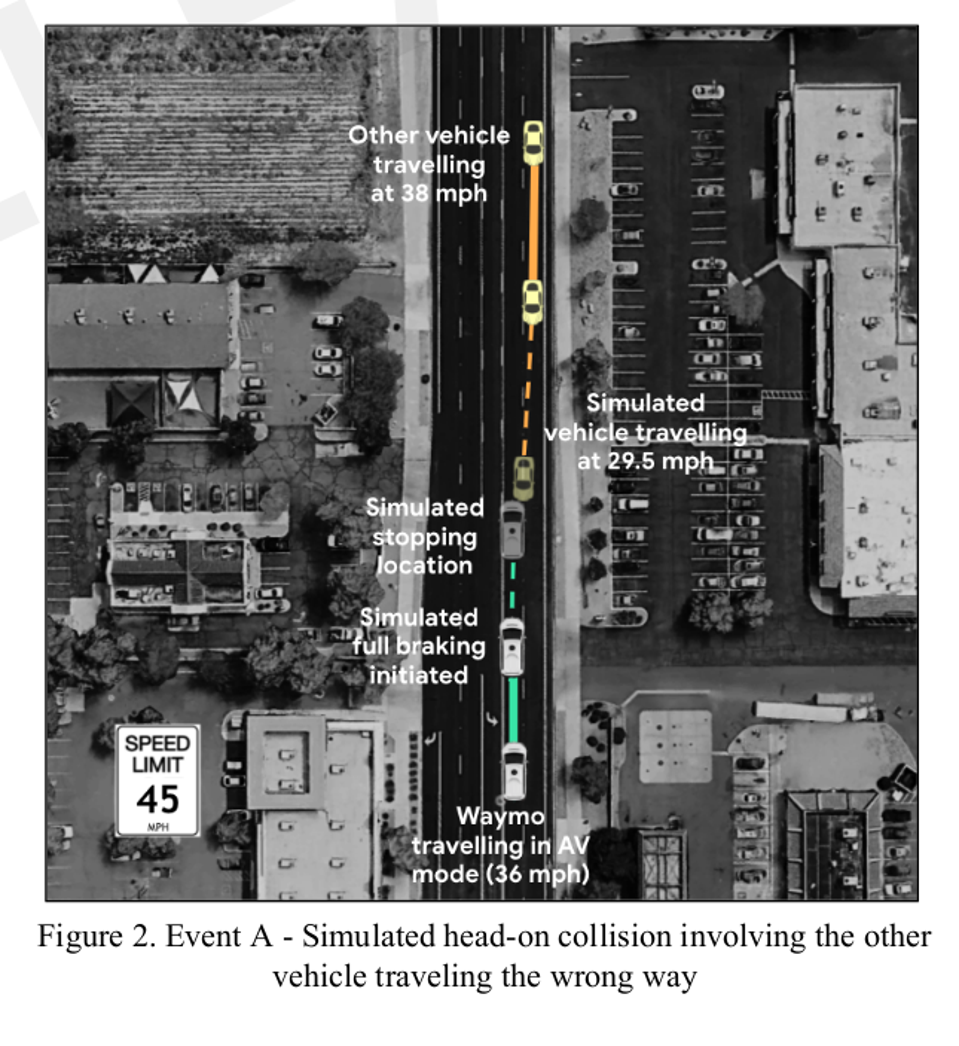
Perhaps the scariest example involved another car moving into the Waymo’s lane the wrong way, on track for a head-on collision. In simulation, the Waymo came to a full stop in the lane, but was still hit by the oncoming car in the virtual. (They don’t reveal how the crash was avoided in real life — perhaps the Waymo driver swerved in a way the software would not, or perhaps the oncoming driver came to his/her senses and swerved away.)
A few of the incidents might suggest partial Waymo fault. In two simulated crashes, the Waymo sideswiped another vehicle. In one case the Waymo changed lanes into a lane where a car was overtaking at 30mph over the limit. In the other case the Waymo was entering a left-turn lane at the start of the lane, and hit a vehicle that had snuck into the left turn lane before it actually began. While those other drivers were at legal fault, it seems the Waymo system could certainly improve in spotting people coming up behind it — and it probably already has.
The Waymo did rear-end a vehicle, but that vehicle cut in front of it and slammed on the brakes for no reason. This is probably somebody “playing” with the Waymo vehicle to test it and doing it badly. (This happens rarely, but is not unknown. Normally the safety driver immediately intervenes.)
The second question is whether the unusual and conservative driving behavior of the Waymo “caused” some of these accidents, not by being at fault, but by increasing the odds of poor actions by humans. Humans expect cars to do certain things, and robocars may not do them, surprising the other drivers. The 15 times a Waymo was rear-ended will all be the fault of the other driver under the vehicle code — but some might not have happened to a human driver who drove in the more aggressive standard human way.
There were also a couple of incidents where a Waymo was making a right turn, and something motivated the human behind them to try to pass them on the right. This then caused the Waymo to sideswipe the other vehicle. It’s odd for a human to try to pass a right turner on the right, so they might have triggered aggression in a driver, leading to an accident that was still that other driver’s fault. This reminds me of Waymo’s first (and only?) at-fault accident, where they attempted to pass a bus on the right in a way that people often do in a wide right-turn lane.
In one instance the Waymo did a hard brake after starting a left turn and deciding to pause, and got rear ended by somebody following too close.
Waymo says they have looked for this and do not believe they are causing any significant number of accidents this way, but it’s hard to entirely rule out. However, the number of 130K miles per contact is consistent with human drivers — slightly better by some accounts — and backs that up. In addition, even if we assign some fault to Waymo in the crashes I list above, they still have a better-than-human accident rate.
This is just suburban Phoenix
It can be argued that even though Waymo “has done it” in suburban Phoenix, this doesn’t mean it’s safe enough in a place like downtown San Francisco or more complex cities like Boston, New York or Mumbai. And you certainly would not expect to just move one of these cars there, map the new town and put it to work. There is more to be done.
Cruise, which trains in downtown San Francisco, has long said they are working there because they want to start with the harder problem first. It remains to be seen when Cruise can deploy there, and how long it will take Waymo to move to that world. Waymo has been training even longer in suburban San Francisco/Silicon Valley where they are based, with some effort in downtown SF.
Even so, there’s quite a lot of the world not too different from Phoenix, so a bit more work can give Waymo a lot of territory. To give credit to Cruise, for a taxi service, the downtowns are definitely the prime market, and a suburban service that can’t go downtown is at at a serious disadvantage. Waymo knows this, so the race is on. When they scale up, they will start learning even faster.
Waymo uses maps for their service area, while Tesla is trying to make a car that drives with just a basic map. Waymo’s approach is currently very, very far ahead of Tesla on the roads where they have a map, but doesn’t work without it. It is not a serious problem for a taxi service which has a service area to need maps. It’s more of a problem when you want, like Tesla, to sell cars to customers who will drive them all over. Mapping isn’t free, but it’s orders of magnitude less cost than building or maintaining roads, and if you have a high volume service, the cost of mapping per customer-mile is trivial and well worth it for the extra safety and faster time to market it provides.
Waymo has staff in an operations center who monitor the vehicles with no safety driver and give them strategic advice if they come to a situation they can’t figure out. They can’t remotely drive the cars, so they can’t do things like intervene in an accident situation. As such, other than helping the vehicles avoid doing the wrong thing in complex situations, they would have played a limited role in keeping the safety record this good.
Is this enough data?
Waymo had no severe crashes of any kind, and asserts no “at-fault” even at low severity. In part, this may derive from the fact they stick to roads at or below 45mph, and take advantage of the suburban simplicity described above. Since fatalities occur about every 80 million miles of driving, and 180M miles of freeway driving, 6M miles isn’t enough, it can be argued, to say anything about fatality rates. A 2016 article from Rand argued that you would need to drive billions of miles to truly prove superior safety. (Rand released a new study this week toning that message down somewhat.)
The best approach is to not think of things in terms of “proving safety” but to quantify safety’s twin, low risk. The goal of society, in deciding how to embrace the arrival of robocar technology, is to make sure the risk is acceptable, not to make it zero or to have absolute proof. In particular, it is important to understand that in almost everything in life, it is not just acceptable but essential to take risks in order to win benefits, particularly when the benefit is a massive reduction of future risk.
As such, while Waymo can’t prove that their car would encounter a fatality at a better rate than the 80M mile rate of humans using just 6.1M miles of data (or even the more than 20M miles they have with other test area, or the billions of miles they have in simulator,) it can now be said that the risk that they are too dangerous is acceptably low. In addition, it would be discovered fairly quickly if this is not true, with harm, but minimized harm.
On the other hand, the risk of having humans do all the driving is now very well known, and very high in aggregate. Every year the deployment of safe robocars is delayed, the longer that risk — with its terrible consequences of 40,000 deaths each year in the USA — continues. We would be insane to wait for certainty because we are already certain how horrible the alternative is.
Whether it’s Cruise or Waymo or somebody else who will make the first vehicle to drive busy downtowns with acceptable risk, we don’t want to delay the arrival of that day. It’s well worth quite a bit of risk. Consider the way that everybody who speeds — which means almost everybody — puts themselves and everybody else on the roads at much more risk than this, and the only benefit they seek is getting somewhere a minute earlier.
When we regulate human drivers, we have a DMV driving test evaluate them for half an hour, and hand them a licence. We do this even though we know newly minted teen drivers are much riskier than mature adults. We are definitely not certain that they are “safe enough” — in fact, we’re pretty sure they aren’t. Indeed, since Waymo has driven for over 8 human lifetimes worth of driving with no at-fault accident, it’s safe to say that no human being has ever, or could ever prove they are this safe. Indeed, people can cause several accidents and prove they are much more dangerous and still keep a driver’s licence.
The reality is, we should be ready, as a society, to take worthwhile risks and let developers take what may seem like larger risks at small scale so that they can then reduce risk vastly at large scale after success and growth. The risks they take at the start will be with small fleets and inherently limited. But the truth is that Waymo has now proven they are past being much risk at all.
Forward for Waymo
Waymo will shortly be opening their service in Chandler to the general public. You’ll be able to use it like an Uber, often with no safety driver. They intend to bring back all their safety drivers as soon as they have virus barriers in all the vehicles. I think they’re ready to go further, and have all vehicles with no safety driver.
(Waymo believes the step they have taken in Arizona is a real deployment, allowing Waymo One Beta users to invite their friends to join, though those friends still need approval by Waymo, because these new members will not be under NDA. I feel a real deployment looks like Uber — anybody can download and ride — though that is difficult because they might well get overwhelmed with requests.)
Are other teams close? We don’t know. Nobody has ever released such detailed data. The gauntlet is down. If Cruise, Zoox, Argo, Tesla and others want to say they are in the game, they need to show the same data. If they won’t show it, we should presume they are afraid of releasing it for a reason. No proprietary secrets are disclosed. A few useful lessons are revealed but everybody should be sharing those lessons anyway, for the good of the industry.
Will Waymo be as bold in deploying as suggested above? Probably not. As I have often said, it’s a quirk of humanity that “people don’t like being killed by robots.” We would rather be killed by drunks. We expect perfection from machines that they can’t deliver, and which we don’t expect from other human drivers. The risk to the public of Waymo deploying today are not just low, they are much lower than the risk which will be created by the people who drive themselves rather than taking a ride in a Waymo. And I don’t just mean the people today. If we assume that Waymo grows in a similar way depending on when they launch, and that if they launch a month later they get big a month later, then the math tells us the risk they prevent is actually that of all the people who didn’t ride with Waymo in that long period before they got big, and it’s equal to all the people who ride in a month when they do get big. If Waymo can grow in the distant future to be 10% of trips in the USA, that means delaying a month causes 80,000 accidents and over 250 deaths due to people who drove themselves rather than rode in a Waymo. For each and every month of delay.
It’s immoral for Waymo not to get going now, and for any regulation to stop them.
Originally published at Forbes.com in Waymo Data Shows Superhuman Safety Record. They Should Deploy Today. Copyright © 2020 by Brad Templeton.


Comments
Monali Jhaveri-Weeks
Fri, 2020-10-30 12:32
Permalink
Your report on Waymo's newly
Your report on Waymo's newly released performance data is really helpful. Can I ask your source for the human driver collision stats?
brad
Fri, 2020-10-30 13:16
Permalink
Human driver stats
Come from a variety of reports from NHTSA, IIHA and Naturalistic driving studies, and Waymo's own research. There are 3T miles driven per year in the USA, about 6 million accidents reported to police, about 3 million injuries (from a smaller number of accidents) and 12 million accidents known to insurance companies. Naturalistic studies and Waymo's experience suggest that there are many more never-reported accidents, probably in the range of 30 million but that's harder to pin down as you can only do naturalistic sampling.
acredinvestor989
Fri, 2020-10-30 17:40
Permalink
Will you please disclose how much Waymo and Google you hold?
This article isn't really journalism-- you didn't try to interview the other parties involved in the crashes, and your concluding paragraph pressures *in bold* every other major player to publish a safety article.
Could you please disclose your holdings?
brad
Sat, 2020-10-31 00:44
Permalink
The story isn't about them
But they have been asked, my myself and others to disclose these numbers and they have declined. My holdings are my own business, and they are not large enough to affect my opinion. But no stock I hold is large enough to affect that. Forbes does require disclosure of potential though, so I disclose it. I like Waymo because they are the best, and this is a very widely held view. I invest in things because I think they are good, I don't say they are good because I invested in them. If you don't believe me, don't read me.
FKA
Sat, 2020-10-31 07:05
Permalink
Why now?
What do they gain from deploying now vs. waiting until they've built something than can be profitably deployed in many more locations first?
If market conditions were better, maybe they'd be able to deploy now and then IPO to get the funds to expand worldwide. But if that's their route they're probably better off waiting at least a few months. Hopefully in a few months we'll have a new President and a COVID vaccine.
In the meantime, they keep doing everything else, of course. But what do they gain by deploying a service without an in-car safety driver? (They save a little money representing an insignificant portion of their costs, and they risk having a catastrophic incident that destroys their reputation. Anything else?)
brad
Sat, 2020-10-31 11:25
Permalink
Don't understand the question
Deploying is expensive. Even with Google's money you don't do it "several locations at once." You also learn from deployment. And you gain a foothold in the towns you deploy in.
FKA
Sat, 2020-10-31 16:09
Permalink
What's not to understand?
You don't understand the question "why now?" Why should Waymo deploy now, and not later?
They can gain essentially the same foothold in the market whether they have safety drivers in the car or not. (Probably not much. It's easy to switch taxi services.)
If Google doesn't have the money to deploy in multiple locations now, how are they going to get the money to do so later?
Either they've got a viable business plan, or they don't. I suspect they don't, but you seem to think they do.
Let's say it costs them $100 million to deploy to a new city. And let's say they can make $20 million a year per city. So, they can stay in one city for five years, and then use the profits from that city to deploy to a second one. Ten years from now they can be in four cities. Twenty years from now they can be in 16 cities. Or they can borrow $500 million and deploy to six cities. Feel free to change the numbers, but it's the same principle. Either they have a business plan that can pay a decent rate of return on their initial investment, or they don't.
(As I said, now is probably not the best time to raise capital. But in a few months it might be an okay time. If Waymo really has what you claim it has, we might see a Waymo IPO in 2021. Facebook raised $16 billion. How many cities can Waymo deploy to with $16 billion?)
I respect your focus on the fact that this technology can save lives. If Waymo has perfected it well enough to deploy, they should do so in as many cities as possible. Save as many lives as possible.
But maybe they're still in the development phase.
brad
Sat, 2020-10-31 16:13
Permalink
Not money, bandwidth
Deploying requires skilled humans. Yes, initial mapping takes effort. You need to learn the unique rules of the road in each town, test the car against them, confirm safety (not as much as you did for Chandler but still a fair bit) and make nice with the local government. You don't have the people to do everywhere at once, so you do it one at a time, and the teams grow and move to the next city -- and as they grow you can have 2, 3, 4 cities in development and testing at a time. And you are getting better at it.
Money helps a lot, but there is just certain amount of time that is needed that you can't buy with money -- unless you can build AGI, I guess.
FKA
Sat, 2020-10-31 16:48
Permalink
no
All of the skills you've mentioned are ones that it'd be easy to find in locals. In fact, the two of the efforts that require the most expertise are the ones where you most certainly would need to utilize the skills of people with knowledge of the state and local laws: Learning the unique rules of the road and making nice with the local governments.
Doing all of that with a single team, one town at a time (or even four at a time) would be idiotic.
But hey, maybe that's what Waymo is doing. Maybe 20 years from now they'll be in a whopping 20 cities.
Imagine if Uber had one team that went from town to town spending months convincing local governments to let them deploy there! If Waymo can't figure out how to parallelize deployment, they're in way worse shape than I think they are, and I don't think very highly of them.
Sometimes I wonder if you might intentionally be saying things like this to try to throw off Waymo's competitors.
brad
Sun, 2020-11-01 10:53
Permalink
Easy to find
Hiring people for mission critical safety jobs is not trivial and takes time. Hiring people for that part time is even harder, since you will let many of them go when done. It's not flipping burgers.
FKA
Sun, 2020-11-01 19:24
Permalink
easy to find
Of the jobs you listed, that's about the only one. But it's also one where people can easily manage teams in multiple locations at once. Will it take time to build those teams? Sure. Will it cost money? Yep. But that's the very essence of what Waymo needs to do if they've truly built the car you claim they've built.
Again, how could it be any other way? You really think Waymo can work on one city at a time and not quickly be surpassed by its competitors? C'mon, deploying to new cities is the essence of their business once they've built the basic car.
brad
Mon, 2020-11-02 00:49
Permalink
Whatever limit Waymo is under
Then so is everybody else, unless the somebody else has breakthroughs the others can't do. Some hope for those breakthroughs, but they show no sign of being close to them.
As I said, one city at a time is the start, and you speed up as you go because you are increasing the number of ground teams you have that can move on to the next city. And you get smarter, better and faster. This is normal for products like this. Even Uber, which can open up a town with just 2 people and a new country with 4, still had limits on how fast it could grow in towns.
FKA
Tue, 2020-11-03 06:12
Permalink
I'm not sure what you mean
I'm not sure what you mean about limits and breakthroughs. If by limits you mean the artificially imposed constraint of only deploying in one city at a time, Waymo's direct competitors won't have that limitation. (Neither will Waymo, of course. There is nothing that prevents them from working in multiple cities in parallel. Their choices make this expensive, and maybe working in multiple cities means they are spending money in multiple cities that theyll never fully recover, but it is possible.)
I'm also not sure what you're saying when you say "one city at a time is the start." Clearly Waymo is working on multiple cities already. The question we were initially discussing (I thought) was whether it makes any sense for them to continue to not use in-car safety drivers in one of those cities once they are able to install protections from COVID spread.
That said, even a few cities at a time is not the right approach, in my opinion. I much prefer the Tesla approach of creating a general solution that's not so dependent on location. Even at four cities at a time it'd take centuries for Waymo to catch up to Tesla.
brad
Tue, 2020-11-03 15:53
Permalink
Tesla approach
The Tesla approach is obviously good if you can make it work. Tesla is the only player to think this will work and get there first. Time will tell which was the right bet. (Tesla is making several contrarian bets. Tesla is known for contrarian bets paying off, but that's been against car OEMs. Not against companies that are their match, or superior, in fields like software development, mapping, neural networks, processor development etc.)
FKA
Sun, 2020-11-08 08:27
Permalink
I guess time will make it
I guess time will make it more obvious, but I'd say we've already seen that Tesla's strategy works.
Anonymous
Sun, 2022-11-20 20:56
Permalink
Gary Marcus and Yann LeCun
interview helps
www dot zdnet dot com/google-amp/article/ai-critic-gary-marcus-metas-lecun-is-finally-coming-around-to-the-things-i-said-years-ago/
Add new comment