



Does new battery swap company "Ample" finally get it right?
- Battery swap has failed before, but new venture might make it work for fleets like Uber and delivery vans with “battery as a service.”
- Swap offers solutions for mid-day charging, battery decline, the use of renewable power and extending vehicle life. The cost of this solution is high, though. Robotaxi fleets will welcome fast mid-day swaps if they can’t do their whole day’s work on a single charge.
- Companies like Tesla which seek to win by innovating in their battery systems rather than standardizing may resist swap.
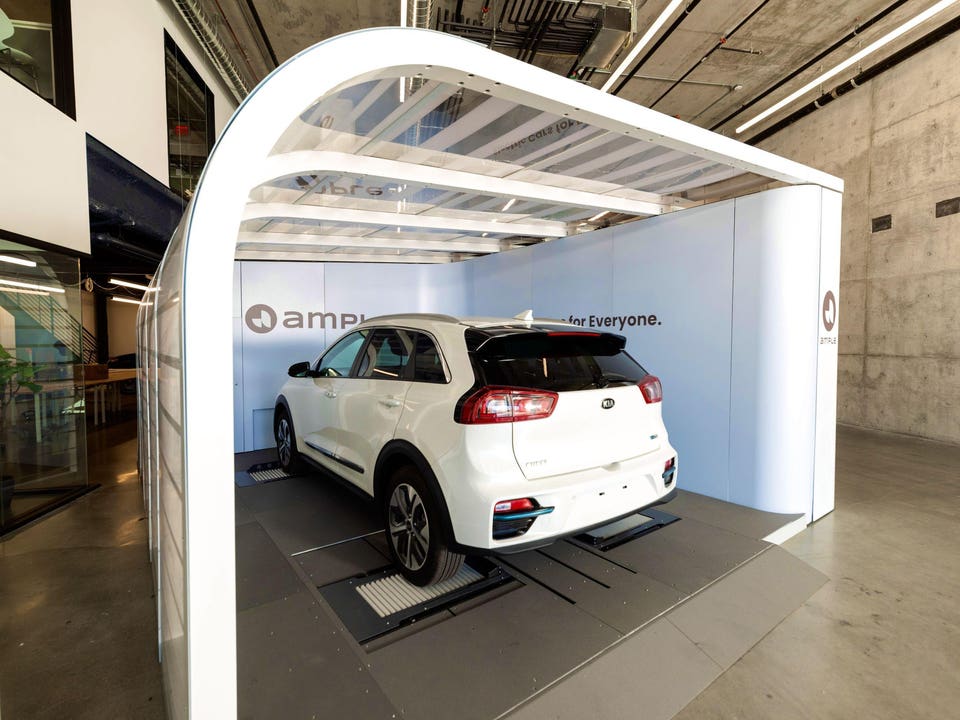
Ample is a new electric vehicle charging system which works by having robots quickly replace small modular battery packs in electric cars, getting them back on the road in a few minutes, not unlike a gasoline fill-up. Unlike prior efforts at battery swap, Ample’s system is lower cost, more flexible and most importantly is aimed at commercial fleets and taxis, not ordinary drivers. Ample states it has partnerships with 5 OEMs with 9 different electric vehicles to use or be adapted for their modular battery packs, and it will be opening its low-cost swap stations in cities with heavy electric fleet operations. In videos it shows a Mercedes, Nissan Leaf and Kia Niro, and it also will partner with Uber.
Everybody is naturally skeptical of battery swap, knowing the story of how Better Place, which tried to pioneer in Israel and the Netherlands, cratered quickly at a huge loss to investors. They hoped to solve the range anxiety “problem” with a “recharge” that took a similar amount of time to a gasoline fillup. There were many reasons it failed (including being too early) but one of the biggest is that the range anxiety problem is vastly overblown — something not understood by gasoline car drivers. Drivers of long-range cars like Teslas just charge at home every night, and always have enough range for their daily routines. The charging takes zero time — you’re asleep — and you never have to go to gas stations or charging stations. It’s better than gasoline, except on long road trips.
To avoid solving this problem which actually doesn’t exist, Ample will put its focus on fleets. Fleet driving is planned. The fleet vehicle drives the same 8 (or whatever) hours each day. Fleet cars which are driving all day may not have enough range to last the day, so they need either fast charging (which still involves a 30 minute downtime) or super-fast charging (which is yet to arrive) or battery swap. This is also true of trucks which need much more energy, and as such are less likely to run all day on a single charge. Fleets drive in a limited territory, often return to base, and the vehicles are selected for the job — so fleet owners might be amenable to getting vehicles with swappable batteries.
Private car owners, on the other hand want to drive and charge possibly everywhere. They don’t need charging during the day. Some private car owners, who can’t charge at night or work, do use fast charging and might like battery swap.
For private owners, battery swap is “gasoline thinking.” Trying to operate the car just like a gasoline car. They are glad to be free of that model — driving until you are low, then hunting for a gas station with a good price, then taking the time to “fill up” there. Fleets are different. Their trips are scheduled. Getting to a battery swap station can just be part of the schedule.
Technology
Unlike Better Place, which built expensive battery stations that were installed in a pit the car drove over, Ample installs a station in a space the width of two parking spaces. In that space is a slot the car drives into with a hoist to lift it up. Robots scurry underneath, unlocking and removing 2.5kwh standardized modules, while other robots replace them with fully charged ones. 20 modules/50kwh/~200 miles will take about 10 minutes, they state, and they promise it will be 5 minutes in a year. While that’s 3 times as long as a quick gasoline fill-up, it’s usually not a burden, and drivers need a break anyway. 50kwh is good for about 200 miles in a typical sedan.
Ample says their stations are cheap — around 1/10th to 1/3rd the price of a high-power DC fast charging station like a 250kw CCS station that, in spite of the power rating, probably takes about 30-40 minutes to recharge the 50kwh. That’s because batteries charge more slowly as they get closer to full. That’s a long break unless you take a meal. Ample’s stations will be cheaper because they don’t need to bring in megawatts of power — they can recharge the modules more slowly. In particular, they can often recharge them overnight, when power costs as little as 1/3rd what it does in the afternoon. Alternately, when surplus solar power is available in the day at bargain prices, they can use that power until about 2pm when the fleets are on the road.
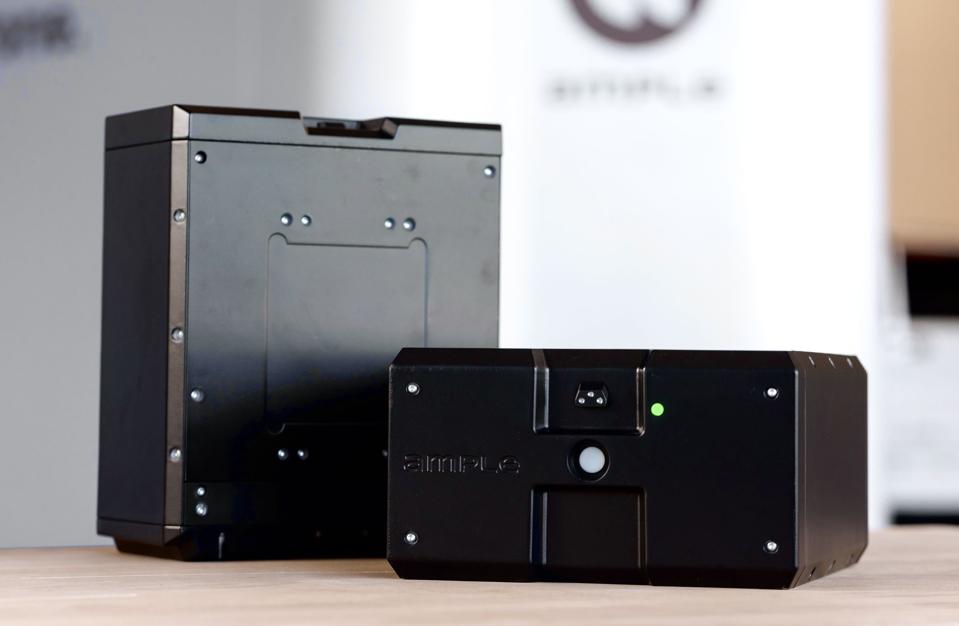
Slow charging is cheaper and also causes less harm to the batteries. Packs recharged at slower rates should have a longer life. Ample will promise its customers their total cost for batteries and energy will be better than gasoline. I am not sure that’s enough of a promise — it should really be much better than gasoline to meet the promise of EVs. Ample suspects fleet operators will be happy with the prospect of “as fast to refuel as gasoline, but cheaper and greener and with all the other advantages of EVs.”
In addition, once a battery does start losing capacity, it’s easy to repurpose the module for use in home batteries and grid storage, where nobody cares about size and weight and capacity loss, only capacity per dollar. This is harder to do with car batteries which one plans to never swap — instead you just drive a car with slowly diminishing range.
In addition, excess capacity in the stations can be used as grid storage if it is known the cars won’t needed it — and fleet demand is predictable.
Who makes and owns the battery?
It is both a curse and a blessing with battery swap that your car keeps changing what battery it has. The blessing is that you never worry about degradation of your battery. Tesla owners obsess over how they have lost 10% of their range since their car was new, and Tesla only views it as a problem if it drops by 30% in 8 years. With battery swap you just rent batteries, and they can always be of high capacity, unless you temporarily take smaller ones at a lower price that day.
This also means that as battery technology improves, you can get the latest batteries and all their benefits, or pay less for the old technology. Of course, charging speed no longer counts as a benefit to you, but size and weight and power and cooling ability do.
Unlike a gasoline car, the only part of an EV power train that really wears out much with time is the battery, and swap resolves that. This can greatly extend the usable lifetime of an EV, particularly in a fleet.
Naturally, this means the swapping company takes the hit on the depreciation of the batteries instead of the car owner. But naturally, they will also pass that cost on to the customer so in the end the car owner does take the hit, just in monthly fees. Each time you swap, you will have to pay for not just electricity, but the cost of the swapping station and the depreciation on the pack you swapped out. And some profit for Ample. Charging at charging stations comes at a price, too. Only charging at home comes at only the price of electricity after you installed your EVSE home charger.
Battery swap has been a success in China, and there some cars effectively don’t come with a battery, and you don’t even buy a battery — you just pay for “battery as a service” from a swap company. Ample may also move some US cars in that direction. This makes the purchase price of the vehicle a great deal less.
Private owners tend not to want to swap, but if they do, it does offer benefits. Today you decide the range of your car when you buy it, and pay more for a longer range car, but you only rarely use that extra range. Even if you never recharge by swapping, this approach would let you keep a small pack (lower weight and rental cost) in your car for tooling around town, but get the biggest possible pack when doing a road trip. Even if there are no swap stations on the road trip, it’s a good time to have the big pack. For Ample though, they don’t make much money from users who rarely swap.
Cost
Ample claims they will charge swapping customers “10-20% less than the cost of gasoline.” They are quite reluctant to answer multiple questions on what the cost per kwh will be, but did say they are comparing to cars that cost about 12 cents/mile and thus will sell electricity for 10-11 cents/mile. However, the Prius, which is the choice of most cost-conscious Uber drivers, only costs around 6-7 cents/mile for gasoline at $3/gallon, though other cars use more. For a small electric car, 10-11 cents/mile works out to 40-44 cents per kwh.
This is not too far from DC Fast charging, which often costs 35-50 cents/kwh. (Tesla sells it “at cost” for 28 cents/kwh.) However, it’s 3-5 times the cost of night electricity in many locations! (The national all-day average is around 10 cents but in California it’s more.) Customers could and probably would charge up by plugging in at night, then swap only what they need mid-day, trying to end up low at the end of the day when plugging in. Not all fleets will have home-base night charging stations of course, and in particular Uber drivers often are not home-owners who have a place to charge at night. An Uber sticking to downtown would last all day on a charge, while one doing a lot of highway and airport runs would need a swap.
A large fraction of cost-conscious Uber drivers drive a Prius, and will pay more for energy under this plan. Saving more with night charging is a bigger deal. Zippy acceleration is not a plus in an Uber, but the lower maintenance cost is nice. And it’s nice to be good to the environment. It’s less clear why an Uber driver would buy or rent a vehicle with higher energy costs than a Prius. Earlier I wrote up about why your Uber isn’t an EV. Most don’t own garages, but those who do will definitely want to plug in there and swap rarely.
Anther challenge for Ample is that fleets operating this way won’t need the stations at all for the first 5-6 hours of the day, and might all need them in a narrow window in the afternoon, something swap is less able to handle. They might need to charge more if you want to swap at peak times. Customers who always swap will do so at more randomly distributed times. Robotaxis, which can drive themselves to night charging and also to swap, would only use it when demand is high and a vehicle can’t do its full day’s work on an overnight charge.
Where is battery innovation done?
A bigger challenge is that today, the battery is a major locus of innovation in electric cars. Indeed, when Tesla began, that was all they were. Elon Musk gave me a tour of the first Tesla factory, and almost all of it was just making and stuffing their new battery packs, which they installed, along with their power controllers, into a body they got from Lotus. They bought the cells from outside and the car body and the motors, all their made was the battery pack. Today, Tesla is more than that, but battery innovation is a very large part of what they are about. A company like Telsa is not going to leave the battery packs to somebody else. They plan to win by being better at it.
This is less true for the companies trying to catch Tesla, including major OEMs and smaller upstarts. They might be happy to let some other company worry about the battery packs. Who knows, maybe Ample can compete with Tesla on battery innovation if it supplies batteries to most of the competitors. Tesla’s plan is to have the best batteries at the lowest cost, and is putting a lot of money into making that happen.
Customers will be choosing between cars with innovative, new-generation batteries that are cheaper or superior in other ways, and less innovative batteries as a service via a swap station. Both choices have their advantages.
As such, maybe the largest and most innovative players will not participate in battery swap, or will participate in it only when selling to fleets, while secondary players will be happy to use swapping systems. With Tesla holding 80% of the EV market share in the USA right now, they are a force that can’t be ignored, though they won’t keep that share forever.
The “Highlander” problem — there can be only one
Another challenge for battery swap is how it standardizes. Ample wants every car to be able to have its modules mounted in away that they can be accessed from the bottom of the car. To get cars into its system, they have built replacements for their existing packs that allow their modules. That would not be easy on cars like the future Teslas that plan to have the battery pack be a structural element — the battery pack will be part of the frame of the car, to reduce weight and cost.
But can the market tolerate having many competitors in the battery swap space? Or would Ample release all their patents to the public domain so that other companies could make competing modules and swap stations that are compatible? Or will there be different brands of swap stations using different modules, and your car must find the right one? That’s OK for fleets, though not practical in the consumer market. Would even a fleet buy vehicles that can only refuel at Chevron?
It should be noted that these cars can still be charged the regular way, and even fast-charged, though there would be temptation to not include fast-charge in a car equipped for swapping. Even for ordinary car owners, swap has appeal on a long road trip. (Today, fast charging takes about 30-50 minutes and as such you try to eat your meals while charging, limiting your food choices quite a bit.)
Fleets
Ample is putting focus on taxi fleets (like Uber, which is partnering with them) and Class 1-3 trucks. Another market may be long-haul trucks. Current electric long haul trucks need a lot of batteries to get some range, so many that it uses up too much of the 80,000lb weight limit of such a truck. Battery swap offers the ability to put in smaller batteries with shorter legs, swapping in stations at the side of the highway. There’s less downtime for the truck and the trucker. Automated trucks would also be happy with this, even stopping every couple of hours for a swap.
Robotaxis may also find value in swaps, because those that need to charge mid-day either face downtime at a time they could be making money, or even expensive power. In the solar future, the battery modules can take power from renewables when it’s plentiful, solving the key problem of renewable technology. Swap stations out in remote areas could have large solar and wind farms on the empty land and make full use of every solar kwh without a grid connection.
Normally, anybody who has come in proposing battery swap outside of China has been likely to fail. Ample has a chance of being the first to beat those odds.
Originally published at Forbes.com in Startup Ample Launches New Battery Swap For EVs That Could Avoid The Failures Of Previous Ventures. Copyright © 2021 by Brad Templeton.


Comments
Russell de Silva
Wed, 2021-03-03 17:01
Permalink
Comprehensive article
Thanks for the comprehensive comparison of the pros/cons of battery swapping.
For fleets of small vehicles, the high energy price Ample charge would have to be offset by saving time on recharge or perhaps by allowing the purchase of a cheaper car with lower range to be feasible. EV range is good now, but batteries are still expensive. If battery price continues to track lower though this scenario might close quite soon.
There is the possibility that Amazon or others of similar size decide it is worth rolling their own battery swap network if they think they can do solar a better price.
Long range large trucks does look like a sweet spot to me, as they might be the only practical way to do long haul electric as it seems like joules/kg is improving less quickly than some other metrics.
Lastly private electric aircraft (like the blackfly IIRC) might also seem like a sweet spot. Range is low because of weight limitations, so any reasonable flight would require multiple stops. Waiting for 45 minutes at each stop would be tiresome. The problem with this use case is of course there are very few private electric aircraft at this point.
brad
Thu, 2021-03-04 08:35
Permalink
Cost of battery
One thing not clear is whether the vehicle buyer has to buy their initial set of modules, or they buy the car without paying for the initial modules and then swap them as a service. The latter is very attractive (but would have to demand you swap as you could get one set of modules and charge mostly at home/base.)
Yes, short range planes could consider this. A bit harder to standardize. This would be for rare use. Truth is, if you have a plane with a range less than 100 miles, you would not want to take a lot of trips where you land every 80 miles (or less) even for a quick swap. Landing and takeoff each take a fair bit of time (though perhaps not evtol) and takeoff takes energy.
Ken Pyle
Wed, 2021-03-03 22:11
Permalink
Great Analysis/Reminds me of Atmo Auto Power
Great analysis, as always, Brad. Having a fast-swap capability would also be good for those people who live in Multi-Dwelling Units and don't have access to chargers. It might also be helpful to those of us who have a 90-mile range electric car and want to go to San Francisco without range anxiety.
The Ample system is similar in concept what Atmo Auto Power system demonstrated at CES2017. They were demonstrating 30-second battery swaps using a low-profile autonomous robot in what looks to be roughly a single parking spot. Atmo Auto Power's president pointed out in my interview with him, as you did, that the swapping approach would allow slower charging. He also talked about the idea that swapping would be ideal for autonomous fleets.
https://www.viodi.tv/2017/02/04/the-instant-electric-fill-up-ces2017/
Ross
Thu, 2021-03-04 18:24
Permalink
Fleets' total range
Recently over on Jalopnik there was a discussion of Ford's newly announced electric Transit van with a range of ~100 miles. Many people derided this as not enough, but several actual fleet operators chimed in saying 100 miles is more than enough for daily use. So I'm wondering what kind of fleets besides long-haul trucks could benefit from this? If your fleet can't cover the total number of miles needed per day, one option is to just buy more vehicles. What's the crossover point where the capital cost of more vehicles exceeds the cost (and limitation of vehicle selection) of battery swap? And for the long-haul trucks, you'd have to build a lot of battery swap stations all across the country. How do you do that incrementally? I suppose you could try capturing one route at a time. Would be a totally different market and approach than local fleets.
brad
Thu, 2021-03-04 22:44
Permalink
What per day
Yes, I think an urban van might well not do more than that. If you are doing suburbs with highway you could need more. A robotaxi doing that would do more - every run to the airport can be a 30 mile round trip in a lot of towns.
I think that Ample is expecting people won't bother with night charging if they have Ample. That they will treat it like gasoline, come in when you are low. I am not sure that's true, not at 40 cents/kwh.
For long haul though, it can make sense. You might swap every 2 hours (140 miles) perhaps. You need a break anyway. Ample claims their stations are cheap and easy to install so loading a highway with stations every 50 miles is quite possible for them. As you say, you only need to do the route the trucks are driving. But they are not doing long haul at first, only smaller commercial trucks
Anonymous
Fri, 2021-03-05 09:24
Permalink
Maybe the most poorly written
Maybe the most poorly written article I have ever read.
FKA
Sat, 2021-03-13 14:54
Permalink
Fleets
For fleets just swap vehicles. Even for road trips this can be an option once rental EVs are more ubiquitous.
brad
Sun, 2021-03-14 14:44
Permalink
Yes, this is an option
Battery swap can make sense if vehicle downtime is expensive. To swap vehicles you need more vehicles, not just more batteries. That is often OK, but if high duty cycle on the vehicles is important to your economics, then battery swap could be a better answer. In addition, typically with vehicle swap you want to charge that vehicle right now, losing the big advantage of battery swap where you charge the batteries when power is cheap only, and at a rate that causes less damage to the battery. Being out of service for a vehicle is more expensive than for a battery module.
FKA
Sun, 2021-03-21 11:42
Permalink
costs
I guess there's a niche where battery swap can make sense, but it's hard to see where it is, because battery swap is so expensive, because batteries are such a large part of the cost of a vehicle, and because such a large portion of the overall cost of a fleet vehicle is per-mile.
Battery swap will become cheaper over time, but so will the cost of equipping your vehicles with longer range batteries.
brad
Thu, 2021-03-25 12:32
Permalink
Cheaper
That's what these guys claim to have done, made it cheaper. Though at their price, I don't think it's enough cheaper. Though it's cheaper than a DC fast charge during the day. But the ideal plan for a fleet would be to charge up at night, and if that's not enough, do a swap of just enough modules to last the day at some convenient time in the day. Though one could argue you should size your vehicle with enough for 55% of a day's driving, and do one full swap mid-day if that fits the schedule. That could be cost effective. You carry a lot less weight of battery which has many benefits, including initial capital cost.
Swap also works on long-haul when you want to drive for 11 hours straight and can't be productive during even a 40 minute fast charge.
FKA
Fri, 2021-03-26 14:52
Permalink
prices
By cheaper I mean cheaper than what these guys are doing.
What rate are you thinking of for "DC fast charge during the day"? Consumer prices?
If prices during the day for your business are so much more expensive than prices at night that you can afford to buy extra batteries, you can always charge batteries up at night and use them to charge other batteries in cars during the day. Yeah, it's not perfectly efficient, but if the price differential is enough, it could be worth it (especially if you have cheap batteries around, like used ones from previous generation fleet vehicles).
The price differential probably isn't enough, as if this were viable at scale the electric companies would just do it themselves. Are large commercial TOU electricity price differentials really so dramatic to make it worth it? I'm not sure where to find prices online, and there are a lot of factors (large commercial operations generally pay on many variables, usually including peak demand, so putting all your demand at night is probably not usually a good plan).
And why are you running EV cars anyway? If it's genuine environmental concerns, charging at night, when energy generation is usually the dirtiest, probably isn't the best move. EV is adequate (though still expensive) for most consumer uses, but if your usage is so high that you can't fit a battery with enough range to handle it, maybe you shouldn't be using EV cars in the first place.
brad
Fri, 2021-03-26 15:02
Permalink
Double battery
There is an in-out cost for batteries, both in electrical losses and in battery degradation, but yes, it's less than the cost of power in the day. Though that argument applies to any power you buy in the day, including for air conditioning. The AC load had in fact made popular a new generation of air conditioners that make ice at night and use it to cool in the afternoon. Over time, most air conditioners might shift to this until solar makes daytime power cheap.
Of course some fleet vehicles work at night, like a fraction of the taxi fleet, so they can't sit connected all night.
Around here, late afternoon power can be 51 cents/kwh at my house. You may get it cheaper wholesale or contracting with your own supplier if you have a known demand to buy the contracts. Guys like Tesla sell it for just 28-31 cents/kwh by subsidizing the afternoon with the other parts of the day. Anybody not selling at the spot price will be subsidizing. This is a fairly high extreme.
Over time, though you want solar power which does not come at night, and only so much wind comes at night. Note people are also doing EVs not simply to be green. Green is a side benefit to many.
In that solar time, the best time to charge is 7am to 2pm, but that's a busy time for fleets. Thus the swap.
FKA
Sat, 2021-03-27 20:36
Permalink
niche
I assume you don't have a large commercial contract with your electric company like an operator of a fleet of electric cars would, so what you pay isn't helpful. Take a look at https://openei.org/apps/USURDB/ and show me what commercial rate schedules are anything close to what you're paying.
I highly doubt Tesla is paying more than $0.30 per kilowatt-hour more than a tiny fraction of the day in a very small number of markets. That is their average cost because their costs include much more than just a per kilowatt-hour price.
In any case, it shouldn't be a problem for most fleets to mostly avoid charging during the late afternoon, if they really needed to. 6 hours at 30 miles an hour is only 180 miles, which is much more than the range on even a base model Tesla Model 3.
Who's running a fleet of EVs for a reason other than a desire to be green (or a government mandate to be green)? The other benefits do not outweigh the costs. Not for a fleet that needs a lot of range.
I suppose a mail delivery company might be at full capacity the entire time from 7am to 2pm on a regular basis. And I suppose if that delivery company wanted to run on solar power, battery swap might be a way to do that.
Maybe that's one niche where battery swap might make sense. I did say at the start that there are probably niches where it does. Just not many.
(Vehicle swap could probably also work for that niche about as easily as battery swap, with about a 20% increase in vehicles, charge for an hour, drive for five. You could load up the vehicle while charging it, so maybe it wouldn't even require much of an increase in vehicles.)
brad
Mon, 2021-03-29 00:31
Permalink
Commercial costs
Tesla buys enough power that they probably contract directly with generation providers rather than using the local utility. Around here though, the bigger cost is the cost of transmission (for all customers.) Tesla charging stations need very high level service (megawatts of peak load, and worse, they will spend long periods near that peak when the stations are full.) The stations are expensive to install though they typically get free land. Tesla claims the 30 cents/kwh price is a break-even price. One reason Tesla has put solar at many of its stations is you don't have to pay delivery prices for that power.
Why run an EV fleet? Lower operating and maintenance costs. You drive 100-200 miles/day and the total cost of ownership of the EV is way less. Particularly charging at night rates. And yes, you can do your mid-day recharge from 2-3pm, though it's a problem if everybody wants to do their charge then. It's a problem if everybody wants to swap then, too, but swap time doesn't affect the cost.
FKA
Sun, 2021-04-04 05:22
Permalink
Tesla claims the 30 cents/kwh
Yes, but they don't explain how they are arrive at that figure or what costs they are including. It's most likely an average cost though, not a marginal cost, as it's very high.
Not if you have to recharge (or swap) at time when you'd like to be on the road.
brad
Sun, 2021-04-04 14:11
Permalink
Costs
Sure, I presume Tesla books great rates on electricity as a major purchaser but those supercharging stations are quite expensive to build and maintain. And Tesla actually maintains them and is building lots more.
I expect most EV fleets that do urban driving don't need to recharge in the day. But if they do swap is a reasonable thing if it's 5 minutes. 30 minute DC charge isn't that bad either because almost all drivers take a break in the day. The savings can be a lot.
FKA
Sat, 2021-04-17 12:24
Permalink
I expect most EV fleets that
So much for battery swap being useful, then.
5 minutes plus the time to travel to/from the swap facility. And that's if you don't have to wait in line when you get there.
And it'll no doubt be really expensive.
Maybe EV will be cost effective for fleets that need a lot of range one day. It's not there yet.
(Once we have robocars, the time to charge won't be that important, except for long trips, and EVs will make a lot of sense outside of those long trips. Even for long trips, it might be feasible to do vehicle swap, at least for the humans on the trip along with small carry-ons. Or maybe we'll just burn a little bit of gasoline on long trips. The idea that we have to go 100% EV or bust is flawed. Switching to EV for all trips under 200 miles could be tremendous for the environment, if we can generate the electricity cleanly.)
brad
Mon, 2021-04-19 22:56
Permalink
How useful is swap
I agree. Swap could be useful for those cars that do want to do more than their range in a day, which is true of Ubers that do runs outside the city, which is Ample's first market. Ample also hopes that fleet customers will just go with swap and not bother putting in night charging for the fleet. If your fleet does not return to a depot that could make sense, or if you don't want to install even Level 2 for every car in the depot. In addition, many Uber drivers can't install charging at home. For them it's fast charging or swap, and swap can compete with fast charging on cost, and it's better on the batteries and faster. It's pure gasoline style operation, though with fewer stations.
Jennifer Seraphin
Wed, 2021-05-26 08:06
Permalink
EVSR: The First EV Team to Enter a 24 Hour Endurance Race Utiliz
SACRAMENTO, Pa., May 26, 2021 /PRNewswire/ -- EVSR (Electric Vehicle Sports Racer), a program of Entropy Racing, is thrilled to announce another first in EV Auto Racing History. The Team at EVSR is preparing for the USAF 25 Hours at Thunderhill endurance race in December 2021. EVSR will be the first EV Race Team to endurance race an all-electric race car with hot swap battery packs allowing continuous racing with no down-time for charging.
EVSR has developed a system of hot-swap battery changing and is able to swap battery packs and do pit stops in just a couple of minutes. The team will be practicing and refining the hardware and procedures to do a full battery swap in less than 2 minutes per swap. While EVSR has participated in 4 previous endurance races (and won its class against 2 other gas cars), this will be the first time any EV team in the world will go head to head with a full field of gas cars in an endurance race using one car for the entire race.
Since the design and build of their Generation 1 EVSRs in 2013-14, Entropy Racing has been refining battery containment to improve overall safety, emergency management, and range. The Generation 1 cars were equipped with a sealed aluminium box that weighed 100 lb (45 kg) per pair and were fixed to the frame. With the dawn of the Generation 2 EVSRs, Entropy Racing designed and tested 3 different containment prototypes to address various issues with the Gen 1 boxes; as well as having the ability to exchange discharged battery packs for charged packs in very short order. The Gen 2 boxes are 30 lbs (14 kg) lighter per pair, contributing to the Gen 2 EVSR being almost 150 lbs (68 kg) lighter than the original, weighing in at around 1850 lb (840 kg).
EVSR race cars are excellent training tools for the novice driver and are also driven by, and have earned the respect of. the most seasoned racing professionals. Professionals that driven our race cars include 5-time Daytona 24 Hour race winner and professional sports car champion Andy Lally, 5 time US and North American Rally Champion Tim O'Neil, 1984 24-Hours of Le Mans Winner Rick Knoop, and talk show host and car aficionado Jay Leno.
Wesley Paxton
Sun, 2021-07-11 08:09
Permalink
EV battery swap
I have contended on behalf of this since 1995 when I heard the late Alisair Cooke write about zero emission vehicles required in California for 2000, they seemed not to arrive. Swap is the only sensible way. When petrol cars came along no-one would have invented a pump to spend half an hour to dribble in a few gallons to give a range of anout 100 miles, but that is what current EV drivers are expected to accept. We all accept standard dry batteries, AA, AAA, etc. No-one has made a BB. EV batteries should be no different. SEAT have built the Minimo with a 15Kwh exchangeable battery, but even some of their dealers don't know it exists. This would be preferable to a squad of 2.5Kwh minis, and all cars would have, 1, 2, or 3 of them to enable partial swap, and no need to get completely flat. Tesla's idea to make it part of the structure means the car will only last as long as the battery, a good dea at Tesla prices? The gas industry has ALWAYS had swap, no-one owns a cylinder, and it works. No mention of the 28 different re-charge systems in UK, that means 27 too many. So expect fossil fuels to outlast current switch-off desires.
Jon Dickson
Tue, 2021-08-03 01:50
Permalink
Finally
So there are a few things to this that mean it's the best option for electric vehicles going forward. If people start to move away from thinking about the battery as something they own, to a source of energy they lease/use.
1- Battery standardisation
If the governments came up with a standardised format of modular compact batteries that can be 'plugged' into a vehicle or in bigger vehicles, multiple batteries. I would suggest one standard form could be 20kg which could be manually handled like a suitcase. Present technology one 20kg battery would get you very far but over time this will change and improve as the energy density of batteries improves.
2-Battery Station (petrol station)
So big energy companies would be the owners of the batteries and the charging would be handled centrally at the station. Why is this better? Most Li-pol or Li-ion batteries should not be charged at greater speed than 1S meaning a 10amp battery should be charged over 1hr at 10amps Individual owners charging 10 batteries separately takes 10hrs time. However, there is a charging trick most drone or rc enthusiasts know about. If you charge the 10 batteries in parallel with a 100amp charger you can charge the same 10 batteries in 1 hour! The charging station could accumulated spent batteries during the day and give out charged batteries they have done in bulk over night off peak on a large parallel charging rigs
3-Lower cost of vehicle and less charging infrastructure at home.
If the big energy companies design develop and maintain their standard form batteries you cost of the vehicle will plummet. Standard 13amp uk home charging would be a backup home charging option. A home bug charger wouldn't be needed.
4 Safer, less weight, efficient vehicles
Its well known many electric cars are travelling around with a very large chemical incendiary bomb under the chassis. Smaller changeable batteries might not get you as far as a 1000kg battery but it will require less energy to lug around the country and be safer for stopping
5 - latest tech
Currently, The second you buy your electric car its battery is out of date and ageing. If the battery stock is developed and maintained by the energy firms. When you lease, you will know you have a charged battery of the latest technology. 20kg today will get you know here but 20kg in 10yrs....who knows. Competition will drive the development as each firm will want you to use their battery.
6 sustainability
If batteries are a standard plug in format the case can be recycled when the battery becomes obsolete.
anies
brad
Wed, 2021-08-04 13:29
Permalink
That's gasoline style thinking
Battery innovation is going crazy, not just in cells, but pack form, cooling, charging systems etc. Not the time to standardize!
Petrol stations are gasoline thinking. We don't need it.
Yes, you don't need charging at home, but charging at home is great. It's much cheaper, the wires are already there for low-power charging (which is all you need 99% of nights) and often for level 2. Charging at home means no travel to a swap station or waiting at one, it happens while you sleep.
I agree that being able to temporarily add more battery is a useful thing, having less battery around the city, add more on road trip. But this is a costly way to do that.
Upgrading your battery tech is valuable, but of course that comes at a cost. Somebody pays for all those retired obsolete batteries, and in the end that's you. It is worthwhile if your battery pack can be replaced when you want to do it, but that' every few years, not every day.
Add new comment