



NHTSA forces Tesla to turn off rolling stop option in FSD prototype -- that's a very bad new power for NHTSA
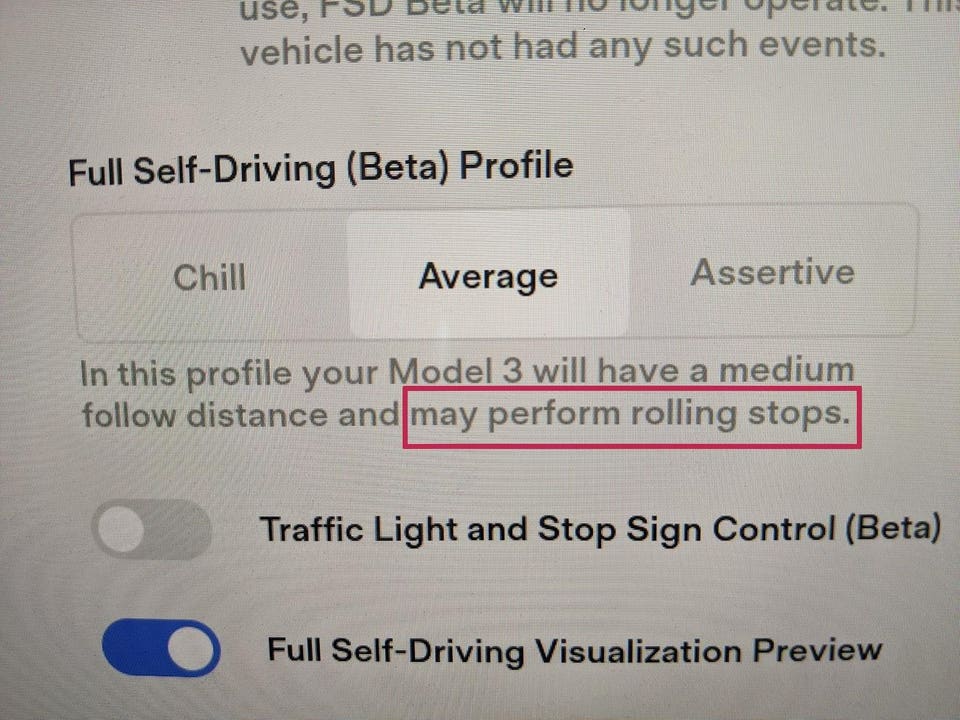
Under pressure from the National Highway Transportation Safety Agency (NHTSA), Tesla will issue a “recall” (do a software update) to remove an option to let their ill-named “Full Self Driving” prototype make rolling stops under certain conditions. (In particular at all-way stops on low-speed roads, when going at low speed and when there are no other cars or pedestrians near the intersection.) To some, this may seem a simple issue, but it’s actually a highly nuanced one which bodes badly for the future of robocars and how they are regulated.
The complexity of this issue revolves around these key issues:
- While we have a complex vehicle code, there is a large body of “unwritten rules” and exceptions for human drivers. Can we have a world where the robocars all stick perfectly to the speed limits and other rules, when people don’t?
- It doesn’t even make sense to have the same vehicle code for robocars as for people. Their safety issues and the reasons behind the rules are very different.
- Are rolling stops actually that dangerous?
- Should a feature change done by software updates be handled with a “recall,” which is a 20th century concept for faulty hardware?
- Tesla’s system is currently a driver assist system, not, in spite of the name, a self-driving system. Driver assist systems are historically not regulated because they can be set in violation of the law.
- Tesla’s FSD, while called a beta, is actually a prototype. To what level should NHTSA regulate prototypes, as opposed to state agencies?
- Tesla doesn’t technically sell the FSD so-called “beta.” Does that affect NHTSA’s autority?
- As a prototype, it’s still not very good. Does that affect these questions?
Unwritten rules
For better or worse, the rules of driving are not all written down. There is a long vehicle code (which is written by states, not NHTSA) but actual driving follows varied rules. Here in California, rolling stops are so common as to be called “California stops.” That’s particularly common when Tesla’s conditions of a 4-way stop on low speed roads at deserted intersections.
It’s not just rolling stops that are common in the unwritten rules. Much more importantly, vast majority of drivers exceed the speed limit by 10mph or more, and are almost never ticketed, especially under 10mph.
Speed limits are a particular problem. Many have remarked that if the robocars all stick to the speed limit, and other rules humans usually disregard, they would be a problem on the roads. Worse, the resulting slower rate of travel might discourage robocar use, even once those vehicles are much safer than human drivers. As such, adherence to strict rules for robocars and loose rules for people would actually end up having more people die. In some countries, they change the law to reflect what people actually do, at least on speed limits — but can this happen in the USA?
Rolling stops are a minor issue but the bigger question is huge.
Vehicle code for robocars & Danger of rolling stops
The entire vehicle code was written with humans in mind. Humans do unsafe things, and even when they only are unsafe some of the time, we often have to forbid them all the time. A rolling stop is one example — doing one at a truly empty intersection as Tesla claims they do is clearly not unsafe. In fact, it’s not even clear it’s that unsafe in general at many all-way stops. Many low-volume intersections have “yield” signs instead of stop signs. Stop signs are actually extremely rare in Amsterdam, the place that cares more about protecting vulnerable road users than anywhere. (And cyclists everywhere almost always roll through stop signs, even though they are much more vulnerable.) In a famous Dutch experiment, they removed all lane markings and signs from a town, and found that traffic got safer and faster just trusting people to be careful. Instead, they prefer “yield” to “stop” or to have roundabouts, where you barely slow down at all if the intersection is deserted. These places where rolling stops are legal and normal have better road safety records than the United States.
Consider most “no left turn” signs. Most of the time, a left turn is perfectly safe and won’t block traffic. Sometimes, though, it’s not. We can’t trust humans to tell the difference reliably, so we put up the sign. If a robocar is well made, we can trust it. It’s a very predictable robot. Most of the rules in the vehicle code meant for humans can be distilled to very simple principles for robocars: “Be Safe” and “don’t get in the way.”
You may want to read my article on a new vehicle code for robocars which explains this and many other principles in detail.
NHTSA doesn’t regulate the rules of the road, though. They control whether a vehicle people sell or import meets their safety standards. More on that below. (They will argue that they are not enforcing the vehicle code, but rather dealing with a car programmed to be unsafe.)
What’s a recall?
The recall system was made for 20th century cars with hardware flaws. Tesla has reinvented what it means to be a car company, and issues software updates frequently, sometimes several per month, the way a software company does. Some of these updates affect driving and safety, some just give you a whoopie cushion. But the old recall system is clearly wrong for this approach and should be rethought, not shoehorned into the new world.
Driver Assist
Tesla FSD dreams of being a self-driving system some day. (Elon Musk recently declared it would be safer than humans “this year” which he has done almost every year since 2016.) Right now, though, it operates as driver assist, requiring an attentive driver to take control at any time when it makes a mistake, and it frequently makes mistakes.
Monitored driver assist has never been regulated by NHTSA for compliance with vehicle codes. You can set the speed on your cruise control to almost any speed, even in cars which are fully aware of the speed limit, or that no road has a speed limit of 90. (Tesla in fact lets you set the speed to things like “Current speed limit plus 9” which matches how most humans drive.
In such systems, the driver is responsible for following the law and being safe, and always has been. If a human driver sets the cruise control to 90, that’s been the driver’s decision and the driver gets a ticket. In the Tesla, the driver can set whether it makes rolling stops, though doing so is the default “Average” configuration. They can get a ticket for such a stop — which mostly only happens when there are bored police or police who want an excuse to pull you over because your skin is the wrong color — but it is the driver that gets the ticket, not the car.
NHTSA is entering new regulatory ground here. In the USA, no road has a speed limit higher than 85mph. Almost all cars can drive faster than that and it is more dangerous than rolling stops. Does NHTSA have the power to force a recall of any car that can go faster than 85mph to put a speed governor on it. (Most cars today do include a speed governor option due to European rules which require it be there, but don’t require it be used.)
All cars today can make rolling stops, after all, and NHTSA allows them to be sold. It depends on whether you press the brake enough. With the Tesla, it depends on that, and also what setting you have chosen for their software.
Prototype that’s not for sale
Tesla calls FSD a “beta.” That’s a stretch of that word. The system has undergone what Tesla has called “rewrites” and will again, which means it’s not yet a beta by the normal definition, but rather a prototype — an experimental system being tested to learn things.
Normally prototypes would not be regulated. NHTSA has authority to regulate cars that are for sale or import in the USA. It doesn’t regulate experimental cars or cars that people build in their own garages. The auto industry was created by “garage tinkerers” with names like Olds and Benz and their status is protected from regulation.
As a software upgrade, Tesla FSD is an odd bird. It is not for sale. Tesla does sell the promise that you will get it someday when it works, and charges a high price ($10,000 going up to $12,000) for it. You get a few mostly useless features when you pay this, but the official reason people buy it is the hope of getting the “real thing” when it comes out, with the probably foolish hope that they will pay less for it than the price on that day.
Just paying that money doesn’t get you this prototype, though there is no question that people pay the money hoping they will get it, and paying is a prerequisite. You have to be selected. In Tesla’s case, they at first selected a very small group, but now there are 54,000 people (including myself) who passed a (dubious) driving safety test. Tesla doesn’t say, but probably at least 300,000 people have paid the FSD fee, so less than 20% of them have qualified for the prototype.
Tesla would be wise to also let some people who didn’t pay the fee get the prototype download, though it would anger those who thought they were paying the fee to get it. They should also make the install more manual — perhaps have you download it onto a USB stick and manually install it. That would clear up the air about whether this prototype is a product you buy — though of course the car remains a product you buy. Does the power to regulate hardware designs expand to regulate software downloads?
The open-source ADAS pilot company “comma,” which sells a system which competes with Tesla Autopilot, explicitly sells the hardware and makes the software free and for customer download. They ran into trouble with NHTSA early on but have not since by following this approach.
Tesla claims that the prototype testing has caused no accidents. That’s probably not strictly true, as there are credible reports of minor ones. Tesla has a history of stretching the meaning of “accident” to refer only to ones that trigger the airbag, and may be doing so here. Indeed, if nobody is getting hurt with this testing, even if it seems dangerous, it is not a public interest to forbid it. It’s not our business if people just whack curbs with their expensive cars.
Bad Prototype, Bad Actor
It’s all further complicated by the reality that Tesla FSD is not a very good prototype. So while I stated that a well functioning robocar can be trusted to do a rolling stop in a deserted intersection, one might argue that Tesla’s system is not yet well functioning. But NHTSA does not seem to be arguing that this is the basis for their authority, nor is it clear they are ready to be the arbiters of what is well functioning, at least not yet. They just say that rolling stops increase the risk of a crash.
Tesla’s description says it only does rolling stops under very specific conditions when it is judged safe, and that’s not unreasonable, if it’s a good judge. The rolling stop may be against the vehicle code, but that’s not NHTSA’s business — that’s up to the police to write tickets.
It may have more to do with the fact that Tesla is definitely the most daring of all companies in this space at pushing the edges. It is the “bad boy” and has not made friends with the regulators. They will be nicer to their friends.
Protecting the safety of the public
NHTSA’s job is to promote safety on the roads. And they actually are fully aware that eventually, the promise is that robocar technology is going to do more to protect safety than anything ever has. This creates a dilemma. Every day you delay the arrival of robocars is probably a day you delay their high volume deployment. When they reach that high deployment, they will be saving probably 50 lives/day in the USA, far more worldwide. This creates an uncomfortable math: every day you delay this technology, you will cause 50 more people to die at the hands of reckless human drivers in the future. Yes, it’s that stark. Delay it a year and you are allowing perhaps 20,000 more Americans to die, and many more to be injured.
That means you want to take an extremely light touch on regulation if it might slow testing and deployment. You won’t go overboard, but you should keep those future people in mind. Vast increases of regulatory powers must be viewed with great skepticism. NHTSA has not regulated things like whether cars can break traffic rules or not before.
Originally published at Forbes.com in Feds Make Tesla Remove ‘Rolling Stops.’ It’s A Terrible Decision. Copyright © 2022 by Brad Templeton.


Comments
Anonymous
Tue, 2022-02-01 20:46
Permalink
can you articulate what safe is?
can you articulate what safe is?
brad
Wed, 2022-02-02 01:25
Permalink
What is safe?
Well, you will get 100 answers from 90 people, but broadly I view it as an attempt to enumerate the level of risk, which is in turn the probability of various adverse events over a large amount of driving. You want to keep that level of risk down below a certain level. Most people talk about making it superior to the level for humans.
Anonymous
Wed, 2022-02-02 10:45
Permalink
measurement and threshold but also a process.
Rand Corp defines 'safety' is not just a measurement and a threshold but also a process. Perhaps Tesla was premature in assesing the capabilities of FSD as sufficient to impliment action based on a threshold. Perhaps, according to the charter of NHTSA, the recall was within the scope of the charter?
brad
Wed, 2022-02-02 11:31
Permalink
Rand definition
As I said, many definitions. But I would say safety is a goal, and one should not confuse the means to a goal from the goal. A safety mindset is a means.
This is also a philosophical question (which our most hated problem, the Trolley problem, actually was created to illustrate.)
Some would look at levels of risk. Others would say that no level of fatal risk is acceptable. Humans tend to be all over the map, and even hold multiple viewpoints at the same time.
Your definition of safety will affect how you measure safety, and measuring safety is probably necessary to attain safety, or at least to know you have.
I don't think they should be involved for another reason. Rolling stops in deserted intersections are safe. In fact, if you look at the Netherlands and other places like it, rolling stops are not unsafe even in non-deserted intersections. In fact much of the world prefers roundabouts where you don't even slow down if the intersection is deserted.
Anonymous
Wed, 2022-02-02 20:24
Permalink
Regulations as a floor for safety
Regulations generally only "provide a floor for the protection of safety".
Rolling Stops began Oct 20 2020. 15 months later Tesla agrees to cease continuance with the current implimentation.
"Processes (other than compliance with regulation) are less likely to be discussed with the general public by government and safety advocates. This is because process information likely comes unilaterally from an AV company — unlike measures.
So although government and advocates might discuss processes with companies, these two groups are unlikely to make statements about process to the general public beyond making public what an AV company has said."
Rand Corp
Ano Nymous
Wed, 2022-02-02 09:05
Permalink
Bureaucratic Existence
You are missing the real issue with NHTSA, purpose. If most of the vehicles on the road are self driving and "near perfect" then the gov agency has a much smaller use in the future and then will get defunded and then people get let go.
Much like how the President asks the DEA if they should legalize cannabis, aka we should remove 50% of your purpose to exist and hand it over to ATF (ATCannabisF), surprising how the DEA always says no. When they should be asking the FDA if it is any worse than alcohol, tobacco, caffeine, sugar.
First rule in gov bureaucracy is to expand your bureaucracy and get more funding. In NHTSA eyes, if it can drive on a "highway" they can get involved.
Anonymous
Wed, 2022-02-02 09:28
Permalink
press reviews public Cruise launch in SF to Tesla FSD
Cruise opened to public yesterday in SF so expect comparisons of Cruise automation technology experience to Tesla FSD.
Yeah-Me-Neither
Wed, 2022-02-02 13:43
Permalink
Rolling Stops
I'll disagree w/r/t rolling stops. The words rolling and stop are antithetical. You can't both be rolling and stopped at the same time. With extremely rare exception, I always come to a complete stop. The only time I don't is in those rare instances in which I think, "You know, that person behind you is an idiot who does not know what stop means."
brad
Wed, 2022-02-02 15:23
Permalink
You may disagree
But in many countries, they almost never use stop signs, and instead have either yield signs (ie. roll through but stop if somebody else has RoW) or roundabouts (go through nearly full speed if clear.)
Their safety records are superior to the USA
So it is stop signs that are bad and rolling stops that are good according to some data.
Anonymous
Wed, 2022-02-02 22:18
Permalink
compiled data from 5 months of reporting
Federal Register / Vol. 86, No. 247 / Wednesday, December 29, 2021 / Notices - 15 pages
Information Collection Request (ICR)
For 2021 (5 months of reporting)
Now based on compiled data: The agency has received incident reports for the past five months.
For both ADS Level 4 and ADAS Level 2 reporting, divided into:
Incident Reporting for Automated Driving Systems (ADS) and
Level 2 Advanced Driver Assistance
Systems (ADAS)
AGENCY: NHTSA
The list of test participants (20) included with the General Order includes several ‘‘vehicle suppliers,’’ companies that supply various components that are then integrated into completed vehicles, ADS, or Level 2 ADAS, by other vehicle or equipment manufacturers.
2022 estimates for total year:
Affected Public: Vehicle and equipment manufacturers and operators
of ADS or Level 2 ADAS equipped vehicles.
Estimated Number of Respondents: 110.
Frequency: Monthly and on occasion.
Estimates: 1150 (1 and 5 day reports)
ADS and Level 2 ADAS are new technologies that fundamentally alter
the task of driving a motor vehicle. Crashes involving vehicles equipped
with these technologies have resulted in multiple fatalities and serious injuries, and NHTSA anticipates that the number of these crashes will continue to grow in the near future given the increased number of these vehicles on the road and the increased number of vehicle and equipment manufacturers in the market. The General Order provides the agency with critical and timely crash data, which assists the agency in identifying potential safety issues resulting from the operation of advanced technologies on public roads. Access to this crash data may show whether there are common patterns in vehicle crashes or systematic problems with specific vehicles or systems, any of which may reflect a potential safety defect.
Anonymous
Wed, 2022-02-02 22:49
Permalink
OMB Control Number: 2127–0754
OMB Control Number: 2127–0754
Anonymous
Wed, 2022-02-02 23:04
Permalink
NHTSA estimates that there
NHTSA estimates that there will be 90
ADS manufacturers and operators and
20 manufacturers of Level 2 ADAS
vehicles each year (including
manufacturers that produce both Level
2 ADAS vehicles and ADS vehicles).
ADS, as defined by SAE International and as used in this document, refers to driving automation Levels 3-5. SAE International J3016_201806 Taxonomy and Definitions for Terms Related to Driving Automation Systems for On Road Motor Vehicles. Previous notices issued by NHTSA focused on driving automation Levels 4 and 5, due to the unique vehicle designs expected for vehicles intended to operate without necessary human intervention, and thus, potentially designed without traditional manual controls.
Anonymous
Thu, 2022-02-03 14:13
Permalink
number of ADS vehicles on roads in 2022
How many ADS vehicles on roads in 2022?
NHTSA list contains ~120 companies with test vehicles/robotaxis required to report.
Mercedes Drive Pilot autos likely on roads in US in 2022 as well.
Anonymous
Fri, 2022-02-04 17:42
Permalink
1000 total incidents for ADAS in 2022?
1000 total incidents for ADAS in 2022 according to this document?
cannot make math work after browsing total VIOs for last 10 yrs with L1 L2 adoption (examples Roland Berger)
definitions below from NHTSA
"Advanced Driver Assistance System” means a Level 1 or Level 2 system.
A Level 1 system is a driver support feature on the vehicle that can assist the human driver with either steering or braking/accelerating, but not both simultaneously. The human driver must remain fully and continuously engaged in the driving task.
Level 2 system is a driver support feature on the vehicle that can control both steering and braking/accelerating simultaneously under some circumstances. The human driver must remain fully and continuously engaged in the driving task.
Anonymous
Fri, 2022-02-04 20:48
Permalink
required reporting only if notified
required reporting only if notified, which is the ambiguity: what is definition of notified.
Anonymous
Thu, 2022-02-03 00:54
Permalink
estimate 1150 ? be the year ?
estimate 1150 ?
be the year ?
for 110 mfgs ?
for l2 l3 l4 ?
here more for why ?
(1) An ADS or Level 2 ADAS equipped
vehicle for which it supplied
components that were incorporated into
the motor was involved in a crash; (2)
the ADS or Level 2 ADAS was engaged
during the period thirty seconds prior to
and through the end of the crash; and
(3) the crash involved a fatality, hospital
treated injury, air bag deployment,
vehicle tow-away, or vulnerable road
user.
Anonymous
Sun, 2022-02-06 09:46
Permalink
Would be helpful to update your editorial with a review
review of the research you had undertaken to disprove NHTSA did not have enforcement authority over the rolling stops programming in FSD
brad
Sun, 2022-02-06 13:04
Permalink
Who has authority
It's not a settled question. They have not traditionally had this authority and have not used it if they had it. It's a new thing. Their authority is over whether the car is safe to sell. They have never said, or wanted to say, "This car can go 100mph, that's in violation of the law and unsafe, so we will not allow it to be sold" or even "This car has a cruise control you can set at 100mph."
Certainly never, "This car will go through a stop sign if you don't press the brake." Tesla has made a system which will press the brake for you if it sees a stop sign. They are calling it out for not pressing the brake all the way, even though every other car made will just drive through the stop sign.
Anonymous
Mon, 2022-02-07 08:33
Permalink
rolling stop on black ice 5 mph slide 10x
rolling stop on black ice 5 mph slide 10x
Anonymous
Mon, 2022-02-07 10:42
Permalink
If a vehicle is "not safe to sell"
If a vehicle is "not safe to sell", is self-certification to blame?
Anonymous
Mon, 2022-02-07 12:14
Permalink
Self Certification
Several reports from the press of note.
A. NHTSA has been reported to have been "frowning upon rolling stops several months after the feature was rolled out". The original rollout began in October of 2020, quite some time, 15 months if correct.
B. The safety analyst Mr. P. Koopman noted on a website - "They are removing agency from the human driver in deciding when to break the law. People selecting a "rolling stop" mode had no idea what they were really signing up for (true behaviors were only disclosed in recall)-- but were going to bear the full burden of any liability for hitting a bicyclist or child at an intersection. That is really wrong. Deciding to break the law on behalf of a driver in an opaque way without involving driver approval every time it is done is inherently a problem".
"Only disclosed in recall" sounds unusual if not troubling though I cannot verify accuracy of statement.
Did Tesla pro-actively approach NHTSA with details of the feature for FSD ahead of time - "Tesla could have and should have worked this out with NHTSA in advance. Then lobbied for regulatory change if needed."
The self-certification component to this enforcement process may be as important as the legal ramifications that surround a stop sign.
brad
Mon, 2022-02-07 12:53
Permalink
Surprised customers
I will agree that many users of the prototype were not aware it could roll. But then, there are vastly more dangerous things it does than a rolling stop. I mean really vastly. I don't think you can say that people today were unaware of what they were signing up for, since they know, and agree, that it can do thousands of illegal and dangerous things. The rolling stop was just the only one that was deliberate.
A rolling stop is not going to cause you to hit somebody at an intersection. You can literally stop in 1.1 feet at the speed it goes to. If you are not paying attention, you could hit somebody if the car's perception totally fails, but that's true everywhere you drive this thing.
Anonymous
Sun, 2022-02-06 12:13
Permalink
best headline yet on rolling stops
"FSD Appears to Ask Drivers Whether It Should Break the Law"
Anonymous
Tue, 2022-02-08 23:19
Permalink
quote of day
elon musk 11:44 AM · Oct 24, 2021·Twitter
Please note, this is to be expected with beta software. It is impossible to test all hardware configs in all conditions with internal QA, hence public beta.
Anonymous
Tue, 2022-02-08 13:09
Permalink
combo
design based and performance based
Anonymous
Wed, 2022-02-09 14:30
Permalink
Quote: one camera 115 tickets per day.
So does Tesla pay the tickets that drivers get for rolling through stop signs?
That's a $100 ticket if you're in front of a camera in DC.
One camera has averaged roughly 115 tickets per day.
brad
Wed, 2022-02-09 17:14
Permalink
Why would they pay
That makes no sense.
Joshua Cagle
Sun, 2023-03-26 13:54
Permalink
Stop Means Stop
So a stop sign has the word stop on it. So the vehicle should stop. Our infrastructure is built this way and we have laws that state that we are required to stop. If it was a yield sign then it could roll it, but it may still have to stop depending on the situation. The software in those vehicles should direct the vehicle to stop for stop signs. If the vehicle you are in does not stop then you are in violation of the law. The vehicle is already driving you, why was it programmed to be too lazy to fully stop and then safely proceed? This article arguing a stupid premise.
Add new comment