



Two self-driving shuttle companies die in a week, but there's good news
Last week saw an announcement that Optimus Ride, an autonomous shuttle company in Boston was purchased in an acqui-hire by Magna, the Ontario based Tier One Automotive company. In an acqui-hire, the company has generally failed, but a buyer pays to pick up the assets and to hire the team, which took time to create. Usually it’s only enough to reward the preferred investors, the team gets options in their new employer.
Optimus Ride built a shuttle on top of the GEM 6-seater electric shuttle platform, adding sensors and their autonomy tools. It evolved out of MIT.
Also announced as shutting its doors was Local Motors, maker of the Olli shuttle. Local Motors began with a focus on 3D printing to make smaller volume vehicles. The started with the Rally Fighter, a vehicle that was crowd designed after contests. Over time, founder Jay Rogers believed that 3D printing could bring a vehicle to production faster and at lower cost than conventional methods than conventional methods, and entered the Shuttle market, partnering with various partners to make them autonomous. Recently, we reported how an Olli shuttle in Whitby, Ontario had a crash resulting in serious injuries. Early reports suggested it was in autonomous mode, but it was later revealed it was being manually driven at the time. That made it mostly a non-story, but the real story of Olli did not go so well, either.
There are many other players working in the shuttle market, including May Mobility, early pioneer Navya, EasyMile, 2getThere, Transdev, Auro/Ridecell and many other players in China. Last week I sat down with the founder of Perrone Robotics, who has been in the space since the Darpa grand challenges. They specialize in making a kit with sensors, software and compute that can be integrated into existing vehicle bodies in a short time to create shuttle services. Other companies customize their own vehicle, or provide software to companies trying to make a custom vehicle.
If you want to make a brand new passenger car, that’s a pretty tall order. The big car companies have had a century to perfect doing that at scale and efficiently. Tesla is the only new entrant to compete in that space in the west in decades. If you want to make a small shuttle, the barriers to entry are much smaller, and that’s why we see so many players. Most shuttles have a boxy form-factor, since they don’t go fast enough to worry about drag, and are meant to be group transportation, with 6 or more passengers.
Indeed, in calling them “shuttles,” this also defines their primary market — low volume and last-mile transit. That typically means fixed route and sometimes fixed schedule service. To overcome the hard problems, many shuttles have operated only on private campuses or very limited routes. Last mile shuttles will run from a train station for a mile or so to bring people to and from the train. This is different from robotaxis, which tend to be for door-to-door operation, though they may do shared rides like UberPool (or at least, would if there were no virus.) Some shuttles are a bit smarter, and will move passengers from stop to stop on a route without stopping at intermediate stops if there is no demand.
Are shuttles worth it?
The robotaxi vision is world-changing because it allows car replacement, which means a big change in how our cities work. Shuttles are much less ambitious. Mostly, they make transit a bit cheaper, which is far from world-changing. It’s a pretty meager thing for self-drive technology to be doing. Many developers already feel that and view shuttles as a stepping stone. They are a more tractable problem, and they have an eager customer among the campuses and transit agencies that want to look more future-facing.
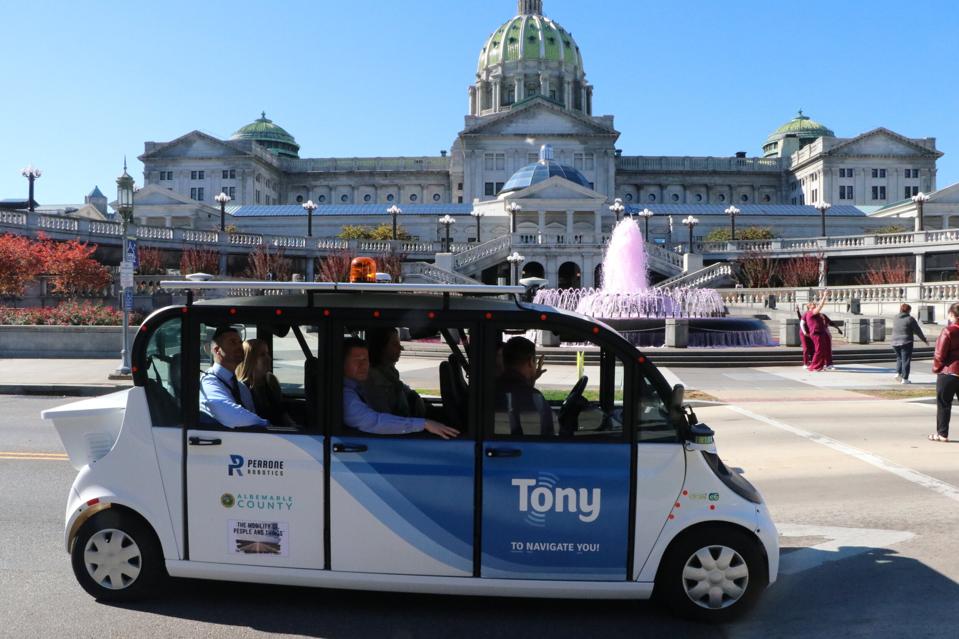
Right now, unfortunately, they are not cheaper. Everybody operates them with a safety driver on board, though sometimes they will claim this person is now more useful, because instead of focusing on driving, they can focus on customer service, particularly for the disabled. They suggest the on-board staffer may remain even after they don’t need to do any driving supervision. Indeed, another issue is personal safety — the driver on today’s buses and shuttles also doubles as a sort of security, making passengers feel more safe because somebody official is there.
Having an attendant serve other needs is useful, but doesn’t make things economical. It turns out drivers are a much larger part of the cost of running a transit vehicle than you might think. That happens in part because often the different parts of a transit system come out of different budgets. Federal money often pays for infrastructure. State or federal money may pay for vehicles, or they will come out of capital budget for the city. Drivers and fuel are pretty much always paid for by the local agency and are thus much of the cost.
It gets better
The result is that self-driving buses and shuttles could cut the cost of public transit, though possibly at a cost in jobs. That’s a good start, though autonomous vehicles are more likely to completely upend public transit and change how it works rather than just remove drivers from 20th century transit styles.
It’s more interesting when the lack of need for a driver means a service can operate 24/7, when today it has to shut down at night due to driver costs. Electric vehicles are much cheaper to operate, making the driver an even bigger part of the cost, and so some agencies could afford to run the vehicle but not to pay somebody to drive it.
This can also mean serving more service areas. But the even bigger win comes when frequency is increased with smaller vehicles. Today, transit vehicles usually are pretty large — in fact for most routes there is a full sized bus, and shuttle routes are money losers to handle specific needs. They have to be large because there are just not enough drivers to do the right thing, which is to run smaller vehicles, more often.
To the surprise of many, smaller vehicles can be more efficient than larger ones. Ask anybody who uses a bus route if they would prefer one large bus every hour, or 6 small vans every 10 minutes? It’s a no-brainer, but no agency has the drivers to do the 6 vans. And 6 vans would cost more energy than one bus, but service every 10 minutes will attract a lot more riders — it’s just vastly more usable. The efficiency of transit is mostly about the “load factor” — how full you can make the vehicles. The hourly bus gets poor ridership by day, and is an embarrassment at night, which is why the average transit bus in the USA holds only 9 passengers. With small vans, not only do you get more passengers, but you can also reduce the service to make the vans more full and to crush the bigger bus on efficiency. There might be service every 10 minutes at peak, every 15 minutes mid-day, and every 20 minutes at night — still much better than an hourly bus, but also more efficient.
All of this happens when you get to take out the driver and shrink the vehicle.
It gets even better
The improvements above describe traditional transit — fixed routes, and mostly fixed schedules. Beyond this, small vehicle transit with robotic driving offers the potential to go far beyond 20th century transit. The pandemic sliced ridership and has made transit agencies experiment with new ideas, including on-demand services and more. I’ve written before on The Future of Transit, a world where the transit system, rather than defining routes and schedules simply notices when groups of people wish to travel along roughly the same route and puts them in group vehicles for their common path, and uses 1-2 person vehicles to get to and from the common path when there isn’t anybody to share with. Such techniques have the ability to offer riders not just door to door service on their own schedules (which they normally pay through the nose to get from cars) with the ability to provide tremendous capacity on our existing road network.
Even before that, robotic vehicles and smart mobility offer an essential ingredient for better shared transportation, namely the frictionless, no-time mode switch. For people to share vehicles (which is what transit is all about) many of them need to do transfers and mode switches. These are made easier when service is smaller and more frequent. When vehicles are super-small (like e-bikes, scooters and minicars) you can move to a world where vehicles wait for passengers rather than passengers waiting for vehicles, eliminating the greatest pain of mode switches and transfers.
The upshot: Small automated vehicles are a poor market today, providing only basic benefits to their users and not yet saving money, but they hold the potential to be the future of transportation in dense cities, where you need people to ride together to make good use of road capacity, but want to get away with pushing too many people together so that the system is inconvenient and unpleasant and inferior to the private car.
Originally published at Forbes.com in Two Self-Driving Shuttle Companies Fail In One Week. What Does It Bode?. Copyright © 2022 by Brad Templeton.


Comments
Russell de Silva
Wed, 2022-01-19 16:11
Permalink
Feeder vehicle as a stepping stone to the robotaxi
While restricted zone shuttles may seem like an easier entry point for companies without Google's resources, something halfway between geo-fenced shuttles and robotaxis might be a way for the bigger players to get actual customers before a full robotaxi service is feasible.
What I mean is that a first mile feeder to larger vehicles would mostly be operating in the suburbs, where traffic density is lower, and intersections simpler.
Two obvious questions would need to be answered to know if this was feasible.
Firstly, does the reduced complexity of suburban streets actually translate into an easier task for self driving engineers to develop?
Secondly does a first mile pickup solve enough of the problem to be useful?
At commuting time the journey is generally between a less dense and a more dense location, so the last mile is more likely to be an actual mile at the suburban end than the city end. This means the suburban last mile may be both easier and more useful to solve.
brad
Wed, 2022-01-19 19:24
Permalink
Limit your driving area
Yes, if you limit your area, it's easier. Of course, some areas are harder.
The key is that if you want to shuttle people from their homes to a transfer point near a major road, that's a sucky job for human drivers. Uber and Taxis all have minimum fares which make rides of 3/4 mile unaffordable. The reason is drivers don't want to do this. Due to rush hour patterns the rides are often one way, or there are waits or empty runs between customers. This uses up a lot of human time and is expensive.
Robots cost some money to do empty miles, but much less. And they don't "mind" them, being robots. They will happily sit until a customer needs them, or position themselves in advance of need, and sit there waiting for you, with little extra cost.
Even if the main 15 person van that travels the arterial road is human driven, that can still work out because that's a more regular job, though wasteful if you need to do empty return legs. You don't usually have zero reverse commute, but it can be wasteful as you fill the van in the commute direction, and only half-fill it in the reverse direction -- but every commuter transit system has that issue.
Owen Byrne
Sat, 2022-01-22 10:47
Permalink
Typo
‘Ready why’
Doron Elinav
Sun, 2022-02-06 22:33
Permalink
Load factor
A load factor of 9 is an amazingly low number. What is the source for this?
brad
Sun, 2022-02-06 23:17
Permalink
Load of 9
Have not checked the recent numbers -- probably worse with Covid -- but the Dept. of Energy's Transportation data fact book has numbers ever year on efficiency per passenger mile (calculated in part using load factors) for all the modes. About 5 years ago they switched how they did electric transport compared to fossil, so you can no longer directly compare them.
Why is 9 "amazingly" low? Seems right to me. You may suffer from a common sampling bias. More people see a full bus than see an empty one, so one's average impression is that buses have more people than that, because few people see the empty buses, other than the driver and the statisticians.
Of course this varies from city to city as well. 9 is the national average. 23 for light rail cars -- after a major increase in the mid-2010s, but they weigh so much (the light refers to capacity not weight) that they are horribly energy inefficient, as bad as putting everybody in their own Hummer on the worst systems. It's an ecological catastrophe some of the light rail that gets put in. Some of it is a bit better, but none of it can beat an electric car.
A bus is about 20,000lbs and a light rail car can be about 70,000lbs, so the bus with 10 is moving 2,000lbs of bus per person, while the light rail with 23 is moving 3,000lbs of rail car per person.
At the DOT site they show the bus load factor as 10 in 2015, so slightly different calculation than DoE. But getting worse. Can't get how you think the reality is "amazingly" low. I mean, what was your estimate of it before you read the stats?
Anonymous
Wed, 2022-02-09 09:03
Permalink
Willer Mobi in Pacific Rim
MaaS services outside of US are maturing at a faster rate.
Anonymous
Sun, 2022-02-20 10:48
Permalink
PuDo (Pickup/Drop-Off)
The lack of substantive discussion about the hazards of PuDo (Pickup/Drop-Off) without dedicated zones on city streets still prevails. Is there an inflection point where one of the unspoken deal-breakers of adoption surfaces as a reality check?
PuDo is a deal-breaker no one wants to admit. Can Shuttles and Robotaxis even share the same PuDo?
brad
Sun, 2022-02-20 11:18
Permalink
Public and private
I have other articles on this but it is a big issue. You have private PuDo which will run by whatever rules the owner wants, though city rules may demand that buildings of a certain size meet certain standards. The good news is that their parking lots, which will get fewer cars, provide available space for this.
Public PuDo will be subject to city policies. Ideally it will be shared as that is most efficient. If I know urban planners, they will try to get exclusive space for their buses and maybe larger shuttles. The best solution would be to share them in the cloud, where the city takes the spaces it manages and hands out reservations to use them, and it can give priority to vehicles with more people.
However, you want to exploit the large supply of small PuDo, namely unused parking spaces, spaces in front of low-use private driveways, spaces in front of hydrants etc. Buses can't use these but there are a lot of them.
Anonymous
Sun, 2022-02-20 12:22
Permalink
Not to mention, programming humans, or robots
Not to mention, programming humans or robots to a driving environment of a dense obstacle course of vehicles darting in, out, or around spaces represents just a minute portion of the ensuing conundrum.
Add new comment