



California Disengagement Reports tell us a little more
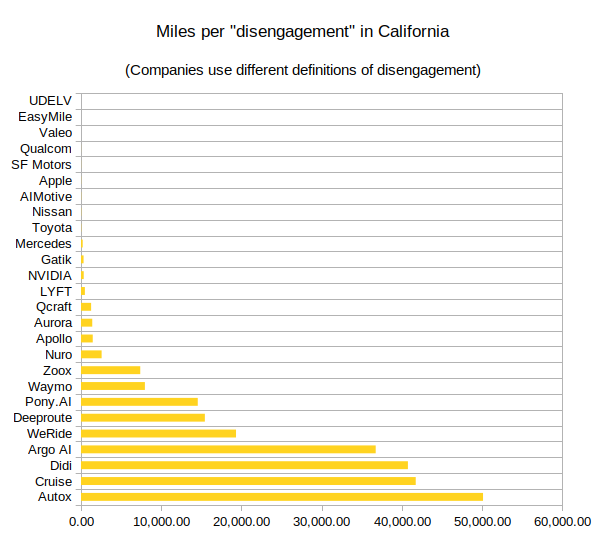
Each year, the state of California requires all parties testing self-driving car systems in California report all the times their system needed to disengage, either for safety reasons as decided by a human safety driver, or because the software detected a problem and demanded the safety driver take over.
From this, one can calculate how many miles each team is driving between disengagements. Each year, this result has not been that useful because there are too many variations in what a team needs to classify as a disengagement. Safety drivers are told to disengage if they have any concern that there might be a safety risk, and often they do so when it turns out there wasn’t really a problem. More sophisticated teams will actually rebuild the situation in a simulator to find out what would probably have happened if there had been no intervention.
Many of the other disengagements happen when the software detects a flaw and decides to insist the safety driver take over. Good software is full of internal self-tests that make sure nothing unusual is going on, and it spits out warnings and alerts of various levels — it is common for this to be happening on a constant basis. Most of these warnings are not serious, but a team can decide which are serious enough to have the software give up. In addition, testing may show that many of these software disengagements may not have been necessary, but they must be reported under the law.
On the chart above, those who are going more than about 2,000 miles per disengagement are probably trying to isolate only the true safety disengagements. Those under may not be — but we don’t get details from the individual companies on what they do. As such it’s hard to say that one company is better than another from this, though the companies with low numbers can be classed as not yet mature projects.
Waymo
One very large change is a big drop for Waymo. They report that this is due to moving to the new Jaguar based platform, though it may also relate to them shifting from operations in Silicon Valley to San Francisco, which is a much more complex environment. Due to the shift of platform, we can’t measure how much more difficult SF is than Silicon Valley, as might be interesting.
Waymo did report 23 collisions in San Francisco, all minor though there were a few minor driver injuries (though drivers went immediately back to work.) While Waymo got no citations under the law for being at fault, it declined to answer whether it was at fault in any of them. In Arizona, Waymo published an extensive report stating they were not at fault in any of the real and simulated collisions involving its vehicles over more than 6 million miles of driving. 23 collisions in 2.7 million miles matches some estimates (including from Waymo) of the rate for minor accidents by human drivers.
Cruise
Good news for Cruise, rising from 30,000 to 40,000. We can presume their methodology remained the same, but may not be the same as Waymo’s. In fact, we can also presume that they are even more confident of their vehicle’s ability to handle the service area of their new nighttime robotaxi service with no safety driver, which will shortly open to the public. It is unlikely they would open that to the public if they were having a true safety incident (ie. likely crash) every 40,000 miles.
Cruise was also one of the few to include miles with no safety driver. It reported no disengagements in these 6,400 miles, and that’s good. Without a safety driver, the only types of disengagements would be a remote stop order from a remote operations center, or a software failure notice. These would typically cause the vehicle to come to a quick stop, and the remote ops center might give it advice on what to do. You don’t want this to happen much at all.
Only 4 companies reported miles in vehicles with no safety driver — Cruise, Apollo, Nuro and Pony.AI. Pony had a disengagement (and minor single-car accident) and had their permit pulled. The truth is, there is no reason to run with no safety driver before you are getting close to going into production. It helps you get ready for production and learn how to deal with passengers. It doesn’t teach you how to be safer. Waymo has a permit but doesn’t yet use it. They do a lot of no-driver operations in Arizona.
Others
AutoX shows a giant jump from 20K to 50K. We don’t know if they are using the same methodology. They are doing far fewer miles and not in downtown San Francisco. Several others show large jumps.
Comparing to humans
Rough numbers suggest human drivers (spread over the whole USA) have a minor ding every 100,000 miles, an insurance claim every 250,000 miles and a police-reported accident every 500,000 miles. If these numbers were numbers for interventions that prevented an accident, they would not be quite at the human level. But they are getting close, which is a good sign. In fact, the real number will be better than what we see, as they are definitely required to report accidents or interventions that prevented an accident no matter what.
I go further, and state that being this close to humans means several of these teams are ready to deploy. While some want to see the systems match or do better than humans, that delays deployment, and that delays saturation. By the time saturation happens, many years from now, the vehicles will be much better than humans and there will be lots of them, greatly reducing risk on the roads. Just as we let risky teen drivers out on the road to learn so they can turn into safer adults, we should do the same for robots, except the payoff is absolutely immense in comparison. A tiny bit of extra risk now for a million times less risk in the future should not be a hard decision.
How to make these numbers better
When the California testing law was written, nobody knew a lot, but they wanted some duty for teams to report numbers on their safety. The safety driver system is working very well — it is extremely rare to have any accidents in California — the cars are making mistakes, as is expected for prototypes, and the safety drivers are preventing this from causing a risk to the public.
It’s a tough challenge to figure out a metric that companies would not either try to fudge, or worse, take risks because it improves their score. You want companies to tell the safety drivers, “disengage if anything seems at all scary” and you don’t want to penalize them for being cautious.
If I had to classify disengagements, I might use a taxonomy like this:
- Vehicle has done a dangerous thing, simulation shows it leads to contact event (classed by severity of contact.)
- Vehicle has done a dangerous thing, sim shows it leads to violation of rules of the road, no contact
- Software fault disengagements, sim shows one of the above
- Vehicle too cautious, actually blocking traffic
- Vehicle too cautious, but did not block traffic
- Vehicle unable to perform function so doesn't do it
- Safety driver was concerned but sim showed concern was misplaced
- Safety driver taking a break or beginning new mission
Even so, it would be hard — without audits — to make sure everybody measured the same. And the reality is that while we are of course curious, the government’s interest is protecting the safety of the public, not peering into the internals of the teams. As long as nobody is getting hurt, the government’s interest is met.
Tesla
Everybody notes the absence of Tesla. Tesla claims they don’t test self-driving vehicles in California. Of course, they promote a product they call “Full Self Driving Beta” and I have it on my Tesla. But in the fine print, and to the government, they call it a driver assist system. That’s true, to a point.
Tesla FSD Beta (really prototype) does indeed need full time supervision. But so do almost all the other teams, which is why they have their safety drivers. The law exempted driver assist systems from the report requirements and permit requirements, but it was not intended to be a loophole anybody could drive any vehicle through. In fact, the DMV forced Uber to relent when it tried to use the same loophole. The difference is not whether you have supervision, but what you are trying to build, the DMV said. There are rumblings they may apply the same to Tesla, though the likely result is simply that the prototype testing by customers would be shut off in California.
Based on evaluation of many videos of Tesla FSD in operation, as well as my own use, a rough estimate would suggest their miles per intervention number would be among the poorer ones on the chart, but at present there is no way to tell which interventions customers are doing are needed and which are cautionary.
Originally published at Forbes.com in California Robocar ‘Disengagement’ Reports Tell Us A Little. Copyright © 2022 by Brad Templeton.


Comments
Richard Young
Fri, 2022-02-11 13:05
Permalink
Disengagements meaningless safety metric
The only meaningful safety metric is crashes. I analyzed all CA AV crashes in my new book. "Critical Analysis of Prototype Autonomous Vehicle Crash Rates: Six Scientific Studies from 2015–2018."
Order from: https://www.sae.org/publications/books/content/r-515/
brad
Fri, 2022-02-11 19:32
Permalink
It is a shame
That SAE puts stuff like that behind a paywall. Usually authors are allowed to send them out free. You can mail btm@templetons.com if you hope for commentary on a paper.
Crashes are the strongest safety metric. However, I think there are some others you can look at, and also track their relations to crashes. Those include violations of the law (like unsafe lane changes even if they don't result in crashes) and other similar things (aggressive merges, forcing others to brake, needing to brake hard for both good and bad actions by other cars.) You can also track getting too close to VRUs even if you don't hit them. Just drifting out of your lane without intending to is worth noting, in fact doing anything you didn't intend to is of concern to most teams. Finally you want to track traffic disruption, where you block traffic.
Ben Thurston
Sun, 2022-04-10 12:36
Permalink
Tesla
I agree that Tesla would be among the worst of all makes shown on your chart, if they were included in this report. But there's a good reason for this—unlike the other major players, including Cruise and Waymo, they are developing FSD to work on all streets and highways, and not just a geofenced city area that's precision mapped, and using Lidar. This is a far more difficult task, and their results show this; in most videos, there's a disengagement or intervention every few miles at best.
In the end, it may turn out that Tesla is unable to achieve an acceptable level of safety without geofencing, precision mapping and Lidar. But it's a worthy goal; and certainly a system that's slightly less safe but operates everywhere is much safer overall than a system that a bit more or even significantly more safe, but operates only in a limited area. And they're dedicating huge resources to this, and getting tens of millions of miles worth of data every month to use for training the software; so I wouldn't bet against them.
brad
Mon, 2022-04-11 19:20
Permalink
Darn right it's more difficult
That's why most people think it's crazy. Why limit your ability and quality so much, just to avoid the cost of mapping. You can see my articles on why that cost is not nearly so much as most people imagine, and why keeping the map fresh is not that big a deal either.
You call it "geofencing" (and many others do) but that's a bad name for it.
Why is it a worthy goal to make your vehicle less capable and less safe, so it can drive poorly everywhere, rather than driving acceptably well in useful markets? Sure, if you could make it drive at that level everywhere that would be nice, but that's a goal for a long way down the road, not for getting the first one out in production and being a real product.
Elon Musk calls LIDAR a crutch because he doesn't think you can make a car work at all without sufficiently good computer vision. That's a possible argument. But if maps are also a crutch, they are an odd one to refuse to use when you have a broken leg. Unlike LIDAR which could possibly be obsoleted by CV, as Elon argues, maps are always a benefit, no matter how good you are without them. They let you see over that hill and around that corner. They add human understanding. Humans use maps all the time and can't drive other than slowly without them. (They just don't think of them as maps, they think of them as markings on the road which tell you what you can't immediately see about the road.)
Add new comment