



Tesla teases a Robotaxi, are they crazy to give up off-lease plan?
At the Gigafactory opening and in yesterday’s earnings call, Elon Musk teased about Tesla working on a vehicle to be dedicated to robotaxi service. This isn’t the first time Tesla has talked about robotaxis, but it’s quite a diversion from past plans, and sits in contrast to the plans of other companies. Several companies have announced dedicated robotaxi plans, most notably Zoox and Cruise along with Waymo and MobilEye in partnership with Geely, but for Tesla, this actually gives up a really huge advantage found in their prior plan that few, if any companies could duplicate.
Musk Said
“There’s going to be a dedicated robotaxi that is going to look quite futuristic-looking.”
“We are also working on a new vehicle that I alluded to at the Giga Texas opening, which is a dedicated robotaxi. It is going to be highly optimized for autonomy – meaning it will not have steering wheel or pedals. There are a number of other innovations around it that I think are quite exciting, but it is fundamentally optimized to achieve the lowest fully considered cost per mile or km when counting everything.”
Previously, Tesla had made two statements about robotaxi offerings. Initially, they said that once they had achieved actual “full self driving” (not to be confused with their current offering of that name) they would create a “Tesla Network” taxi service that would make use of both Tesla owned vehicles and cars from customers willing to let their vehicles be hired out when not in use. It was suggested that if you were willing to hire out your car, it would make very big money for you — Elon Musk said one would be crazy to buy any other car, since a Tesla would make money rather than cost money.
The off-lease plan
They also described a plan that was one of their smartest. Tesla indicated that it would simply take existing Tesla cars that came off-lease, and quickly convert them to be in the robotaxi fleet. The conversion would be simple on something like the model 3 — just take out the pedals and wheel and insert a nice plate where the wheel was, plus a few other minor changes. Because of the minimalist design of Tesla cars, this change would be simple and the result fairly sleek. As Tesla believes that all their cars have the hardware to do self-driving already, the change would be minimal.
The giant advantage there is that a lease customer has used up around 40% of the depreciation of the vehicle, enjoying it while it was new. Nobody cares if their taxi is 3 years old, so it’s perfectly good for that market. That means they can operate a robotaxi fleet at only 60% of the vehicle cost compared to anybody trying to build a dedicated robotaxi who has to buy the vehicles new. The vehicle cost is still the largest component of cost (especially with electric vehicles) so it’s a big win.
The genius was that it’s very hard for anybody else to do this. You can’t just convert random used cars into robotaxis easily to pull this off. It’s only easy if you are the car OEM and designed the car for that conversion. In addition, if you find your fleet is too large, you can covert the units back to used cars and sell them. That means you can get bank financing to purchase your vehicles because banks are fully comfortable with the financing of traditional cars.
As such it seems crazy they would move away from this smart plan that gives them a leg up on everybody else.
Contrast that with the custom vehicles built by Zoox and Cruise and Geely. While they gain many advantages by being custom — Zoox’s whole raison d'être is those advantages — they must build new vehicles with all that costs. Car buyers care a lot about getting a new car, but taxi riders don’t care at all. That premium is thrown away. In addition, custom vehicles can’t be sold for another function. That makes it much harder to use debt financing to build the fleet, since if the business fails, the vehicles may just be scrapped. A big burden to new robotaxi companies is getting the capital to buy fleets of 10,000 robotaxis to do service in a new city. Companies like Alphabet, GM and Amazon have that capital, but not everybody does.
Of course, for Tesla, the big rub is that they don’t have full self driving yet, and in spite of constant predictions of “any day now” from Elon Musk, they may not have it soon, or ever, at least with the existing hardware. So they might not be able to pull off this plan as written. On the other hand, they retain the option of changing the sensors on an off-lease car, even (gasp) adding a LIDAR, if that turns out to be required. This is costly but still much cheaper than building a new car from scratch, though because they use a glass roof, they have not designed the vehicle to easily have sensors mounted there.
You can retrofit other cars, but short of a complete dashboard removal, they won’t have the sleek robotaxi look a Tesla would have. Tesla’s all-software-controls design is well suited to this.
Tesla Custom Robotaxi
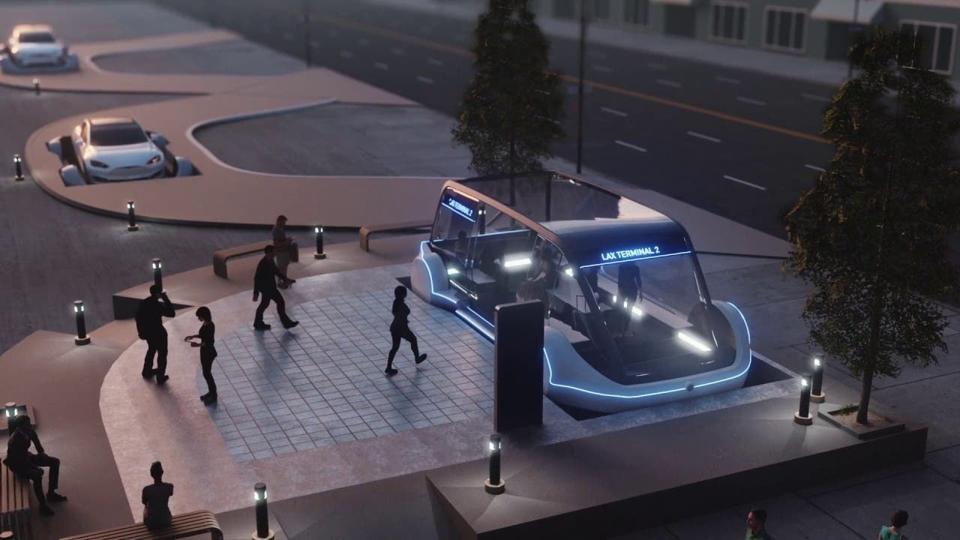
Now Elon Musk indicates they might give up all those advantages to build a custom robotaxi. They might do this for the same reason Zoox and Cruise want to — things like face-to-face seating, big sliding doors, easy access, 4-wheel steering, easier cleaning and more. It may be another “Robezium” design like the Cruise Origin and Zoox (a roughly symmetrical box with a roughly trapezium-style shape.) It may look like the vehicles teased by “The Boring Company.” It’s hard to see it being worth saving 40% of the cost.
It’s unlikely, but perhaps this is even an admission that they can’t actually turn old Teslas into robotaxis, out of fear that pure camera-based FSD might not happen. They don’t like to admit that possibility, though.
Custom robotaxis will be a thing in the future, to be sure. Once the world really adopts robotaxi travel, people will start to insist on a vehicle with no compromises to that vision. But that’s not what the world will insist upon on day one. On day one they will be happy to ride in a regular vehicle like a Tesla model 3 with no wheel. They will be a bit bothered that sedans are harder to get in and out of, and the fact that you can’t sit face to face with people. Eventually the robotaxis designed to do that better will win out. Eventually. In fact, while the low height is necessary for extreme aerodynamic efficiency, it’s not to hard to design it so that the front seats can be reversed in the conversion to get that face-to-face social taxi.
Low cost pod?
Elon musk brags low cost operation, less than the cost of a bus ticket. That’s doable, though my own forecasts for that have involved very low cost vehicles, and in particular vehicles for 1-2 people. It is possible that’s what is being spoken of, a 1-2 person “pod.” Such vehicles can be very cheap to make, even new — well under $10,000, and meant for urban lower-speed use. A $10K electric vehicle can be very cheap to operate. In my article on robotaxi economics I include a spreadsheet which suggests a small vehicle robotaxi service could cost under 30 cents/mile. That will go 8 miles for less than the price of a subsidized bus ticket, and around 20 miles for the price of an unsubsidized one. (Disclosure: I am an investor/advisor in Nimbus, a company building early manually driven vehicles of this type with a sales price target under $8,000.)
It’s a little harder, but not impossible, to compete with the bus in a 4-person city-only vehicle. Few companies sell low cost city-only vehicles, because customers only like to buy cars that can drive them everywhere — but they are great for urban dwellers and for taxi services.
While many people expect self-driving cars to cost more than traditional cars, this is in error. A large fraction of what’s in a car today is there only because it has a driver. That includes almost all of the dashboard, the motorized adjustable seats, the mirrors, the wheel, the pedals and even the fancy sound system. (Quality noise canceling headphones can provide a better mobile audio experience if you don’t have to drive.) Taking those things out saves more more than the cost of LIDARs, radars and compute. Tesla even believes it only needs cameras and compute, making for a big saving.
As usual, Tesla continues to surprise — their earnings certainly did — and it’s in a good position to do well in this space if it can build a working full self-driving system. Unfortunately, their current system is in a very sorry state compared to other companies, and awaits major breakthroughs. However, if they need to, and are willing to eat crow, their huge resources give them the option of acquiring a startup that managed to create a working stack to meet their needs, so they are a force to be feared. They have shown they are good at making cars, and are only going to get better. The robotaxi business requires both self-driving software and the physical vehicle. Doing both offers some advantages.
Originally published at Forbes.com in Tesla Teases A Custom Robotaxi, Are They Crazy?. Copyright © 2022 by Brad Templeton.


Comments
Anonymous
Sun, 2022-04-24 21:13
Permalink
Curious
Do all Tesla Shanghai profits stay in China?
Will Tesla ever be able to repatriate any profits earned in China to the United States?
How many Tesla automobiles made in China are sold in China versus exported abroad, and if Tesla has 4 factories currently producing Tesla automobiles, what percentage of total Teslas manufactured by the 4 Tesla factories does China production represent?
If parts and labor are the cheapest in China, and Tesla China exports automobiles abroad, what percentage of Tesla profits are from China?
Does the economics of Tesla China force Tesla USA to produce Tesla robotaxis in lieu of automobiles?
Or will tge PRC CCP encourage Tesla to source robotaxi design and production in Shanghai?
Anonymous
Tue, 2022-08-09 14:11
Permalink
Nationwide TV ad campaign started today
Today @RealDawnProject launches a nationwide TV ad campaign demanding NHTSA gov ban Full Self-Driving until Elon Musk proves it won’t mow down children
Anonymous
Thu, 2022-08-11 10:18
Permalink
Electrek website states RealDawnProject failed to
Electrek website states RealDawnProject failed to even activate FSD Beta properly during test.
brad
Thu, 2022-08-11 13:38
Permalink
Saw that
But also saw a capture with FSD on. Need to see the full video, where is it?
Anonymous
Thu, 2022-08-11 21:12
Permalink
hyperlink in pdf on project website
hyperlink in pdf on project website
Anonymous
Thu, 2022-08-11 21:15
Permalink
Inquiry made
driveteslacanada dot ca/news/raw-footage-shows-tesla-fsd-beta-was-active-during-the-dawn-projects-tests-video/
Anonymous
Thu, 2022-08-11 09:49
Permalink
Ralph Nader issues statement on Tesla FSD
Ralph Nader
Tesla’s major deployment of so-called Full Self-Driving (FSD) technology is one of the most dangerous and irresponsible actions by a car company in decades. See full statement.
Anonymous
Sun, 2022-08-21 00:58
Permalink
Tesla 10.13 beta new Deep Lane Guidance module
new Deep Lane Guidance module copies the competition like Intel/Mobileye
Anonymous
Sun, 2022-08-21 22:31
Permalink
highway city stack merge, new cameras, dms upgd
highway city stack merge, new cameras, dms upgd, .... new hw
2024
Anonymous
Sun, 2022-08-21 17:04
Permalink
Tesla cameras and 10.69
any new info? - your post on Reddit 6 mos ago
Everybody knows the Tesla has poor quality cameras. And that Elon Musk promised they would make FSD work with the existing cameras. So he is motivated by pride to make that happen, but there is another reason.
If at some point they conclude they need better cameras (or worse, LIDAR) they will need to retrofit the cars of everybody who paid for FSD. That will be expensive and they definitely prefer not to do it and to only do it once. (New customers can be charged a price that covers this extra cost.)
So the motive is to keep trying to make it work until the day it becomes clear a better camera is required. That will probably be the day that other people are making it work with better sensors and they have to stop trying to do it. Otherwise, why not keep trying?
Unfortunately the consequence is that they will try hard to make it work with poor cameras, which is not the path to maximum performance.
On the other hand, this does not justify not putting better cameras in new models being shipped, as that would not be that expensive. But those better cameras would be a "crutch" that would let the team tempted to make it work with just those.
I don't see it working with the existing cameras. Only the front ones have any way to clean them, and they often get dirty or rain covered or blinded. The blindspot cameras are blinded by the turn signals at night to a large degree. You can do so much better now. No other team would hesitate to be using the best cameras they can get. BT
Anonymous
Sun, 2022-08-21 19:08
Permalink
Tesla signed megadeal with Samsung for new camera
Samsung Electro-Mechanics Co., the electronic components unit of Samsung Group, has won a multi-billion-dollar deal to supply camera modules to Tesla Inc. for most of the US company’s electric vehicles.
The South Korean company beat other bidders, including crosstown rival LG Innotek Co. and Taiwan’s Primax Electronics Ltd., to clinch the deal estimated at between 4 trillion won and 5 trillion won ($3.2 billion-$4 billion), according to people familiar with the matter on Wednesday.
The agreement with the Electro-Mechanics arm of Samsung is believed to be worth in the region of $3.2 billion to $4 billion. It was first reported by the Korea Economic Daily – an outlet that has broken the news of previous partnerships between the pair – and will make Samsung the largest supplier of camera modules to Tesla.
The new deal is for Samsung’s version 4.0 camera modules, with 5 million pixels. These are claimed to show images that are five times clearer than Samsung’s previous 3.0 modules and would represent a significant step up in quality from those presently in use by Tesla.
With the deal, Samsung will supply 80 per cent of camera modules used by Tesla. LG Innotek will supply the other 20 per cent.
The contract will see Samsung supply camera modules for the Model 3, Model S, Model X, Model Y, Tesla Semi and the Cybertruck.