



Electrify America Chargers are rarely used, what's up with non-Tesla charging?
Electrify America reported they conducted 1.45 million charging sessions in 2021. They announce that with pride, but it’s worth noting that they had around 3,500 charging stalls at the end of 2021, and around 2,300 at the start, for an average of just under 3,000. So that works out to a rough average of around 1.25 charging sessions a day per stall, a shockingly low number. They began the year with just 0.5 sessions per day and grew to the larger number by the end of the year.
Of course, as an average, some stalls would see far more and some less, and they would see more on some days and less on others. As such many stalls would not see use on many days, while others might get a line at certain times.
EA charges 31 cents/kWh if you pay their $4/month membership fee, and 43 cents otherwise in most locations.
According to EA, they distributed 41 gigawatt-hours in 2021 in this 1.45 million sessions, for an average session of around 28 kWh — which amounts to 80 to 120 miles of range per session, much less than the capacity of most modern cars. In addition, even if they earned the full 43 cents for each kWh, this implies revenue of around 17 million dollars. At the USA average price of 13 cents/kWh this suggests roughly 12M of gross margin.
These small numbers are surprising because Electrify America is the largest of the non-Tesla charging network (though a fairly distant 2nd to Tesla.) It’s unlikely any of the others are doing much better. The number is certainly not enough to support the cost of a charging station, though today that cost is handled by government subsidies, and particularly in the case of EA, due to the large penalty VW had to pay over the dieselgate scandal, which is what got EA started. Based on data from subsidy applications in California and Texas, installation costs anywhere from $100,000 to $200,000 per stall, while Tesla manages a much lower price.
There are a variety of possible reasons for this low usage:
- A large fraction of EV buyers are homeowners. That’s because EVs are perceived as expensive (mostly false) and because owning an EV is a much nicer experience if you can install charging at home (very true.) Those who have charging at home only use fast charging stations when on intercity road trips, and thus they make up only a small fraction of charging.
- It appears that non-Tesla cars don’t do too many EV road trips. Casual observation of fast charging stations (both Tesla and non-Tesla) and non-urban locations shows that non-Tesla cars are much less frequently observed outside the cities. They were barely observed at all before EA. Tesla has worked very hard to establish their cars as the best (and sometimes) only cars which are easy to road trip in, and while this is changing, things are taking time to change with it. (In fact, now that many Tesla drivers have adapters, it turns out that at some stations, Teslas are now the most common car to visit! That was definitely true for some time with CHAdeMO stations, as that’s what Tesla’s first adapter supported.)
- Another reason may be that non-Tesla stations have earned a (deserved) reputation for low reliability. Without reliability, drivers are more afraid to take road trips where they might get stranded.
Reliability
The reliability question has triggered much discussion. On the web site Plugshare.com drivers rate the reliability of stations, and while most Tesla superchargers get 10/10, a disturbing number of other stations have poor ratings. Bad ratings derive from both hardware failures, and a surprising number of billing failures — the station is operational but has trouble authenticating or taking credit cards. Tesla’s proprietary network has no user interface because users simply plug in and walk away. Reports of failures due to billing are extremely rare.
Electrify America reports that they have 9 teams of inspectors who perform more than 20,000 charger tests per year. That’s good, but with 3,500 stalls that’s an average of once every 2 months. On the other hand, most stations have many self-diagnostics, and you would think that networks would quickly notice if a stall is having people interact with it but not selling any charges, or not interacting with it at all.
One would think that — but in fact reports of very long periods of downtime at stations (not necessarily EA) are frequent. Examination of stations under repair on Plugshare shows many stations that have been inoperable for months.
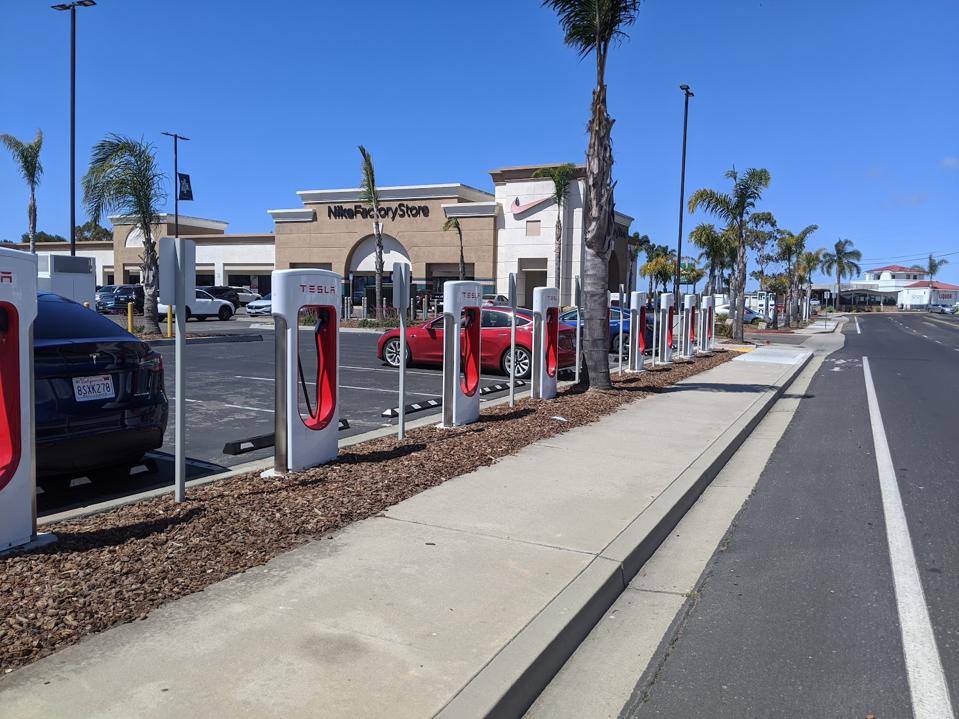
Tesla stations also fail, but their approach, which has many more stalls per station, is more robust against failure of single stalls. When you have 2-4 stalls in a station, failures can cause bigger problems. On the other hand, having more , smaller stations is beneficial to drivers who want and need to charge in more places.
This is not to say that there aren’t many fully operational stations. But some EV drivers feel concern over the fact they can’t be sure. While it’s not recommended, many EV drivers end up pulling into stations with very little charge left, and not enough juice to get to a different station. They can’t tolerate failure or doubt. (On the plus side, when there are more, smaller stations, it makes it much less likely you can still make it to another station.)
All network operators need to get rid of their reputation for low reliability. EA’s inspectors are just the start. Stations should get better at detecting any problems. If they can’t detect them each station should have a button in its UA for a driver to report a problem. Repairs should be dispatched more quickly. Sadly, one reason they aren’t is the low revenue numbers for the stations. Selling electricity to EVs is not yet a business, and it may have trouble ever becoming one. It’s not funded on revenue but on grants and penalties — or in the case of Tesla, because it sells cars, not electricity. This creates a risk that there is less motive to keep stations in good order. (Hard numbers on Tesla usage are not available, Tesla does not respond to press inquiries.)
Fail operational and free
Because billing and authentication failures are a problem, stations should be designed to fail operational, which is to say they still charge even if they couldn’t get billing to work. Doing so eliminates all fear of failure to authenticate, at the risk of giving away some free electricity — which is not really a significant risk at this stage in the game. If, some years from now, the lost electricity is a problem, this can be changed. Today it’s far more important to create a reputation for working.
This approach has other benefits. A machine should begin charging right away, so a driver can plug in and then work on swiping their credit card or using the app. This means they get charging faster, and sessions at the charger are shorter, which is a win for both charging network and driver. If they can’t get billing going within a few minutes, the charging could stop, meaning very minimal free electricity, but a better approach would be to have a remote helpdesk operator try to assist (and also try to detect theft.)
EA and others now support the “plug and charge” protocol, and more and more cars are starting to support it. This implements (in an overly complex way) the experience that Tesla began with, and the experience everybody wants. In time, just plugging in will be the norm, but it could start now. A few minutes of free electricity (if not more) has a side benefit — it can save somebody’s trip by letting them get enough to make it to a different station.
This approach is not as important at urban stations where another station is often close, but could be vital at more rural stations. If a person plugs in and does nothing with the UI or card reader for more than short time, the station can start beeping and alerting, or slowing power before stopping it to make it clear that payment efforts must begin.
Will some people find a way to hack this, and scam some electricity. Of course — though many stations have video cameras to record who does this. It’s a small price to pay for never failing due to authentication and billing issues again.
Originally published at Forbes.com in Electrify America Chargers Are Rarely Used - What’s Up With Non-Tesla Fast Charging?. Copyright © 2022 by Brad Templeton.


Comments
R Sharan
Fri, 2022-10-28 07:31
Permalink
Non Tesla chargers
I find many of these chargers have broken cables and thus non-functional. It seems they are purposely broken so non ev vehicles can park there.
EV driver
Fri, 2022-10-28 19:00
Permalink
My experience
I got a Hyundai ionic 5 last winter and drove it with my family on 4 road-trips this summer between 6 and 12 hours, going from New Jersey to the Midwest and New England . We used EA exclusively and only had one negative experience that involved waiting for a charger for an hour. In every other case, we drove in, got 150 miles or more of charge and left 15 minutes later. It was incredibly efficient, and free (because we have temporary free service with the car purchase). If we were paying at these commercial chargers, it would have been about 40% the price of gas in our other car. Charging at home or at work is even cheaper. Can’t imagine buying a gas car again.
Captain Jack
Sat, 2022-10-29 06:45
Permalink
Need for speed vs cost and battery life
While your piece focuses on the two major playa's and their pedestrian relationship to the EV charging business there's a another business model in town. Stores that install free chargers as a come on and another important benefit for the business. The charger kiosk affords the opportunity to bombard the shopper with ads seconds before they enter the store. For the most part they are the slower and recommended for longer battery lifespan L2 'slow chargers' as routinely fast charging is not recommended. However one business does have a DCFC a charger that's free for 30 minutes, 30% for my Niro, adding 80 to 100+ miles range.
At this point in the evolution of EV's they're overwhelming advantage is as a relatively short range commuter around town car and not as a turnkey alternative to ICE cars for the majority of people who've been ingrained to expect 'set it and forget it' convenience. Currently it takes careful planning even for Teslas and especially in cold weather.
Meg
Sat, 2022-10-29 10:11
Permalink
Double the cost
It's .22 kwh at home and .43kwh.. not much of a mystery
brad
Sat, 2022-10-29 13:25
Permalink
Cheaper at home
Yes, for people who have charging at home, that's always the place to do it. But fast chargers are used on road trips.
Tesla chargers get much more use (most Tesla owners can charge at home.)
Orda
Sat, 2022-10-29 10:47
Permalink
EV Charging
Doesn't every town have a public electric utility? Shouldn't our tax dollars provide charging stations via these utilities?
lwpcolonel
Sat, 2022-10-29 14:25
Permalink
EV Charging
The biggest portion of the EV charging demand will likely be met by the commercial and public sector fleet users on an in-house, 'Off-Peak' basis. It is feasible due to the scale and the savings plus must fleets have a limited range of daily operations lending itself to in-house, off-peak load charging with the substantial long-term savings. Like school buses charging in the district at night and UPS and FedEx doing the same. Individual consumers, like myself would likely install a fast charging system in their homes and possibly utilize solar and battery systems for long-term savings and environmental benefits. Surprisingly, many people will spend for convenience, savings and environmental protection with priorities varying. Eventually, longer ranged and a more universal EV fleet of general users will bring about standardized solutions that are acceptable due to everyday practice. I recall when I was very reticent about "Pay at the Pump" because I was concerned about whether my payment would be secured and recorded so that it didn't appear as though I had just refueled and left without paying. In a few years these teething problems will be history as will ICE driven vehicles.
lwpcolonel
Sat, 2022-10-29 14:57
Permalink
Home EV Charging Costs
Where we have our primary residence we are very fortunate to have LG&E/KU which is part of PPL. The cost for EV Charging (without a commercial "Demand Meter") has been just 11.9 cents per kilowatt with all taxes and that's about a third more than pre-pandemic. It takes about 6-9 hours using the 220 special installation which was about $1200 installed by a licensed electrician. For cars that's the least you need with a Faster Option available for about $5k. I have been charging my wheelchairs for 19 years and most can't take the 220 or Faster Option, but my current electric wheelchairs take from 6-9 kilowatts to charge and I go as many miles as some people drive. So planned charging and potentially getting stranded has been a long-term issue that I well understand, not the least of which is due to their 450 lb. weight not fitting into a car. So being stranded is a new issue for new EV users which is why Plug-In Hybrids still have a market. For ideal charging, if possible, a solar panel and battery can make this type of charging absolutely free after paying for the installation. This greatly reduces car charging costs and reduces smokestack emissions. It also helps to speak with local building code enforcement officers to be certain that all necessary permits are acquired in advance, especially if you are doing more than just installing a 220 outlet, and find qualified licensed contractors, (electrician and general contractor/civil engineer) depending on the size of your proposed charging system and overall project.
lwpcolonel
Sat, 2022-10-29 14:58
Permalink
Home EV Charging Costs
Where we have our primary residence we are very fortunate to have LG&E/KU which is part of PPL. The cost for EV Charging (without a commercial "Demand Meter") has been just 11.9 cents per kilowatt with all taxes and that's about a third more than pre-pandemic. It takes about 6-9 hours using the 220 special installation which was about $1200 installed by a licensed electrician. For cars that's the least you need with a Faster Option available for about $5k. I have been charging my wheelchairs for 19 years and most can't take the 220 or Faster Option, but my current electric wheelchairs take from 6-9 kilowatts to charge and I go as many miles as some people drive. So planned charging and potentially getting stranded has been a long-term issue that I well understand, not the least of which is due to their 450 lb. weight not fitting into a car. So being stranded is a new issue for new EV users which is why Plug-In Hybrids still have a market. For ideal charging, if possible, a solar panel and battery can make this type of charging absolutely free after paying for the installation. This greatly reduces car charging costs and reduces smokestack emissions. It also helps to speak with local building code enforcement officers to be certain that all necessary permits are acquired in advance, especially if you are doing more than just installing a 220 outlet, and find qualified licensed contractors, (electrician and general contractor/civil engineer) depending on the size of your proposed charging system and overall project.
Matthew Montoya
Sun, 2022-10-30 02:40
Permalink
Ev charging
I think we are in the growing pains phase. Companies are having a hard time getting a handle on EV owners' behaviors and are basing it too much of the ICE habits with gas stations. Unless I absolutely needed to, why would I spend almost as much as a tank of gas to charge? Even the Level 2 chargers are often triple what electricity costs at home. I might use fast charge in a pinch to give me enough to get home if I was almost out of charge or maybe on a trip but that's it. I have used paid chargers twice and that's even with a 40kwh battery. I got an EV because of its economical nature. Fast charging isn't practical and paying for charging outside my home is also a limited thing.
brad
Sun, 2022-10-30 11:20
Permalink
Charge at home
Of course, if you have charging at home that is all you use around your town, though with a 40kWh you may not quite be able to do that some days. Fast charging is strictly for road trips. It costs more, and people pay it, even paying a price near the gasoline price.
Dan Macmurphy
Sun, 2022-10-30 13:24
Permalink
Non- tesla chargers in my area are level-1 ... really stupid
Duke powwer put in 4 charge stations (I was impressed until I tried to use one). The charge app was awful, took 20 min to set up... then the Kwh supplied made me laugh. Worse than home and 3x the $$$.
Really a fast charger is the only way to go...and I will gladly pay more for that .
Lonnie Roof
Tue, 2022-11-01 11:34
Permalink
Why they are not being utilized enough
Unfortunately, EA chargers although plentiful, are poorly designed and maintained. Just yesterday I went to Walmart and tried to use one out of 4. Not one worked. I called EA and the lines were busy, then I finally got on hold and held for 30 minutes. Finally I had to leave. While I was there, 2 other EV'ers tried to charge and no luck. This infrastructure is not going to handle the onslaught of soon to be EV owners. It is not working now. I traveled up the central valley of California and there was a lot of frustration to find working chargers. However, the Tesla network is fine, lots of working chargers.Unfortunately, I could not avail myself as I own a new Rivian Truck.
brad
Tue, 2022-11-01 11:47
Permalink
Indeed
No charging network was built as a business except maybe EVgo. So no motives to maintain it. Tesla network built to sell cars, so some motive there. Subsidies hurt this, not help.
Karen Simon
Sat, 2022-12-24 09:24
Permalink
Electrify America
One of the selling points to me was free charging through Electrify America. The problem is the closest EA charging station is 40 miles away. So much for that perk. I paid $900 for a home charging station and $500 for an electrician to install it. And my electric bill went up an additional $175/mo. Next car I buy will be gas driven.
brad
Sat, 2022-12-24 11:52
Permalink
Good deal
Charging at home is the right way to do it -- fast charging stations are for road trips, so it's no problem that your nearest EA station is 40 miles away. I never use fast charging in my own town.
On the other hand $175/month is quite a lot. What do you pay for electricity? At the national average electricity price (it's much more in California and some other places) the typical person should pay about $33/month for electricty for their car if they drive 1,000 miles a month, and do all of it around town from power in their home.
Even in California it would only be about $50 extra/month. Gasoline is a lot more, depending on your car. In a Prius about $80, in a more typical car, twice as much.
So something is very wrong if you pay $175 -- unless you drive vastly more than most people, in which case it's a steal because you would be paying way more than that for gas.
Deviser
Fri, 2023-01-06 10:28
Permalink
Watch Out For Onerous Terms & Conditions
In order to use Electrify the user has to agree with a bunch of conditions.
These may include paying their legal fees and some damages if a third party, out of the blue, through no fault of yours sues them. This may include a fault in the charger or your infringing someone's patents.
Charles Young
Sun, 2023-01-15 08:22
Permalink
Traveling in my Mach E
While I normally charge at home in my Mach E, I occasionally have to drive 200 miles to pick up family members at a large airport, especially at holiday time. The EA chargers have proven very reliable for me, but other chargers have been less reliable. Once I had to go to three locations before getting one to work, arriving with 15 miles left - definitely heart in throat material.
Deviser
Fri, 2023-02-03 06:08
Permalink
Indemnification Requirements
Electrify America requires customers to indemnify the company against some third party actions. While this might not be the reason for the lack of usage of EA chargers, it should be. Why should a customer take on such a risk for third party actions whom they don't even know?
brad
Fri, 2023-02-03 12:55
Permalink
Link
Got a reference to these contract terms? I think you can use an EA station with a credit card, though it is easier with the app, and if you want better prices (EA just raised prices) you need to have an agreement.
TheEVRealist
Mon, 2023-02-27 14:01
Permalink
EA Chargers
Folow @Rateyourcharge on twitter where we report down and broken chargers. EA is constantly at the bottom of our list for reliability. People are selling EVs and not buying new onrs because of it. The Top EV reviewers on youtube are telling people to stay away. I just sold my BMW iX because of EAs inability to keep chargers up a d went to a plug in Ev hybrid. The other thing is EA might say their chargers are up on their app but it is on fact down. False repoeting is high and why i dont trust their metrics.
brad
Mon, 2023-02-27 21:51
Permalink
Go with Tesla
If I were an EV maker, I would consider cutting a deal with Tesla to use their NACS connector (that's free) but in particular for their cars to get access to the SC network and the working CCS stations via the adapter. Drivers would be very happy with that.
Add new comment