



Does it make sense to have off-grid solar in parking lots to charge cars?
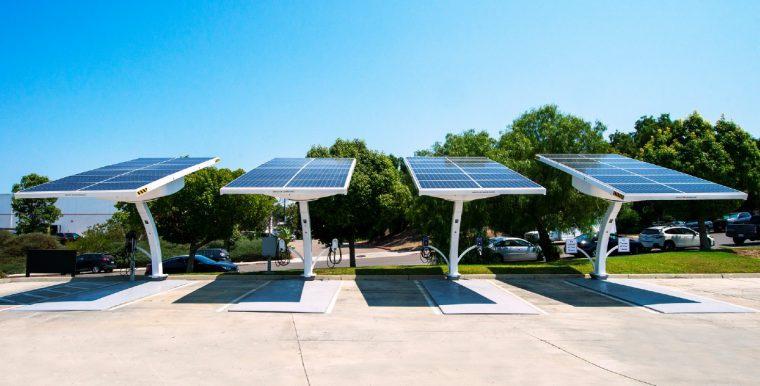
Charging EVs in parking lots with solar power is a marriage made in heaven. But the general rule for any solar or charging installation is that it be grid tied, so it can charge vehicles from the grid when the sun is not shining, and feed excess power back to the grid when the cars are not charging.
In spite of that, a company named Beam Global is selling solar charging stations for parking lots with batteries and claims they are more cost effective in many cases to grid connection.
That should not be true if it were just about electrical engineering. If cars aren’t charging, or they are nearly full, or if batteries in the charging station are nearly full, any solar power produced at that time will simply be thrown away. That means it won’t offset the use of fossil power on the grid, and it’s also an economic loss. Work parking lots are often empty on the weekend, and cars have varying needs. If your off-grid station has enough battery to handle the job on average days, it won’t handle the Monday surge — or if it can handle the high load, it needs a lot of battery which can be very expensive. There can be 2-3 times as much sun during the summer as the winter. Also in the summer, the grid is desperate for electricity on the hot afternoons and will pay handsomely for it.
Off-grid systems must deal with the cost of their batteries, their solar panels, and the waste that comes from mismatch between car demand and solar production, both of which vary based on time of year, type of driver, and weather.
Beam claims their system is cheaper because of the high costs of a grid-based or grid-tied-solar charging installation. Such projects usually involve consultants, plans, permits and then trenching and digging up the parking lot to install wiring. The wiring run and trench may be quite involved depending on where the chargers are sited. There can often be a need to expand electrical service to the building (though if systems were better designed that would not be true.)
However, for locations where grid-tied charging is not so expensive to install, because wiring is nearby or permits and construction are easy, they are less likely to win on cost, but they still would win on hassle and install time.
The trick is that high power construction and electrical projects can be very expensive. So expensive as to exceed the costs of an off-grid system, says Beam. This has indeed been the bane of many solar projects — today panels are cheap and the solar panels themselves are just a small part of the cost of any home or building solar install. Permits, grid-tie systems and licensed contractors don’t come cheap, and they also take time.
Beam builds their stations in their factory, at scale — which is a big cost win — and then ships them on a flatbed trailer to the site, where they are simply dropped in any sunny parking spot. Without permits or contractors this can be done immediately, not months later.
The Beam system is not cheap, however. Just cheaper for some locations than the high cost of traditional install.
Can the grid do better?
Beam claims their customers are all doing the math and finding the off-grid approach cheaper than installing grid-powered stations. An interesting question is whether that has to be. With all the legislative push to encourage EVs and solar, the world needs streamlined regulations and mass produced products to make it easier to install grid charging. (Disclosure: I have an investment in a company which builds controllers that allow buildings to install large numbers of grid chargers without needing to upgrade service to the building.)
- Streamlined electrical codes which, while still safe, make it easier to install grid EVSEs with bulk-manufactured equipment and contractors from anywhere, not just local ones who know local electrical codes.
- A move away from overprovisioned charging lots that try to bring 7kW or more to every car, when in fact the average car in an office parking lot for 8 hours needs less than 2kW, and only a few cars each day need more.
- Installation of necessary conduits by default in new parking facilities, as it’s much cheaper to do the work when building the lot.
- Solar charging with much less battery but still grid tied, reducing the max power that flows over the grid link and reducing its cost as well as battery cost.
Solar and parking are, as noted, a great combination. Solar panels produce power only when the sun shines, and so they need loads that will take that power. Cars parked at offices are fine charging when the sun shines. They do sometimes need to charge when it doesn’t, which is why these units have batteries — and also because it allows some of that power to be stored when no car is charging. But the grid is the ideal place to send solar power to in the afternoons, when it has high demand and the cars are full.
We want the grid or grid/solar approach to do better because they are the greenest approach. While solar panels are always a green thing, solar panels that waste a good portion of their output are less green. Because of this, it is a good idea to avoid the thought that a charger like this makes a car “solar powered.” While it’s technically true, it hides the fact it was done in a non-green way. Solar grid-tie doesn’t make you imagine your car is powered by the sun, but it’s better for the environment, which is the real goal of powering things with the sun.
Beam’s factory-made solar station has merit even if you’re going to grid-tie it, due to the lack of construction of the solar station and mounting for the charger, which can get surprisingly expensive.
The future
Grid-tied charging lots are also the path to V2G, where cars provide some of their power back to the grid in its times of need. This isn’t really a thing today, and it may be quite some time before it’s practical.
In the future, cars will also be able to drive themselves. This means they can drive to where there is charging, rather than needing to put charging where we park the cars. Low speed relocations for charging — even just to another part of a parking structure — are much simpler to do than full robotaxi service. We could do that today. This changes both this solar approach and the grid approach.
- On one hand, you get to put the charging in places it’s cheap to put it — near to existing wiring and power supplies, places where you can trench or put in overhead wiring without digging up concrete.
- On the other hand, off-grid solar chargers can sell their surplus power cheap, assuring cars will come take it. If an off-grid solar array has no car connected to it, it can broadcast that it will sell that otherwise wasted power at a low price — encouraging some car that is a bit low and waiting for just such a message to drive on over, if it’s not too far.
Both those approaches demand cars that can plug in automatically, either with a new charging plug on the front, rear or bottom of the car, or with a robotic arm charging plug that combines with the car’s ability to position itself exactly to make a cheaper solution.
Originally published at Forbes.com in Off-Grid Solar Charging For EV Cars In Parking Lots Makes More Sense Than You Might Think. Copyright © 2022 by Brad Templeton.


Comments
Ruth Mccarty
Sat, 2022-12-03 14:23
Permalink
Ev charging
Why can't ev car companies figure out how to have a built in solar panel on the roof of the ev?
The charging would be self contained within the vehicle and would only require plug in during the night and overcast days. The car could charge itself while going down the road during the day making able to travel farther during daylight hours.
Russell de Silva
Sat, 2022-12-03 23:38
Permalink
Solar energy is diffuse
Solar panels on car roofs makes little sense because it is more difficult to mount them on a car roof than in a field. Secondly you would not deliberately leave your car out in direct sunlight because of the damage UV does to paint, vinyl and upholstery.
Solar is also diffuse, so you don't get a lot of charge out of it.
I can't see any way that local solar is better than buying solar off the grid. A large scale solar power array is bound to generate cheaper power than a small local one.
brad
Sun, 2022-12-04 20:44
Permalink
This is covered
In a number my articles, particularly the one on the Aptera, which is the only car this even remotely makes sense for, and even then not really. It's anti green, provides almost no energy while driving but maybe could reduce plugging in a bit because that vehicle is efficient. It would not make much difference on larger cars. If you park your car in the sun all day (which you may not want to do and may not be able to do) you might pick up 5 miles of range.
Russell de Silva
Tue, 2022-12-06 03:24
Permalink
Industrial scale solar surely more cost effective
Except for very remote areas, I cannot see where locally produced solar is better than solar produced at industrial scale by a solar farm.
Panel installation is more expensive. If completely off grid, battery backup would be prohibitive to guarentee service. If connected to the grid (in both directions) storage is not required, but that in itself is expensive. Why would you not just build more solar farms, and connect chargers to that?
The grid would require less storage as a percentage of capacity than a local installation due to the complementary generation using all of solar, wind, hydro (pumped or otherwise), nuclear, heat storage, and others.
I fail to see the attraction of rooftop solar of any sort, and surely if incentives are needed (not a given) they would be better given to large scale generation companies/SOEs.
What have I missed?
brad
Fri, 2022-12-09 09:39
Permalink
Distribution
Industrial scale installs are indeed cheaper.
Local solar benefits from getting free real estate (your roof) but most of all from not needing to pay for the distribution network. Today the distribution network here in California costs a lot more than the power generation.
This is so true that even going off grid makes sense to some people, and it should not.
Russell de Silva
Fri, 2022-12-09 16:52
Permalink
Surprised by high cost of transmission
I had assumed transmission for the producer was much lower than generation cost. Apparently this used to be the case.
https://www.spglobal.com/commodityinsights/en/market-insights/latest-news/natural-gas/112421-us-power-transmission-distribution-costs-seen-outpacing-electricity-production-costs
But it appears they are almost on a par 4.3 for transmission vs 4.6cents/kwh for generation.
Regardless it is odd that Californians are charged a lot more for transmission.
brad
Sat, 2022-12-10 00:38
Permalink
California transmission cost
It started with Enron, which bankrupted (or nearly so) California utilities, and then PG&E killed a lot of people and convinced the PUC to let them raise the transmission rates through the roof.
This chart doesn't copy and paste well, but as you can see generation is just 14 cents winter peak, 11 cents winter night -- but I pay 43 cents and 25 cents, so 2/3rds of the peak cost and almost half the night cost is not generation. Solar gives power at all those times but no distribution cost.
FKA
Wed, 2022-12-07 05:14
Permalink
The grid
The grid is not green.
Add new comment