



California s New Solar Rules Greatly Cut Payback, But Could Power Trading Fix That?
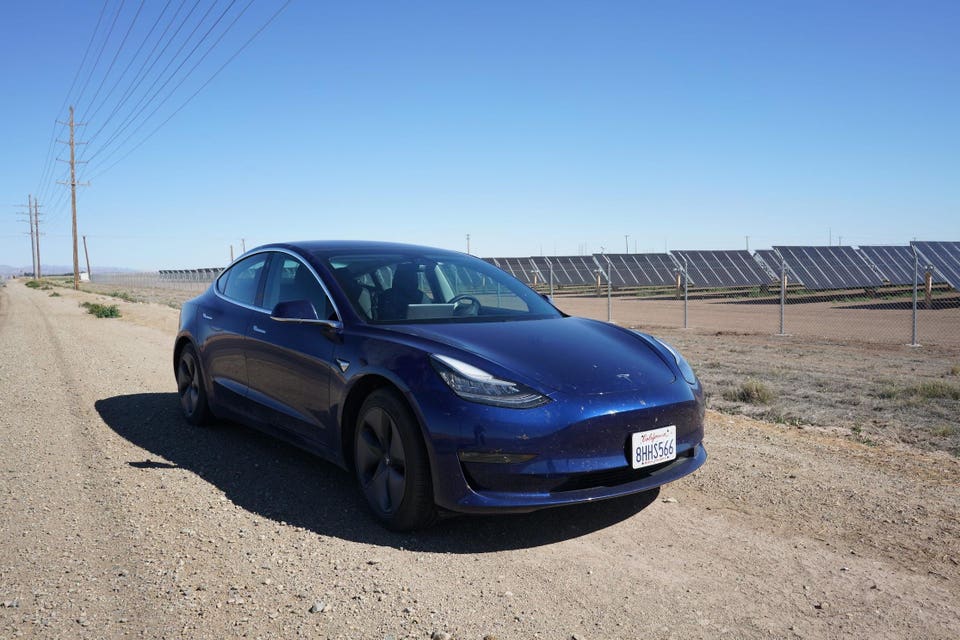
April saw a massive flurry of orders for home solar panels in California, due to a massive change in the rules on how homeowners are compensated for their surplus solar power. (I ordered panels prior to the deadline to take advantage of the older rules.) Under the new rules, most customers will find their solar panels much less lucrative, and it will take longer for them to start saving money over grid power. One way to fix that is to have a home battery, and even having an EV is a form of home battery. But might it be possible to help your neighbor charge her EV to gain this benefit if the logistics of that were made easy to do?
The math of solar and the grid is complex. It was simpler under the old rules. During the day, your solar panels usually generate more electricity than you use, and you feed that into the grid for others to use. When the sun stops shining, you draw power from the grid. The old net metering system simply subtracted how much you put out from what you took in (in buckets based on the time of day you did it.) If you put out as much as you took in, your “net” was zero and you paid close to zero for power. The grid was a perfect and almost free battery you could stuff your extra power into, and pull it out later.
That’s fantastic, and makes the choice of solar easy, but power companies argued that it wasn’t fair, and the California PUC agreed. In their world, the value of power changes all the time. The old rules let you put out energy at noon, when there’s a big surplus and the price is low, and draw it back later when the price in their markets is higher. So under their new rules, if you put out energy, they will pay you only the same wholesale rate they are paying others, and you buy any extra you need at the higher retail rate. These rates are very different in part because in California, the bulk of the cost of electricity is a delivery charge — paying the grid companies for having the wires — and not a generation charge, where you pay the remote power plant. When the power plant is on your roof, and you use its output, there is no delivery charge, which makes solar a good deal when you use it.
The new rules may be more fair to the power company, but they will discourage the installation of solar, which is not what we want from a public interest standpoint. The power companies fear that eventually there will be so much extra solar from homes in the middle of the day they won’t be able to handle it. It already creates a minor crisis at 6pm when all those solar panels shut off and other plants, mostly fossil suddenly have to ramp up fast to meet what is often the peak demand of the day when the weather is hot.
It seems likely that in the future, with lots of solar, the wholesale cost for spare solar at 11am might drop extremely low. The only compensation is that briefly, just as the sun is going down, the rate can be very high — but it’s because the sun is fading and so most panels aren’t providing much. Even today, some estimates suggest it will take 3 times as long for solar panels to “pay for themselves” — which means to reduce the grid power bill by as much as they cost — as under the old rules. However, after that point there’s a profit so they are still worth putting in. We may see more solar panels installed to face west or southwest in the future, to catch the sunset light. This lowers their total generation but can increase the value of the energy they produce.
A homeowner can get around this with a battery. They can put their surplus solar into a battery, and draw it out later, using the grid much less. Batteries are expensive, though, and they wear out as you use them. The grid is willing to pay a lot for power from a battery just as the sun goes down, so it can be lucrative — for those who hope to use car batteries as house batteries in “V2G” style, this is the one time in the day that it makes the most sense to do it, though a lot of cars are still in their evening commute.
Charging cars during the day
An EV has a very large battery, and unless you are taking long trips, it doesn’t matter when you charge it during the day. Most people charge at night because the car is parked, they are asleep, and power at night is cheap. It’s the obvious choice — except for the fact there is no solar power at night.
For those with a car that doesn’t do a commute and stays plugged in at home, the best plan will be to charge it with any surplus solar power you have. There are a variety of small companies which will use the data from your solar panels to tell the car to only charge with that power, and soon Tesla cars will work with Tesla solar panels to do that. In addition, several power companies work with customers to move the charge time of cars to when the power company has surplus solar power, though the incentives are currently minor.
Much of the time, the driver doesn’t care much, though if you plan a trip in the morning, you don’t want to find that your car didn’t charge in the night because it was waiting for cheaper solar surplus energy in the day. The biggest burden is simply remembering to tell the system to make sure the car charges at night sometimes. Because night power is cheap, there is not much incentive to do that, which probably needs to change. Right now, the “my car is full every morning” approach is simple and appealing — but more fossil based.
Cars that commute need to be plugged in at office and commuter lots. That works even better if those lots get solar panels. In France, new laws require new parking to have solar panels.
Local sharing
Some of these problems could be fixed if there were a frictionless way to sell my surplus solar power to my neighbor, particularly to charge her car. When it comes to providing power to a neighbor, almost none of the grid’s transmission equipment is used — indeed my immediate neighbors on the same transformer have a direct connection to me. Today, under the new metering rules, a solar owner might be offered just a few cents/kWh under the new “avoided cost” rule that only pays the wholesale price. But my neighbor is paying the full retail cost and would happily pay me something in between the retail cost and avoided cost, and the power company deserves only a tiny fraction because almost none of their equipment is involved.
It is not possible to do this today, nor would it be easy if I had to set up complex billing with my neighbors, but independent virtual power companies could be enabled to do this, taking a cut, of course. The nice thing about solar panels is you can easily control their output, so you can assure you never put more power into the grid than is requested by neighbors or the larger grid, never overloading equipment. On some days your neighbors might take all your surplus and pay you decently. Other days you might need to sell it to the grid at the low avoided cost value. Perhaps in the future the avoided cost would go to zero and you would stop sending the power — or consider getting a home battery.
As more people put up solar, it would be harder to sell to your neighbors. As such, all customers would not be treated evenly, which may bother some. Company parking lots surrounded by residences with solar might just run off that extra, or vice versa. As long as the grid did have capacity to move the surplus, it would, and when economical, it would get upgraded. Energy storage companies would be happy to buy any surplus they can get delivered at a good price.
If a car owner wants to do vehicle-to-grid, they will need to time it right. They must plug in to recharge the battery from 9am to 2pm to get the surplus solar. Then they must be plugged in to a two-way special V2G plug during the super-demand peak (from just before sunset to around 8pm) when the spot rates for power are the highest and will justify the extra wear on the car’s battery. If the two-way plug is in their home, they may use it from 3pm to 9pm to offset their own usage during the peak-rate period — which can be over 50 cents/kWh in California. For V2G what matters is the difference between the price of the power that went into the battery (ideally cheap surplus solar from your own panels) and the avoided cost price when the power is sold back. On hot summer evenings this cost can be quite high.
If all of this sounds complex, it is. The market opportunity will be for companies and systems which make it all easy, and deliver lower costs to consumers without them having to think much about it, allowing them to be greener at the same time. For that, PUCs need to facilitate these companies, and require incumbent monopoly power companies to work with them in a way that’s fair to all. EVs require us to expand the grid (though no more than it’s been expanded in the past to meet other new needs) but this time it’s important to expand it with solar, and EV charging is the ideal application for solar, if we make this easy to do and help people save money.
Originally published at Forbes.com in California’s New Solar Rules Greatly Cut Payback, Power Trading May Help?. Copyright © 2023 by Brad Templeton.


Comments
Russell de Silva
Thu, 2023-05-25 16:23
Permalink
Why do your own solar when there's a ton of other providers
The low return on solar for house owners simply reflects its low value because its peak generation period doesn't match the peak demand.
Rather than come up with a complicated arrangement of maximizing utility of rooftop solar, why not just use the power from the grid? They will be installing large scale solar anyway because we will be discouraging fossil fuel generation, and this will inevitable lead to cheap power around noon.
As long as the price to the consumer reflects the supply/demand accurately, there's little need to install your own solar and hope for electricity retailers or generators to support it.
End users can just change the time they charge their vehicles, aided by chargers at their workplace.
When power companies are installing solar in large amounts there seems little benefit in reproducing this capacity on your rooftop when it can be done more cheaply in a field somewhere.
brad
Fri, 2023-05-26 15:32
Permalink
Low return
California PG&E territory electrical prices are super high -- 24 cents/kWh at night, 54 in the peak day.
It's very easy for solar to beat those. Wholesale solar prices are indeed cheap but I have to pay fat PG&E delivery prices on top of them, making solar an easy win that will pay for itself very quickly.
If I did not have all the extra costs from permits and install, you can get solar to earn out in almost no time. You can get 1kW of panels today for under $1,000 and it keeps dropping. All the rest of the typical $3/watt price is install, permits, markup and other overpriced gear for inverting and grid tie.
That 1kW of panels will generate about 1.5 to 2 mWH per year, which costs around $400 to $600 at retail. In other words, the panels recoup their cost in 2 years and last for 25.
I have laid out that I would love to get a pool pump that has an input for solar panels, not grid tied. I could just nail them on my north fence in an hour, and they would only generate at about 60% efficiency for being vertical, but without all those other costs they would be very profitable. Pumping pool water is one of the magic solar loads --you don't care when you pump it, so pump when the sun shines.
Shlomo
Sat, 2023-05-27 21:38
Permalink
In the US Amazon resells these kits
In the US Amazon resells these kits.
Russell de Silva
Sun, 2023-05-28 15:11
Permalink
Sounds like the electricity
Sounds like the electricity market is the thing that needs fixing.
But agree about the pool pump, and presumably pool heating as well (if desirable in the summer)
brad
Sun, 2023-05-28 16:48
Permalink
Pool heat
Is often best done with solar thermal, though in theory you can do it better at higher cost with PV and a heat pump.
The electricity market is broken in a number of ways, but many of its principles make sense. We think of electrical energy as a commodity, which you buy by the kwH like you buy gasoline or water. But it's really a service. The wholesale price of the energy is low -- 2-3 cents/kWh from the best sources -- but you can pay $1 to get it at certain times of day, and always quite a bit more. That's one reason that people are so interested in new ways to store it, to make it more like a cheap commodity than a service.
Russell de Silva
Mon, 2023-05-29 14:07
Permalink
Let the generators store it
I still think it makes much more sense for storage to be on an industrial scale, and probably not using batteries which are hugely expensive.
If we already have EVs with long cycle lives, e.g LFP, then using the resource makes sense. Powerwalls and solar rooftop OTOH don't make sense to me because it can be done so much more cost effectively by industry rather than individuals.
Industrial scale storage should drastically reduce the fluctuations in price without the need for complicated home installations.
brad
Mon, 2023-05-29 19:51
Permalink
Store it anywhere
Cars don't make much sense as storage, though in future they might. However, the key thing about local storage is you don't use or pay for distribution. Right now that makes a huge difference. You will use whatever offers the best price. Grid storage close to your house that doesn't need much distribution could make sense if it can do a better price. Grid storage far from your house will have distribution cost.
Storage at your house also offers backup power if the grid fails, and while it doesn't fail often here, there are places where that's very valuable, and people attribute greater value to it even when the failures are rare.
Home installations are "complicated" but that's what computers are there for. For the user it's just install it and turn it on and let it run, most of the time, though if you want backup ability you want smarter devices in your home to shut off all non-necessary loads.
Right now grid solar is cheaper than roof solar to install -- but because of grid costs, it ends up costing more. Otherwise, roof solar would not make much sense.
Add new comment