



EVs won't overload the power grid, in fact they (and ice) can save it.
The U.S. west is suffering a major heat wave which may result in rolling blackouts and reminders not to charge electric cars in the afternoon. With California also ordering that all cars by 2035 be electric, this has resurfaced a common meme often spoken by EV opponents, the idea that the power grid can’t possibly handle this.
At the same time it’s true that we plan a highly renewable grid, but the key renewables, solar and wind, are intermittent, dependent on the time of day and the weather.
It turns out these two problems can actually somewhat cancel one another out, and combined with some other technologies there’s not going to be a problem at all.
Need more energy, not necessarily more power
It’s true that for all cars to go electric, we need to generate more electrical energy. Grid capacity can be measured both in total annual energy production, and also by maximum power, and these are different things. Energy is a commodity like gallons of gasoline or kWh. Power is the instantaneous delivery of energy, the amount of energy you can deliver in a second.
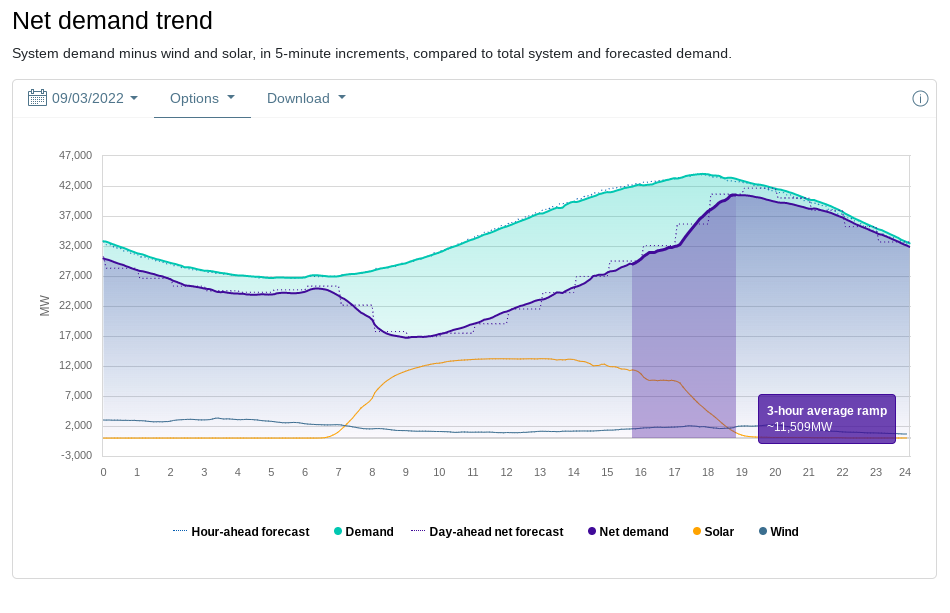
On the grid, power demand and supply fluctuate during the day. They are low at night, but on warm days, the demand keeps climbing as the day wears on and it gets hotter, causing the need for more air conditioning. AC is the primary driver of peak demand on the grid. The demand tends to peak around 6pm but is still strong until about 9pm and then it declines into the night. At cooler times there is no peak when it’s hottest, so there tends to be two (much lower) peaks in the day. At any given time the grid has a power capacity. That fluctuates during the day due to the renewables, but the key goal is to make sure that from 4pm to 9pm, when demand is highest, we have enough supply capacity to meet it. So we spend money to make power plants and transmission lines to provide that supply.
The chart shows California’s demand and supply during the heat wave, on Sept 3, 2022. Total supply was over 55gW, so there was a fair bit extra, but during the peak from 3pm to 9pm, it’s over 40gW.
The rest of the day, the supply is still available. We may only turn on all the power plants in the late afternoon, but we’ve paid for them and can run them at other times if we want. Some plants, like nuclear plants, have to run all day, they are hard to turn off. Efficient natural gas plants take some time to warm up and cool down, but we can turn them off when not needed. Hydro plants can be turned on and off as desired. Solar plants of course only generate power in the day, and the most when it’s sunny.
Cars can charge any time of day. The average US car drives less than 40 miles a day, which means they can usually go 5 days without charging if they needed to, but they can definitely pick when they will charge as long as they can plug in. Most plug in at night, when there is the most excess power capacity on the grid, and power is the cheapest. In the future, more will plug in at work, but there will be excess capacity until about 2pm for those cars. A very small number of cars on road trips will need to charge in the late afternoon, and they will pay a premium for it.
People who didn’t understand this thought it was ironic that California announced the plan to go all-electric by 2035 the same week as a heat wave made them remind people not to charge from 4pm to 9pm. This got mis-reported as them asking people to avoid charging their cars, but in fact the advice not to charge at peak is standard good advice at all times, not just in heat waves. Nobody in California found themselves with a dead car due to this shortage, because it’s only a demand peak for power, not energy, at the peak times.
(It should be noted that in spite of warnings, the California grid operator never had to do rolling blackouts. Simple text messages asking people to reduce power did surprisingly well.)
A refersher:
Energy is what does useful work, like moving a car a mile or cooling a home. It is measured in units like kilowatt-hours (kWh) or even in gallons of gasoline. Power is the rate energy flows, measured in unites like kilowatts or horsepower. Your car might need a gallon of gas to go 30 miles, or a 7.5 kWh if electric, but it needs more horsepower to do it faster. Particularly because kW and kWh sound so similar, people get them confused.
More Energy
We don’t need to increase the power of the grid much to charge all the cars, but it will need to produce more energy. Even if all new cars in 2035 are electric, it won’t be until about 20 years after that before most of the gasoline cars leave the road. Today Americans drive about 3 trillion miles per year (half a light-year!) If they did all that in cars like the Tesla Model 3, that would need 750 more terawatt hours (tWh) per year. In 2020, the USA generated 4,000 tWh so this is an increase of about 20% — though not until around 2050. It’s more than that, because there will be trucks which use much more energy per mile, and other less efficient cars, and there will be more cars and more driving, but this gives you a back-of-envelope idea of the amount of extra energy needed. (We also want to move gas heating for homes and hot water from fossil to electric heat pumps, which is a different discussion.)
The US power grid already increased in total energy output by 20% in the last 30 years, so this is certainly something that’s been done before without any special effort. Because the increase might be larger, some special effort may need to be made. (Maybe not, we keep getting better at being more efficient, and many of our appliances and things like our light bulbs use a fraction of the power they used in the past.)
While we need 20% more energy, we don’t need much more power because of the electric cars. We may need more power for other things — particularly population growth — or we may need less when we get more efficient. New power plants offer both more power and more energy, though in different ways. If we planned to just burn more coal and gas, we actually could get more energy from the existing plants by burning more fuel, but that’s not our plan so we will need more renewable plants. We won’t need more grid because of the cars, though.
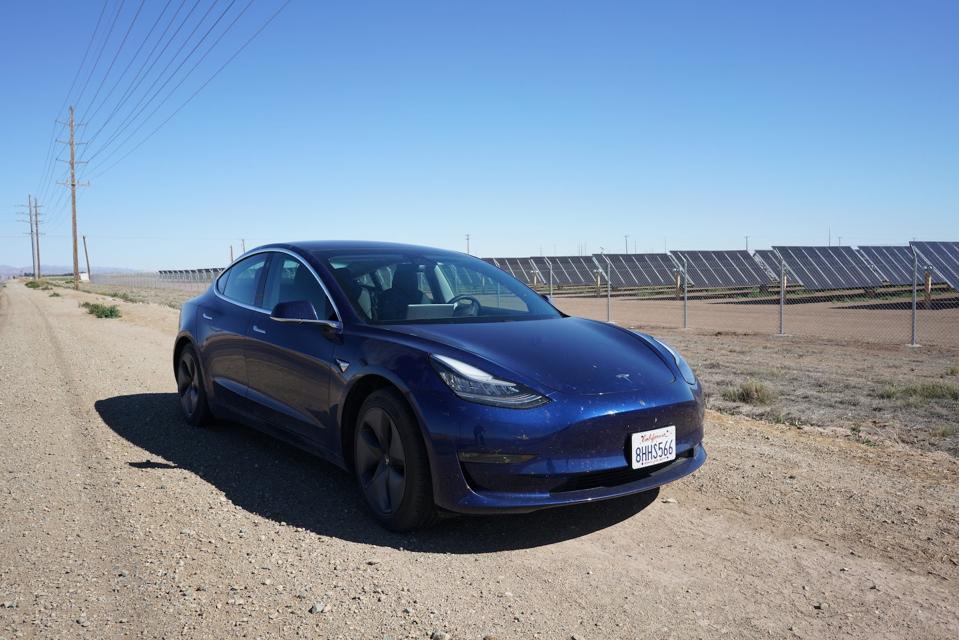
This extra effort is going to come mostly from renewable, especially solar. That’s not for any environmental reason. Today solar power is the cheapest type of new power plant to build. When you look at the total cost per kWh from any type of plant, solar is the winner — and it’s getting cheaper every year. If you just want energy for the lowest price, and you can pick and choose when you use it, the solar is the only plant to build simply on price — though the zero emissions are certainly nice.
While it clean and quiet and easy to operate, its one downside is it only gives power when it’s sunny. In fact, if you wanted to generate 24 megawatt-hours per day, you could do that with a 1-megawatt ordinary plant running all day, but with solar you might need a 6-megawatt plant, and you would only get your power in the daytime, unless you also had storage. But that 6 megawatt solar plant would cost less per unit of energy than the 1 mW gas, coal or nuclear plant.
To solve that problem, you need to find a big load that can take the intermittent power delivery of a renewable plant when it’s told to — when the sun shines or the wind blows.
That’s exactly the type of load batteries, which is to say EVs, are. As long as a car is plugged in, it will take power when there’s a surplus, and not take it when there’s a shortage. Very few other loads are that flexible. For every other load, you need the power when you need it, but with a battery you take it at a different time than you use it. One other load like this is filtering swimming pool water — you just need to filter enough every day, it doesn’t matter when.
Heating and Cooling
The biggest load on the electrical grid, and the cause of peak demand, is cooling, and as we switch heating from fossil fuel to heat pumps (air conditioners in reverse) it will also become a big load. But heating and cooling can also shift their need, if we use gear designed for that. That’s because you can store heat (or cold) in the cheapest “battery”of all — water.
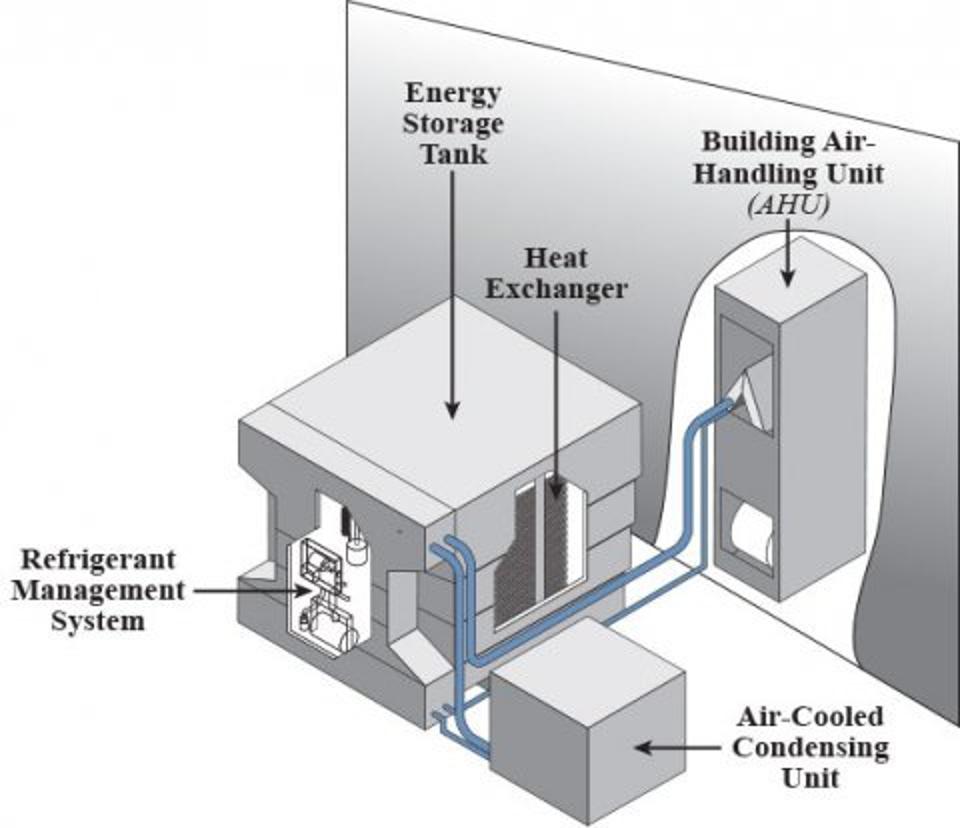
Newer advanced air conditioners know just how much air conditioning will be needed later that day. During the night and morning, they chill and freeze water into insulated tanks of ice. They do this when the electricity is cheap and plentiful, and when the temperature is lower and it takes less effort. Later, when power is scarce, they use that ice to cool buildings. Our temperature forecasts are now very accurate so computers can control this whole process to make it fast and efficient. Power will either come at night (when demand is low) or in the morning (when it’s still cool and there’s a big surplus of solar power.) The solar surplus will be so large that all the loads that can move in time (like batteries, cooling and heating) will take the surplus in the morning. Renwables need storage, but that storage will be the batteries already in the cars, and the tanks of ice or (for heating) hot water. There will also be other types of storage (pumped hydro and batteries and other methods) but we’ll need a lot less of that than we would if we stick with our old air conditioners.
As such, a large fraction of the problems of a future renewable grid can be solved with EVs and ice. Note that this does not involve the cars serving as batteries through what is called “vehicle to grid” technology. That may be done once batteries get to be super-long-lasting, but it doesn’t make sense when expensive car batteries get used up as they operate, unless power can be sold at very high spot-prices during grid overload.
(Ice storage for cooling and heating has been surprisingly slow to be deployed. According to Mike Hopkins, former CEO of Ice Energy, the earliest company in the space, people who install air conditioning are just not used to new things, and even basic government mandates aren’t making it happen fast enough. He believes that the law should start demanding storage — not necessarily ice — for heating and cooling in new construction, and this will solve the peak demand problem.)
Solar’s problem is it generates power on the sun’s schedule, not yours. EVs need lots more electrical energy, but can accept it on the sun’s schedule. The two problems work to cancel one another out. When you add the ability of air conditioners, home heating systems and hot water systems to make and store heating and cooling and dispense it later, it’s like the problems were made for each other. Of course, this doesn’t solve everything — we will need other types of storage, and probably more wind, nuclear and geothermal. And we’ll still use our natural gas plants for some time to come at the top peaks. Some people think we’ll even use the batteries in EVs to sell power back to the grid at the peak to avoid that. In the chart above, the yellow solar line will get much taller — in fact taller than the peak demand, but that creates a big problem at 7pm when the sun goes down and suddenly all that peak power has to come from non-solar.
The way that EVs are the salvation of the grid is they let us build a ton of cheap, green solar capacity and then give us a place to put all the extra solar output from morning to 3pm.
A future day on the grid
Here’s a summer day on the future grid. At sunrise an immense amount of solar panels start generating. They quickly supply far more power than people need, and so that extra goes into charging electric cars and making ice for the hot afternoon and evening. It powers any other loads that can happen then, like filtering pool water and running very energy intensive industrial processes that need cheap power. The rest goes into storage — pumping water back into reservoirs, charging batteries, lifting weights, making green hydrogen and any other type of storage we can build. Almost all other power plants shut down to their minimums, though nuclear plants and a few others are always on.
A lot of the power making ice and charging cars is coming from solar panels right on the buildings where this is happening, so it does not even flow through the grid. The cars may be parked under solar panels in the parking lot, charging them. The company (or home) sells the rest of its solar surplus to the grid and its neighbors.
Most of the day runs like this but in the mid-afternoon demand rises from those people who have old air conditioners and other applications. As the demand rises the price of electricity climbs, and the cars reduce charging and the buildings switch from making ice to using it for cooling. The sun’s still up so no need to use any stored power, all the way to 6pm, when the sun starts going down. When that happens there’s a big crash. The other power plants know this is coming, so they all switch to full — the hydro, the geothermal and more. The storage plants start selling their power at a high price, mostly to those people with old air conditioners, but also to the people coming home and turning on the oven and lights — though the lights of 2035 are all LED.
If it’s a rare heat wave day and the grid comes close to capacity, word goes out to raise thermostats for those without ice, to not run clothes dryers, to stick to the essentials. If there’s spare solar from plants to the west, that will also be bought over long-distance grid lines. If the demand is really high, cars plug in to “V2G” plugs to sell the power in their batteries for a very premium price that makes this worth doing. In addition, in bad peaks the call goes out to all idle self-driving cars — “please drive yourself to a V2G point and we’ll buy your power for big bucks.” The cars do that if the offer is good enough. Indeed, with millions of robocars there’s almost no load that can’t be handled for a good price.
Alternately, they may fire up some of those old natural gas plants which have been sitting idle most of the year. The price will be very high because it’s costly to keep a plant maintained to be used a few times a year. These will emit CO2 but at a tiny fraction of what they used to do. They might primarily be used for the rare combinations of high heat with no sun, like a rainy week in the summer. Not ideal but possibly cheaper than building that much storage.
After 9pm the crush is over. Now the night sources — nuclear, wind, waves, tides, geothermal, biomass and storage cover the load until dawn. For this reason, wind power must also be increased though it also has off-days. Unlike 2022, when most cars and batteries charged at night, they will wait unless there is a surplus. A pity, because otherwise night is the best time to make ice. Just before dawn, solar power from the east may be used in some places (ie. California might pull power from Nevada or Arizona where the sun has risen.)
Running all night does require more storage than we have today, which is why storage is a hot investment area today. More challenging are the times when it is cloudy or many days, and solar output is reduced (though not eliminated.) Power may be only 1/4 on those days, and one amazing answer is that solar is so cheap that you can almost build 4 times as much as you need on a sunny day. More likely it’s cheaper to develop types of long-term storage. Hydrogen or synthetic biofuel has potential here. Solar-thermal, which is currently not economical compared to PV, may have more merit. But for a while, we may get the natural gas plants out of mothballs and pay the price of that.
A winter day is different. It has two, much lower peaks, one morning and one evening, but not from air conditioning. As we move to electric heat using heat pumps, the night load will increase. Here, storage of heat made during the day makes sense. The heat can be made with surplus solar power (which there is less of in winter but still plenty) and also captured directly from the sun. Sadly, hot water is much bulkier as a form of heat storage but it’s still essentially free — the main cost is the bigger tank.
We’ll also need to install a lot more charging plugs where cars park from 8am to 3pm, which is a mixture of workplaces and homes. While night is the most convenient time, the cheap solar power surplus will be in the morning. There is still much to be done, but EVs, with their flexibility at taking power, will be part of the solution, not part of the problem.
Originally published at Forbes.com in EVs Won’t Overload The Power Grid, In Fact EVs (And Ice) Are Its Salvation. Copyright © 2022 by Brad Templeton.


Comments
David Brown
Tue, 2022-09-13 05:44
Permalink
Ice Energy
Very interesting, do you know if anybody picked up the Ice Bear tech after Ice Energy went bankrupt? Or any comparisons of Ice Bear vs geothermal heat pumps?
brad
Tue, 2022-09-13 14:07
Permalink
Ice Bear
Yes, the assets were bought and are sold by https://thuleenergystorage.com/products/ in a modified form. And there are other ice energy storage companies, some older than ice energy. And there are lots of credits to be had for putting them in, which makes it a puzzle as to why it's not done more. However, as heat waves create all the peak demand on the grid, it's such an obvious plan that one hopes it will get past the hump and become the norm for AC. And later for heating, though since there is no phase change with water, it's not quite as easy to do with heating, and you need bigger tanks, and probably fairly hot water to avoid even bigger tanks which can be dangerous. Ice is easy, stores a lot of cold and is not dangerous.
Anonymous
Sun, 2022-09-18 20:16
Permalink
Let's talk electricity
When it comes to electricity, the supply must perfectly match demand at all times.
insightful thread from Alexander Stahel ( BurggrabenH on twitter )
Let's talk electricity
10:34 AM · Sep 8, 2022
part of thread -
The grid builds on physics, not ideology. One such law says that the alternating current that flows through the grid needs to match generation with consumption because electricity cannot be stored in the grid. It is all that matters.
(more later about incrementals like batteries and pump storage).
The grid's health condition, measured locally but of supra-regional significance, is the network FREQUENCY.
It reflects the indispensable balance b/w generation and consumption. It MUST be kept in a VERY tight corridor to avoid infrastructure damage or a shut-down.
In order to keep the frequency STABLE, at any given moment across load & generation are forecast, by the quarter-hour, hour, day, etc) and auctioned off among thousand of participants. All of this is, may I say, is high tech (unlike e-retailing) - major league tech.
Frequency deviations – incidents - happen for various reasons, require INSTANT addressing & increased with the share of wind & solar.
Embrace renewables but know that they are NOT dispatchable (reliable) sources of energy from a grid perspective (think minute by minute).
... For transition to work, wind & solar must only be permitted if delivered with required c-storage & high-voltage transmissions lines as its final dispatchable package. That would reveal its hidden unit cost;
...Can technology bail us out? ...
"energy miracles" break-through tech on storage, fission, fusion, hydrogen, thermal - We need all of it. ....
now read thread #2 - For those of you short of time, attached a brief summary of the issue at hand.
brad
Mon, 2022-09-19 11:54
Permalink
Please create a pseudonym
If you just post as anonymous threads are less likely to be engaged.
Benjamin Liang
Mon, 2022-09-19 14:34
Permalink
iPhone Powerbank (smart-grid)
Think about it. Your Tesla is a just a big DC battery you can hook up to whatever.
You know your iPhone dies around 1pm at school so you bring a power brick to recharge it.
Well in Florida, when we have hurricanes, we all line up at the gas pump because we anticipate that we can't get gas later. We'll in the future, Floridians will just skip the line and pump their batteries at home. Then, god-forbid, if a hurricane does come and shut down the grid, we can hook up our EV's to our homes and get power for 72 hours. https://www.motortrend.com/news/2022-ford-f-150-lightning-electric-truck-charging-generator-power/
I think what Brad is saying is that CA is telling people to 'don't recharge in the day' is not a weakness. It's actually a resilient strength. 'Recharge your car latter for cheaper' Help CA, help yourself. If there is an outage, god-forbid, you don't need to fire up a generator, just hook up your Tesla to your home. Wall-street should make some contracts that rewards you for buying electricity outside the 'maximum surge' of the electricity chart as some sort of function of time. If you get enough volume, it could be lucrative.
Anonymous
Sat, 2022-09-24 10:11
Permalink
Stanford study: EV charging and grid stability
news dot stanford dot edu/press/view/45245
Anonymous
Sat, 2022-09-24 10:42
Permalink
Stanford - grid will experience significant stress
Stanford study
....move to electric vehicles will result in large costs for generating, transmitting, and storing more power.
...the state has targeted five million EVs on the road by 2030. When the penetration hits 30% to 40% of cars on the road, the grid will experience significant stress without major investments.
... 5.4 gigawatts of energy storage capacity is the capacity equivalent of 5 large nuclear power reactors.
Anonymous
Sat, 2022-09-24 21:25
Permalink
stats
ourfiniteworld dot com/2022/09/20/ramping-up-renewables-cant-provide-enough-heat-energy-in-winter/
brad
Sun, 2022-09-25 04:16
Permalink
Of course
I don't claim the current grid can provide all that energy. I said it must grow around 20% in energy capacity. What I wrote is that it doesn't need that much more power capacity, if the cars charge when there is surplus power, and not when demand is high. Of course there needs to be investment in new grid power, and storage as well.
Anonymous
Sun, 2022-09-25 20:17
Permalink
9 years, 7 mil EVs, and 8.8% of state’s electricity
question: for every 1 million new EVs, what is the % of Cali's grid consumption (see 2019 PEW Trust estimate at bottom)
Stanford quote:
(When the penetration hits 30% to 40% of cars on the road, the grid will experience significant stress)
data
VIO - about 18 million on road in 2021 in Cali and thus 35% penetration is about 6.3 million EVs -
quick calculation: 8.8% of CA grid used in 2031 is by 7 million new EVs
from further below
8 years till significant grid stress
When EV VIO (vehicles in operation) hits 18 million EVs, which will be about 75% penetration, 20% of grid is for EV. The grid set for big burp at 10% of consumption by EVs, imagine 20%.
EVs Dec 2021 on roads - 563,070 in CA
2030 Target- 5 million "new" EV sales
So by 2032, which is TEN years, Cali will have about 7 million EVs on road (see CA ZEV targets below)
historically, 2 million new car sales per yr in Cali, and now there is a new yearly ZEV target - see below
Target - 14 million "new" EVs on road by 2035.
2021: 18 mil currently registered VIO
CA yearly ZEV sales targets –
35 % 2026 = 700,000
68 % 2030 = 1,360,000
100 % 2035 = 2,000,000
Pew Trust says in Cali,
5.4% of the state’s electricity, or 17,000 gigawatt-hours by 2030
(est based on ?? million EVs)
Then, if
4000 kilowatt-hours per auto per yr,
28,000 gigawatt-hours for 7 mil EVs.
8.8% of CA grid used in 2031 is by 7 million new EVs
California’s plans to increase electricity consumption by as much as 68% by 2045.
A model utility with two to three million customers would need to invest between $1,700 and $5,800 in grid upgrades per EV through 2030, according to Boston Consulting Group.
just the 2030 goal requires the equivalent of about 1.75 large nuclear reactors ???
Anonymous
Sun, 2022-09-25 23:01
Permalink
10% of grid by 2030 better estimate
Caiso sees $30.5bn in high-voltage bulk transmission infra needed
10% of grid by 2030 better estimate
using avg miles of 13,476 per year at 0.346kWh per mile for 4662 kilowatt-hours per EV per yr, and most estimate 7.5 mil EVs in operation by end of 2030.
Anonymous
Mon, 2022-09-26 21:07
Permalink
Caiso
www dot rechargenews dot com/energy-transition/california-scopes-30bn-grid-plan-in-face-of-unprecedented-green-power-demand/2-1-1165980
brad
Wed, 2022-09-28 13:49
Permalink
Don't be "anonymous"
You don't have to say who you are but pick and reuse a pseudonym if you want conversation.
Shlomo
Thu, 2022-12-15 12:51
Permalink
Morgan Stanley Adam Jonas says EV sales slowing much more
12/14/2022
U.S. electric vehicle adoption will be much slower than in the coming years than previously anticipated, Morgan Stanley analyst Adam Jonas says.
Jonas now sees electric vehicles reaching 11% of the U.S. auto market in 2025, and 26% in 2030, according to a new note released Wednesday. That's down from his prior U.S. EV penetration forecast of 13% and 32%, respectively.
A weak global economy and high battery costs are raising concerns about EV demand in China and Europe as well.
Jonas cites a "complete narrative change for EVs" over the past six months.
Kriya Tekstil &...
Sat, 2025-01-11 09:16
Permalink
Q & A
Why do skeptics argue that EVs will overload the power grid?
brad
Fri, 2025-02-14 17:47
Permalink
Good question
I mean the grid does need to grow in capacity to move our road travel from gasoline to electricity. But it's not like this isn't something that can't be handled reasonably easily. The grid has grown by such amounts many times.
As to why they get upset, some of it is just fear of change. There may be some who have conflicts of interest and want to maintain gasoline, or just like it.
Add new comment