



New Chart of Tesla Autopilot Safety record
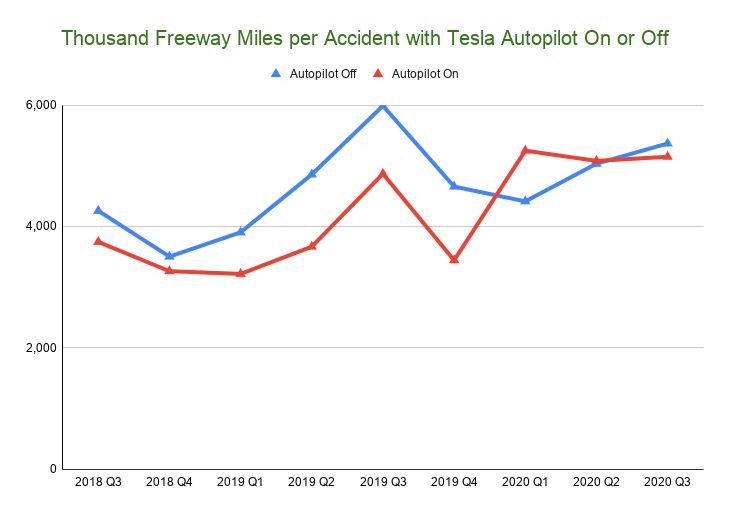
Every Quarter, Tesla publishes statistics about the distance driven per “accident” by the Tesla fleet. They provide rates for driving with autopilot, without autopilot, and without autopilot or the other accident prevention systems. The latter is pretty rare, so the interesting question is, “Are drivers safer with Autopilot on or off?”
The report they publish is highly misleading, and strongly suggests the answer is “greatly safer with it on.” That’s not true, and the most recent quarter numbers show it was probably slightly safer with Autopilot off. Last quarter they were roughly even, and in Q1 having Autopilot on was the modest winner, but that’s the only time — all other reports have shown driving with Autopilot to be moderately more risky. Of course the last 3 quarters have included the Covid lockdown, with less traffic and fewer accidents in general.
Here’s the text of their report:
“In the 3rd quarter, we registered one accident for every 4.59 million miles driven in which drivers had Autopilot engaged. For those driving without Autopilot but with our active safety features, we registered one accident for every 2.42 million miles driven. For those driving without Autopilot and without our active safety features, we registered one accident for every 1.79 million miles driven. By comparison, NHTSA’s most recent data shows that in the United States there is an automobile crash every 479,000 miles.”
At first reading, the Autopilot number looks almost twice as good as the non-Autopilot number. The problem is, this is what you would expect, because according to research at MIT, 94% of Autopilot use is on limited access highways. (In fact, officially Tesla only approves of using it on highways.) The new “FSD” product being beta tested by a few users is intended to do the same thing on city streets. Non-Autopilot driving is a mix of 40% highway and 60% city streets. (That’s less highway than most cars do because of drivers turning on Autopilot.) Most importantly, accident rates per mile are around 3 times higher on city streets than on highways. Highways are much simpler to drive (that’s why Autopilot is limited to them) and while the accidents can be more severe there are far fewer of them. (The 3:1 ratio is derived from fatalities, I am still seeking more accurate data on all crashes.)
That means that if you see an accident rate for one mode which is almost all highway, and another mode that is a mix of city and highway, the rate will naturally be much better in the highway mode. A little bit of algebra calculates the real number of miles per accident on the highway — and the rate on city streets will be around 1/3rd of the miles per accident.
For the Q3 2020 report, that means that driving the highway with Autopilot, you see an accident every 5.15 million highway miles, but every 1.7 million city miles. Combine those together (in the 94-6 ratio) and you get Tesla’s number of “once per 4.59 million” total miles. Turn Autopilot off and you go 5.37 million highway miles between accidents (4% better.) This is just an estimate based on data we have. Tesla will know the real rates on the different types of road but has declined multiple requests to provide them. 4% is really within the margin of error, so this quarter, the numbers can be considered roughly equal. In fact, the margin of error is large enough that even the other quarters could be roughly equal, though the general trend seems to rate Autopilot as slightly less safe than not using it. Indeed, the wild swings in the numbers published by Tesla suggest that there’s a lot of randomness in the results — they’re probably not varying this much in quality. In addition, we’re (slightly) presuming that Autopilot drivers have similar ratios of accidents between highway and street, but this does not affect things much since Autopilot is so rarely used on city streets. But it’s possible that Autopilot is more dangerous off the freeway and a bit safer on it.
If we reduce the estimate ratio of accidents/mile on freeway and non-free to just 2.3:1 (as a number from another source suggests) the chart shows Autopilot slightly below non-Autopilot until Q1 2020, then being around 15-20% better in 2020, possibly due to Covid or software improvements — both would be altering the results.
With this modest margin, one can attribute the problem to a group of people who don’t watch the road when using Tesla Autopilot as they are told to do. We’ve seen a small number of them meet their doom, and they are at higher risk using Autopilot, while the diligent drivers are probably at a similar or slightly better level of safety when using it.
There are a few other strange things in the Tesla report. First, they quote the number of “accidents” which they say includes any activation of active restraints (airbags/pretensioners) which is crashes over 12mph. Other numbers suggest airbag deployment in general is about every 3.5M miles for all cars, which annoyingly doesn’t mesh. They also report an unrelated number from NHTSA for “crashes” which is almost an order of magnitude different from the Tesla numbers. The NHTSA number is derived from police reports. It should not be compared to Tesla’s “accidents” number, and Tesla admits this in the fine print, but it should be made much more clear.
Consumer Reports down-rates Tesla for not monitoring the driver
In ratings released today, Consumer Reports rated Tesla’s Autopilot second among such systems, giving the first place nod to GM’s Super Cruise. They declare that Tesla’s performance was the best (though not by a large margin) and they dinged it for not having the camera-based driver monitoring that Super Cruise has which makes sure eyes are kept on the road, and not being more explicit and limiting about where you can use it. (Telsa Autopilot will let you turn it on on any road that looks good enough, including roads it really can’t handle. Super Cruise will only operate on a mapped freeway.)
This is an interesting judgment. Buyers rarely rank a product higher because it limits what they can do, or nags them more to use it well, but CR feels this is an essential feature in its ratings to improve overall safety. Tesla only monitors the driver by detecting occasional torque forces on the steering wheel which can thus show your hands are on the wheel. It does not look at your eyes. Newer Tesla vehicles do have a camera that can see the driver, and Tesla has reportedly done experiments at using it for driver monitoring, but they do not do that at present. Some drivers don’t want their car to monitor them and how safe they are being, other drivers welcome it.
It is worth noting that better driver monitoring would probably improve Tesla’s safety record above, which is brought down in part by accidents caused by people who don’t pay adequate attention to the road. Even an optional driver gaze monitor would help, though I suspect Consumer Reports would not approve of it being optional. Tesla could easily limit Autopilot to only limited access highways. Based on past experience, Tesla is willing to defy the tastes of Consumer Reports. All other brands scored more poorly, with only the Lincoln/Ford Co-Pilot breaking 50 points on CR’s 1-100 scale.
Originally published at Forbes.com in New Tesla Autopilot Statistics Show It’s Almost As Safe Driving With It As Without. Copyright © 2020 by Brad Templeton.


Comments
FKA
Sat, 2020-10-31 06:18
Permalink
fake news
That chart is based on your guesstimate?
brad
Sat, 2020-10-31 11:30
Permalink
I would call it an estimate
That the ratio of accidents highway to non-highway is around 3-1 is not a guess. That this would be the ratio for Tesla drivers not using autopilot is not a guess. That it would be the ratio for drivers on Autopilot is not something I have data for but it's a reasonable assumption, and because Autopilot is 94% freeway, it's not that strong an assumption -- it would have to be way off to alter the core of the chart.
FKA
Sat, 2020-10-31 17:37
Permalink
I would call it libel
But you'll probably get away with it. Tesla would have to open itself up to discovery in order to sue you for lying about them.
(I don't see the word "estimated" anywhere on your chart, let alone "numbers made up by someone who frequently tries to say negative things against Tesla".)
brad
Sun, 2020-11-01 10:49
Permalink
Says negative things about Tesla
The math and uncertainty are well explained in the article with the chart. Says negative things about Tesla? You haven't been reading me. I own a Tesla. It's the best car out there.
FKA
Sun, 2020-11-01 19:11
Permalink
the article
The article explains that you're making a bunch of assumptions, many of them dubious.
I've been reading you for quite a while.
Random
Tue, 2021-01-05 09:45
Permalink
Thanks!
I've wondered about this ever since Tesla started posting these safety reports. It seemed that reasonable assumptions should be available even if Tesla doesn't provide them. I'm glad you went looking for them.
Random
Tue, 2021-01-05 09:45
Permalink
Thanks!
I've wondered about this ever since Tesla started posting these safety reports. It seemed that reasonable assumptions should be available even if Tesla doesn't provide them. I'm glad you went looking for them.
Michael Stephen...
Tue, 2021-04-20 19:23
Permalink
margin of error?
"4% is really within the margin of error"
What margin of error? These are exact measurements, are they not?
brad
Sun, 2021-05-02 10:54
Permalink
Exact measurements
The study of the places were autopilot is used was not done by Tesla, it has exact data. Indeed, Tesla would have exact data on how many airbag engagements are on highway and how many not.
However, these crashes are still random events and the rate varies a great deal from quarter to quarter, so they are just an approximation of the true number we're after, even if all airbag deploys in the quarter are measured, as each quarter differs in what roads are driven and many, many other factors.
Daniel Mirkin
Sun, 2021-09-05 06:49
Permalink
Tesla Safety
I have driven my new Model Y for 3 months now and from personal experience, my impression is that it is the safest car I have ever driven. It warns me if it thinks I am going out of lane or that it sees, yes, sees that the car in front of me has slowed. All while being the fastest car with the best brakes I have ever had. I highly recommend that you drive one and judge for yourself.
R5
Wed, 2022-01-19 16:20
Permalink
Great Work
Can you share the numbers that led to this comment….” They also report an unrelated number from NHTSA for “crashes” which is almost an order of magnitude different from the Tesla numbers. The NHTSA number is derived from police reports.”
Thanks for all the leg work here. It’s be interesting to hear how insurance companies charge a premium/discount, that could be a very interesting data point from the ones that have a lot of skin in it.
brad
Wed, 2022-01-19 19:17
Permalink
NHTSA stats
https://crashstats.nhtsa.dot.gov/Api/Public/ViewPublication/813209
About 3 trillion miles driven in the USA per year.
R5
Thu, 2022-01-20 16:38
Permalink
So would that suggest Tesla
So would that suggest Tesla cars are more likely to be in an accident (is that what your numbers say) and confirming the insurance… its higher on average but not sure of the components of why.
Add new comment