



Mercedes promotes Drive Pilot standby driver ("Level 3") system
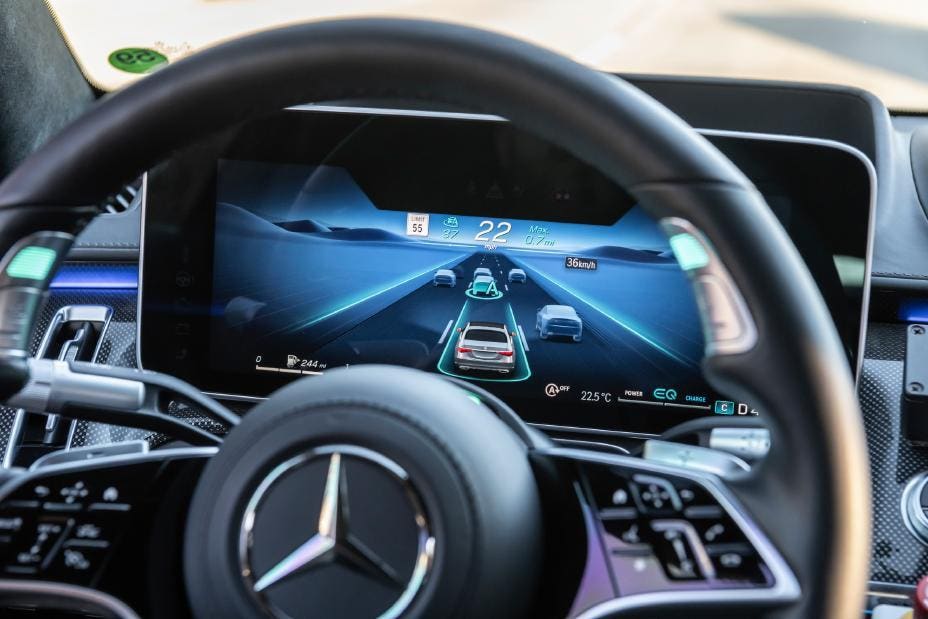
Mercedes has released a new version of their “drive pilot” system in high-end cars that will let the driver ignore the road in certain special circumstances, namely some highway traffic jams. It will operate now in Germany, and they are hoping for regulatory approval in California and Nevada by the end of 2022. They call it a “Level 3” system, based on a misguided set of self-driving levels from NHTSA and SAE, and is one of the earliest such systems to be deployed by a car manufacturer. It’s pricey and fairly limited, though it’s notable that Tesla doesn’t do it. They demonstrated it recently as a possible $5K add-on to a S-Class 580. To understand it, there’s a lot to unpack:
- The limitations of this system and when they might go away
- The sensors and technology
- What other players are doing and not doing
- The meaning of the highly-flawed “levels” of self-driving
- The value to customers and society
What it does
This is a car that can mostly drive itself, but only on limited access highways in good weather conditions when traffic is below 40mph — in other words, during a traffic jam. That means that if you are on the highway and traffic slows down, you can push a button, and take your hands off the wheel — and more importantly take your eyes off the road, allowing you to do things like watch videos and play games on the car’s console, or chat face to face with your companion. Oddly, Mercedes says that you can’t do what everybody wants to do, which is use your phone, because the laws currently forbid that. Of course, people will do that anyway — and much more they aren’t supposed to do, like fall asleep.
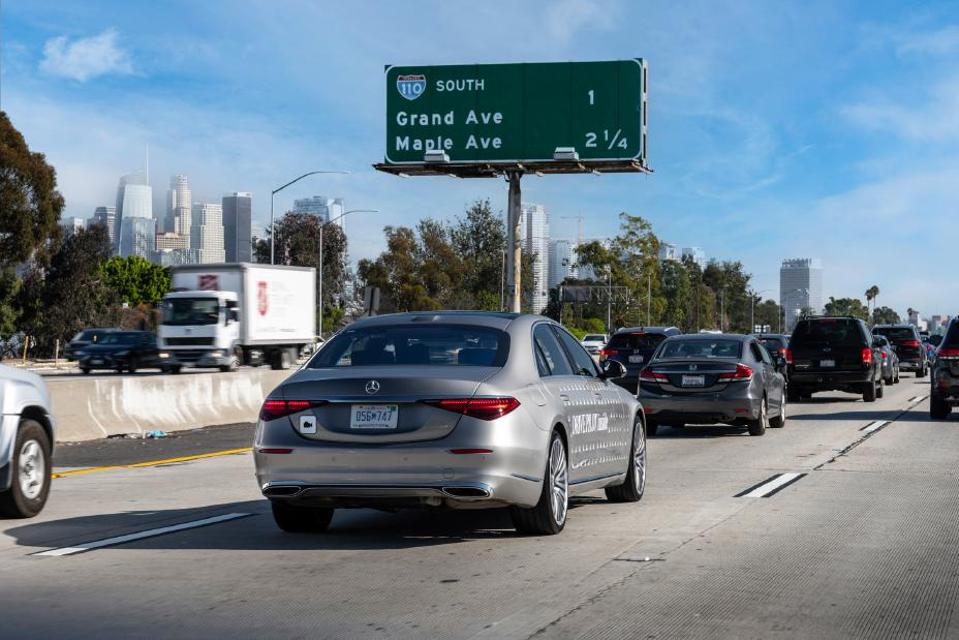
When traffic clears up and the car in front of you pulls far enough away, the car signals the driver to take over. They use sound and lights, and in a nice trick, tightening the seat belt to make sure you pay attention. You need to take over if your exit is approaching, or there is construction, or the weather changes as well. They also make a big deal that you must take over if an emergency vehicle is present, and they have sensors looking for flashing lights in all directions. It doesn’t work at night or in snow, there is conflicting information on how well it handles rain. No tunnels or toll booths or other such complex things.
Sensors on the vehicle include those cameras, plus radars, a forward LIDAR and some microphones to listen for rain and presumably sirens. LIDAR is just now showing up in consumer cars for driver assist. Famously, Tesla deprecates LIDAR, and not just because of its higher cost, though that’s the reason their hardware base didn’t include it. Almost all self-driving teams plan to use LIDAR for reliable sensing.
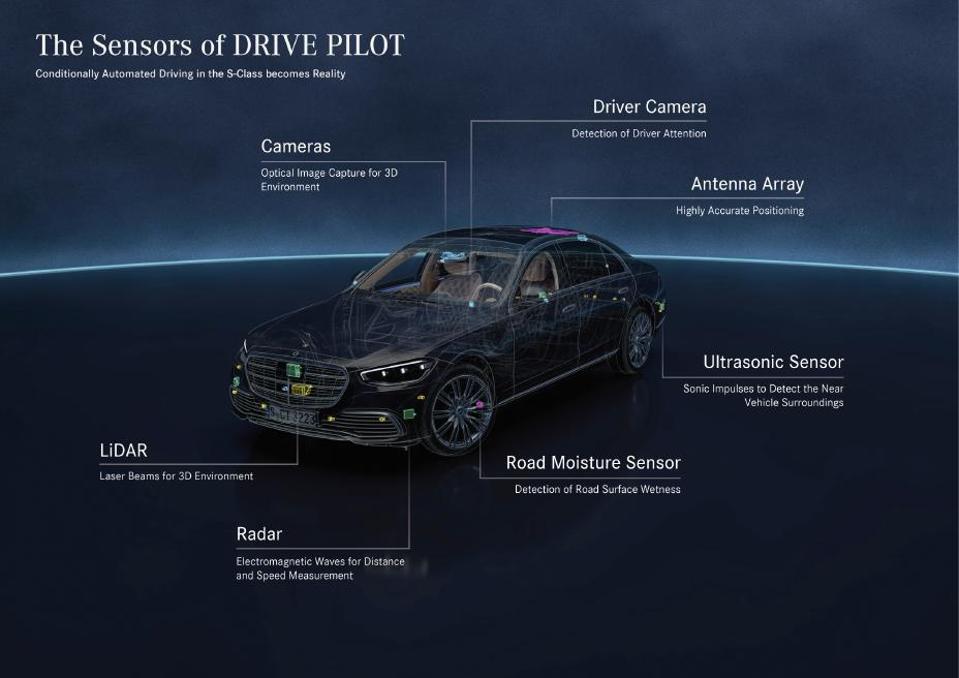
Mercedes also has put in some extra accurate GPS. That’s surprising because pretty much all self-driving teams use GPS sparingly. They consider it a clue to help figuring out location, but since it’s only a clue they don’t need to overdo it. It doesn’t work in urban canyons or tunnels as well. Mercedes Drive Pilot also doesn’t work in those locations which leads to speculation it might rely more heavily on GPS than other systems. It is true that modern differential high-accuracy GPS systems on open roads can be more accurate than GPS of the past.
The driver has 10 seconds to take over after a warning. While I have not seen details on this, most traffic-jam tools have taken advantage of the fact that it is fairly safe to just come to a stop in the middle of a lane during a traffic jam. The smarts to pull over are not needed as they might be if you want to drive at full speed.
What about Tesla and others?
A few other companies have worked on such “level 3” systems like Audi (which backed down) and Honda, which sold only a small number of Legends in Japan with this function. Of course, famously, Tesla has been selling customers a “Full Self Driving” package which is a promise that in the future, they will get that ability. A very simple and poorly performing prototype is now available to a large subset of those customers in what is called a “beta test” though the software is not yet remotely near beta level. Tesla’s older “Autopilot” system works only on highway situations (including at full speed) and works much better, but is still only a driver-assist system needing full time supervision.
Many have wondered why Tesla doesn’t, as an intermediate stage, release a traffic-jam pilot that does actual self-driving (no supervision needed) system, similar to this Mercedes. While there are merits of going for the brass ring without distraction, there is also merit in giving a useful feature to customers who paid a lot of money. (In describing the price of their system, Mercedes has only said it will cost well under $12,000 — the current price of Tesla’s promise of a future system.)
Mercedes promotes their use of LIDAR. Tesla believes LIDAR is a distraction, and that the only solution is to develop advanced AI that doesn’t need LIDARs. Other teams like LIDAR for its high reliability — it’s not going to ever miss (or falsely identify) something as big as a car 200 feet away from you in a traffic jam. The reliability is “bet your life” level, unlike that of computer vision. For low-speeds and short ranges though, computer vision can do the job — especially stereo vision, though Tesla doesn’t have that — and so they should be able to play.
“Level Three” and liability
A key thing about real self driving (with standby driver or otherwise) is that it does mean the self-driving system takes responsibility for mistakes, while with ADAS there is a supervising driver with responsibility. This is needed because you are not going to hand off driving to a system if you will be blamed if it makes a mistake.
In 2011, the US safety agency NHTSA laid out a document with “levels” of self-driving. They weren’t developers and really didn’t understand the problem so their levels were very poorly laid out, but they caught on and were adapted by the Society of Automotive Engineers (who also are not leading self-driving developers.) While some of us protested that the levels were inaccurate and not really levels — because they did not describe a likely way in which the technology would progress — they came into wide use. The levels categorized self-driving systems by the role of the human being involved, a bit like categorizing motorized vehicles by the role of the horse.
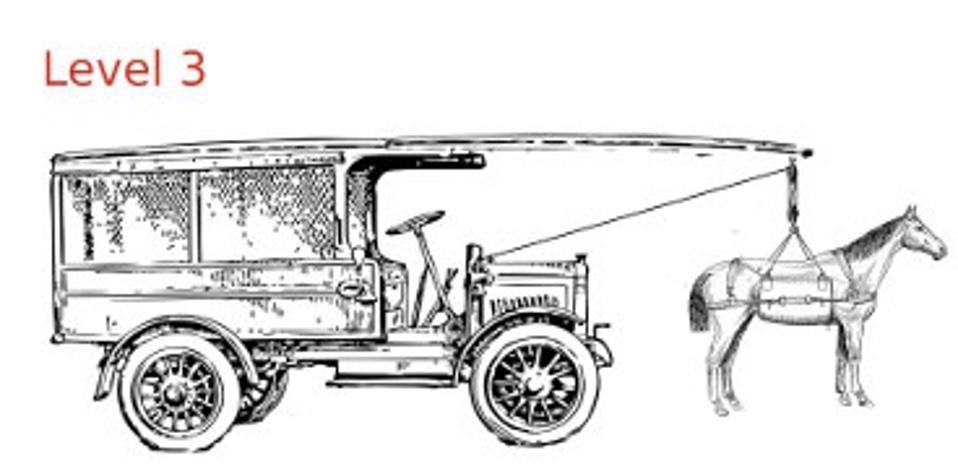
The most debated of these levels was the 3rd, where a car could drive itself, but only on the highway, and so a human driver had to be on “standby” to take over when the highway ended or there was construction or something else the system could not handle. This was different from a monitoring driver who has to take over in urgent situations (such as the car trying to drive off the road.)
Some viewed this as a technical “level” — the car isn’t good enough to handle all the roads so it needs the standby driver. Others viewed it as a legal matter — a level 3 car was just a level 2 car so good that the maker could take legal responsibility for what it did. Those who felt there was no progression from ADAS to self-driving didn’t feel it made sense to talk about level 2 getting that good, but it is true that a real self-driving car does need to take legal responsibility. You would not get into an Uber if told you would have to pay or even go to jail if your Uber driver was negligent.
So while some see this level 3 as a progress from level 2, it’s actually a special subset of a self-driving car (level 4.) The very particular subset is a car that needs to leave its driving domain while moving, which essentially is primarily on the highway. Every other type of self-driving car (except the mythical level 5 which does not actually exist) has a domain in which it works. It doesn’t leave that domain. It may come to a stop at the edge of the domain and then turn into a manually driven car. The level 3 car is special, in that the domain can end at a freeway off-ramp or the start of a construction zone, and there it must plan for a handoff while it is moving. But otherwise, it is a full self-driving car within its particular domain (freeways) and must handle any contingency in that zone.
The handoff
The handoff idea was always challenging. Most people settled on needing about 10 seconds of warning. Studies showed that almost always people could stop what they were doing and take over in 10 seconds. But not always — particularly if they have fallen asleep. They will fall asleep, unless you have major countermeasures against it.
Research done at Google with employees commuting in such cars in 2013 found that even paid employees could not be trusted to follow the rules, so they gave up any effort towards the idea of a standby driver. Others took the plan of just coming to a stop in the road, or being able to pull off if the driver didn’t respond within the 10 seconds. Stopping in the middle of the road is somewhat risky, but usually works — and is pretty much always safe in a traffic jam.
The value
Google decided not to make such a product both because of the challenge of making it safe and the question about its value. For many drivers, to be able to relax on the highway would certainly be valuable. Doing it just in traffic jams is not nearly as valuable, but still a very pleasant feature. Both of these functions, however, only allow for making private cars — starting with private luxury cars — a bit more useful and valuable. While they should improve driving safety over time, the initial ones will be similar to humans in safety, and the rate of crashes on freeways is actually much lower than on city streets.
The real value comes in the robotaxi concept for many. The robotaxi changes the nature of transportation and the city, eliminating the need for parking and for car ownership. Robotaxis can refuel/recharge themselves as well. That’s what revolutionizes industries. The big teams at tech companies want to do something big, not just improve luxury cars. If this feature does cost $5,000 as expected, it should make sales in that space, though that’s a fairly high surcharge for ordinary cars. Even so, once it can do the whole commute, people with long commutes or vacation homes might easily pay that price.
One downside of traffic-jam assists is that they make traffic jams more tolerable, which could actually increase them. Today, many drivers avoid driving in rush hour because they hate traffic jams. If a jam becomes a chance to get some work done or even to sleep, more people might be ready to drive when traffic is thick. They might even welcome the traffic jam, particularly in electric cars which are efficient in that situation.
The Mercedes offering is somewhat strange in how they tell you to only use applications on their console. Like most car OEM infotainment systems, these are far inferior to what you get on your phone or tablet. I don’t think most customers will obey that restriction, unless they are forced by a camera that watches them.
Naturally, Mercedes will go further. German automakers have tended to be conservative on deploying technology like this, and even pulled back on their actual robocar projects, but we should expect this one to grow, though German regulations will need to grow with it. Before long we might see the ability to go at full highway speed.
There, Germans have an edge because many of their freeways have no official speed limit. In other countries, the system designers will be forced to deal with the issue of deliberately going over the speed limit if they are to move at the speed of other traffic and not be an obstruction. On the plus side, systems like this can have the speed set by the human driver, who will be responsible for the speeding ticket, but it could be the developers will be afraid of letting the driver set it at the speed of traffic. We just saw NHTSA force Tesla to remove the ability to set their system to do rolling stops at completely deserted 4-way stops, something that is 100% safe, and done constantly by human drivers, though usually illegal in the USA. (In Europe, 4 way stops are quite rare, and they use roundabouts and yields instead, with better safety records!) For the first time NHTSA was forcing cars to obey the law, rather than just be safe.
In the USA, there is no legal requirement for the 40mph limit, but then there is no legal definition of how to get approval to sell the full-speed car either. In full speed traffic, just stopping in the middle of the lane may not cut it, either. But if the cars have to stick to the speed limit, they will both be a little dangerous and create a lot of frustrations on the road. We’ll find out the answer soon.
Originally published at Forbes.com in Mercedes Drive Pilot Lets Driver Play Video Games In Traffic Jams, Is It A Big Deal?. Copyright © 2022 by Brad Templeton.


Comments
Anonymous
Tue, 2022-03-22 13:43
Permalink
Sales in the two states with this
How many sales estimated in the two states with this option of Level 3, in the low hundreds, maybe 200 or 300?
brad
Tue, 2022-03-22 15:24
Permalink
California is pretty big
But presumably a stepping stone for them to other states. But they did the work to build it for Germany, why not be able to sell it in California?
Anonymous
Sat, 2022-08-06 09:50
Permalink
EU legislation for Automated Driving System (ADS)
Not much discussion on the European Union (EU) draft version of its legislation for vehicles with an Automated Driving System (ADS).
The EU Proposes a Type-Assessment Approval TAA for AVs.
If TAA were enacted in the US, it would be a very unpopular decision for the US OEMs, ...
... and they would likely put up a big fight to stop it. Perhaps it is a question that needs a lot of discussion .... EETimes
Anonymous
Sat, 2022-08-06 10:02
Permalink
Closing thoughts by the reporter
Closing thoughts by the reporter
WHAT IS THE IMPACT?
The EU ADS legislation draft address all AV use cases including personal AVs and makes it a very ambitious and impactful regulation proposal. It specifies the ADS requirements and performance for auto OEMs and service providers, but not what technology to use. The ODD of the ADS will determine AV use cases.
The descriptions of how an ADS assessment will be performed are very complete and is likely to generate many sleepless nights for several AV engineers and executives. The M&S section is particularly impressive from my perspective and is likely to impact how the AV industry uses simulation and modelling across the board for designing, developing, testing, and deploying ADS vehicles.
Unlike the EU, The U.S. does not use type–approval procedures to determine if a vehicle can be sold. Rather, each auto OEM self–certifies that a vehicle model is ready for safe use and sale. Hence the type–approval procedures will have limited direct impact for vehicles sold in the U.S. But the indirect impact will be substantial as U.S. OEMs will participate in the European ADS market segments and will need type–approval.
Anonymous
Sat, 2022-08-06 11:34
Permalink
EU proposal
After reading more on the EU proposal from a Michael DeKort medium blog, this subject is not easy to digest without adequate investment of effort. Self certification is a subject best left for the Phil Koopman, Michael DeKort and expert crowd.
On a sidenote, is ArgoAI publically going after Tesla?
Anonymous
Sat, 2022-08-06 17:28
Permalink
compliance assessment and type–approval
U.S. OEMs who participate in the European ADS market segments will need type–approval.
Annex 2 - ADS performance requirements specifications
Annex 3 - ADS compliance assessment specifications
Starts September 2022 for new type models?
Anonymous
Thu, 2022-08-25 10:24
Permalink
Waymo study review
headlines
Smart cars' biggest safety risk? They're boring to drive
Anonymous
Sat, 2022-08-27 17:51
Permalink
HerbertD pic
HerbertDs July 22nd Linkedin picture from earlier in March at SXSW has to be for a reason given the timeline and events.
Anonymous
Sun, 2022-08-28 02:11
Permalink
Self-Driving Vehicles Not Ready for Prime Time, Toyota Says
Self-Driving Vehicles Not Ready for Prime Time, Toyota Says
thedetroitbureau dot com
Aug. 25, 2022
During a day of presentations at the Toyota Motor North America Research and Development Center outside Ann Arbor, Michigan and the nearby American Center for Mobility, engineers and scientists from the Japanese automaker said they are skeptical any
Anonymous
Mon, 2022-08-29 00:42
Permalink
Hyundai narrows Level 3 self-driving tech gap with Tesla to one
Hyundai narrows Level 3 self-driving tech gap with Tesla to one year
KEDGlobal Aug 29
South Korea’s top automaker Hyundai Motor Co. has narrowed its technology gap in Level 3 self-driving vehicles with Tesla Inc. to one year, moving a step closer to fully autonomous cars.
The automaking unit of Hyundai Motor Group also said it aims to overtake Tesla in autonomous vehicles’ system computing speeds within the next few years.
At the recent Global Investors Conference hosted by Samsung Securities, Jang Woong-jun, head of Hyundai’s autonomous driving business, said the company’s self-driving technology gap with Tesla, which previously was years behind, has been narrowed to one year.
“Tesla’s advanced driver assistance system (ADAS) is ahead of us. But we’re confident we can overtake Tesla in the near future,” he said.
Industry officials said it’s the first time Hyundai has publicly mentioned its autonomous driving technology level compared to that of Tesla.
more ....
Anonymous
Mon, 2022-08-29 08:22
Permalink
G90 Hyundai's first level 3 car launch later this year
G90 TO BE HYUNDAI’S FIRST LEVEL 3 CAR
Hyundai plans to launch Level 3 autonomous cars starting with its flagship luxury Genesis G90 sedan later this year, followed by affiliate Kia Corp.’s large-size electric sport utility vehicle, the EV9, next year and Hyundai’s electric SUV IONIQ 7 due in 2024.
The automotive conglomerate aims to roll out fully autonomous driving cars by 2030 after pilot services on real roads in 2023.
Anonymous
Mon, 2022-08-29 08:44
Permalink
42dot startup and Motional
TESLA 3 DISASSEMBLED
Hyundai has cross-checked its level of autonomous driving technology by disassembling the Tesla Model 3.
According to Hyundai, the Tesla EV has 39 integrated controllers, the brain of autonomous vehicles, compared to 50 for the Hyundai IONIQ 5.
The more such controllers, the higher chances for malfunctions and lower efficiency.
Hyundai said it will reduce the number of integrated controllers in the next-generation IONIQ 5 to four and cut further to three for body control, infotainment, and driving and parking by 2025.
For Hyundai’s third-generation controllers, the domain control unit (DCU) that controls the car body is under development by Hyundai Mobis Co. The driving DCU will be supplied by Halla Group’s autonomous driving solutions subsidiary HL Klemove.
Hyundai AutoEver Co. will manufacture connected car systems and the middleware software that controls the consistent operation of autonomous driving systems and OTA updates.
Hyundai’s Jang said its third-generation integrated controllers will have faster computation speeds than Tesla’s full self-driving (FSD) cars, which boast a speed of 144 trillion operations per second (TOPS).
TO EXPAND SELF-DRIVING BUSINESS STAFF
Hyundai Motor Group plans to raise its autonomous driving business staff to 650 by year-end from the current 600.
It recently acquired 42dot, a Korean autonomous driving startup, and appointed the startup’s Chief Executive Song Chang-hyeon to oversee Hyundai’s mobility development projects.
To prepare for a commercial self-driving service globally, Hyundai and its US mobility joint venture Motional Inc. are testing IONIQ 5 robotaxis on public roads in Las Vegas and other US cities. Hyundai aims to take such services to Singapore and Saudi Arabia later.
Add new comment