



Tesla removes ultrasonic sensors and disables parking features, something only Tesla could do
Tesla announced that they are removing the ultrasonic sensors from models 3 and Y, and later from S and X. New buyers of these cars will find this means it disables features like the useful auto park and park assist, as well as the less useful summon and smart summon features in the “enhanced Autopilot” and “FSD” packages. While these features will be disabled in these new cars, Tesla promises it will fairly soon re-enable them with a future software release which will provide them using just the cameras.
Park assist (the beeps and screen displays which show you are getting close to walls or other vehicles when parking) and auto-park are now fairly common checklist features for middle and high-end cars. Customers expect them, so removing them is no small step. On the other hand, Tesla is selling all the cars they can make and so probably doesn’t fear it will lose sales over this. Even so, this opens up many questions:
- Tesla will save money removing this hardware, but it’s fairly cheap hardware so not a great deal. But why remove it before the replacement software is ready, depriving buyers of a checklist feature?
- Can Tesla easily implement these features (and more) just from cameras, and if so, why isn’t this working already?
- How does this compare to the way Tesla removed radar from new cars, reducing functionality, then slowly (but not completely) brought it back?
- How does this illustrate Tesla’s car-as-computer approach in contrast to other automakers?
What are ultrasonic sensors?
Ultrasonic sensors are cheap, small “sonar” that sends out an inaudible sound wave, and wait for it to reflect back off things at the speed of sound. They can tell you how far away any significant object is out to a few meters. Tesla has 12 of them, on the face and sides of the bumpers. These cost only a few dollars though mounting them and wiring them adds to that. Munro Live estimates the total cost at about $114. Almost all automakers uses these to provide park assist warnings and more, as did Tesla. They give a very simple picture of the world — is there anything out there and how far away is it? Some fancier ones generate a low resolution image. They are also used for blindspot warnings and they can detect the guardrail next to the road.
The picture is pretty poor, so many people find park assist to be annoying, providing beep warnings too early or on things you are not on trajectory to hit. Many prefer the use of a backup camera, at least for going in reverse. But the ultrasonics make the job easier.
They are mainly mounted in bumpers, which does increase the cost of accidents and insurance, however.
With Tesla’s sales of 90,000 cars/month, $114 amounts to under $11M per month (or just $5M in the USA where they have started this) which is not chicken feed, but also not a lot if Tesla thinks it will restore parking assist in just a few months. ( Once they make the software do it from cameras the decision to remove the sensors is a no-brainer. When Tesla pulled radar it was commonly speculated to possibly be due to the global parts shortages — some alleged Teslas were sitting ready to ship except for the radar, and pulling radar fixed that. When they pulled radar, the new cars had a much lower speed limit on Autopilot, longer following distances and many users reported a serious increase in the amount of “phantom braking” — when the car brakes for a ghost, a ghost that radar might have confirmed wasn’t there. Over time, Tesla still hasn’t restored the full 90mph Autopilot speed it had with radar, and phantom braking is still an issue. The currently 85mph speed is pretty decent, though the 80mph they had for a while was not sufficient on faster highways where that speed, while illegal, is still pretty common.
Even so, radars are more expensive than ultrasonics, and they were hard to find. That doesn’t seem to apply here.
Tesla’s autopark originally used only the ultrasonics and could not see things like lines in a parking lot — it needed to have cars on either side to park between. Later it evolved to use both the cameras and the ultrasonics.
Can they do it?
Tesla is following an all-computer-vision approach, and in particular has recently rolled out a testing version of their “virtual LIDAR” which attempts to build a 3D representation of the world just from camera data, without necessarily being able to identify things to figure out how far away they are. (The human mind uses its knowledge of how big cars and people are to guess the distance to them.) They are now calling this the “occupancy network” system, an effort to build a map of what parts of the world before the car are “occupied” and which are empty, thus allowing the car to decide where it can go.
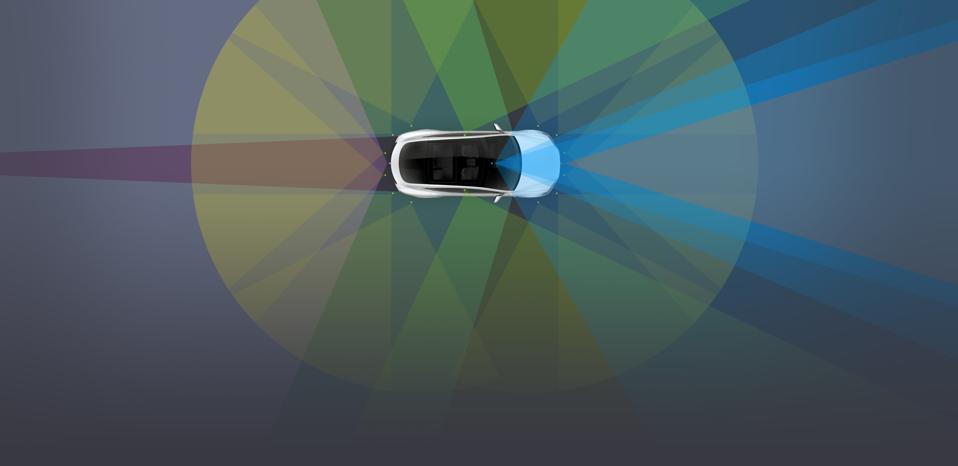
If you build such an accurate 3-D map of the world, it’s then pretty easy to provide parking assist and auto-park within it. In fact, you should be able to do a better job. Typical ultrasonic based park assists don’t really understand the shape of things and give alerts about things the car is not about to hit. A better system can predict where the car is going to go and know when a warning is needed, or park with more confidence.
Virtual LIDAR isn’t a technology that works yet for the bet-your-life reliability needed for self-driving on the roads. Tesla is betting it is now good enough to handle parking, which is done at much slower speeds, closer ranges and with opportunity to pause if uncertain. Ultrasonics are very limited in resolution and make mistakes but are used in only limited ways in most cars.
The problem is that there are areas the cameras can’t see, most notably the space right in front of the car, which is invisible to both the driver’s eyes and the camera. To provide parking assist here, the car must map the space when it can see it, and work from that memory. That can work fine as long as nothing in the space is likely to move. Fortunately the most likely things to move — other vehicles and pedestrians — are all tall and are visible to the camera even when their bottom half can’t be seen. A small child might be hidden, but a system should identify that and simply not operate if there is a small child in front of the car, obviously. Cameras also have a limit to their depth of field and can’t easily deal with things very close to them, but once again it is sufficient to map the objects when they are not that close and remember their shape. If they move, that can be detected, even if blurry.
Providing parking assist is one thing. Self-driving may be more difficult due to the blind spots of the cameras. A parked car that wants to leave on its own may not see an obstacle that has appeared in front of it that is not visible to the forward cameras. Many robocar designs have LIDARs on stalks to make sure they can see all around the vehicle, which a Tesla can’t easily do. For driver assist, the human can be counted on to fill this gap.
The ultrasound sensors also provided an assured perception of things like guardrails when on the highway, which gives more confidence to Autopilot and self-driving functions. Even if the perception system were to make a mistake about the lanes or guardrails, the ultrasonics have assured the vehicle won’t veer into the guardrail under any circumstances. This redundancy will be gone.
Software Car
Most interesting is how this illustrates how different a car company Tesla is from the old-school OEMs, even now that they woke up about the Tesla threat many years ago. Tesla is probably going to get away with removing the parking features from the car, though it may take a short-term hit on sales of enhanced Autopilot (for whom the parking features were the best part) and FSD. It’s hard to imagine old OEMs saying, “Oh, sorry, your car won’t have that feature, but give it some time and it will reappear with a software feature.” Customers would not trust them and probably wouldn’t have it. For many, the fact that Teslas regularly get new features after you buy them has been a nice selling point for the cars, though the rate of new features has slowed a fair bit in the last few years with all the focus on FSD eating resources. Customers will be willing to accept Tesla’s promise that they will get this feature before too long.
Even in spite of Elon Musk’s current poor track record on promising dates to deliver functions. In the computer and phone world, it’s pretty normal to buy hardware and expect it to get important new functionality later with a software update. That’s not been true with cars.
Originally published at Forbes.com in Tesla Removes Ultrasonic Sensors In Bold Move That Cripples Features But Promises To Restore Them. Copyright © 2022 by Brad Templeton.


Comments
Anonymous
Thu, 2022-10-20 11:44
Permalink
Musk told a post-earnings call
Musk told a post-earnings call on Wednesday that all FSD users in North America will get an upgraded version at the end of the year...
... drivers would rarely have to touch the controls.
"The car will be able to take you from your home to your work, your friend's house, the grocery store without you touching the wheel," he said.
Musk also said Tesla hopes to provide an update to FSD in 2023 to show regulators that the car is much safer than the average human.
europe dot autonews dot com/automakers/tesla-flags-its-cars-are-not-ready-be-approved-full-autonomous-year
brad
Thu, 2022-10-20 12:35
Permalink
He's said that before
So it's hard to know what credence to put to such predictions.
Anonymous
Thu, 2022-10-20 13:58
Permalink
waymo
Waymo ramped up AV driving in SF ~1.5 yrs ago, yet have only launched crewed AV ridehail in SF.
Passengers legally in an uncrewed Waymo in California are for AV "testing" per CA_DMV not CPUC ridehail.
shlomo
Sat, 2022-10-22 09:17
Permalink
Reddit user Aniccia post
www dot reddit dot com/user/aniccia/
shlomo
Sat, 2022-10-22 10:06
Permalink
Costs
spectrum dot ieee dot org/deep-learning-computational-cost
shlomo
Thu, 2022-10-20 19:35
Permalink
Humor from another Muskism yesterday as well
Musk said during a call with investors on Oct. 19 following Tesla’s third-quarter earnings release. Apple and Saudi Aramco are currently the world’s two most valuable companies, worth $2.3 trillion and $2.1 trillion respectively. Per Musk’s claim, Tesla could be worth more than $4.4 trillion one day, nearly seven times its current market cap.
brad
Thu, 2022-10-20 20:32
Permalink
He believes that
A company which pulls off an all-roads able robotaxi, which he thinks they will do any day now, would be worth that. A company would produces a $20,000 fully capable humanoid robot would be worth more than that. He thinks both those things are soon.
Shlomo
Fri, 2022-10-21 14:02
Permalink
All roads
All roads is unachievable.
brad
Fri, 2022-10-21 14:50
Permalink
Indeed
You think that and I think that and most other people think that. But he says he believes otherwise, so that means he is being consistent if he forecasts Tesla will have it.
Anonymous
Tue, 2022-10-25 13:10
Permalink
I'm cancelling my model Y
I'm cancelling my model Y order because of this! My order was based on the features that would be provided, including enhanced auto-pilot (parking assist, auto-park, summon, etc.). They took a non-refundable deposit and then announced they are taking away the USS and these enhanced features, several which are standard on many modern EVs, especially at this price point. I didn't sign up to pay this much money to be a guinea pig for something that has been taken away for a promise of something that might be good enough in the future. Not getting the new system working before removing the old system is a terrible move. This move has angered both current owners and prospective buyers alike. Many have said they will look at non-Tesla options for their next EV. Other auto makers are catching up and Tesla will start losing significant EV market share by 2024.
brad
Tue, 2022-10-25 14:00
Permalink
It is odd
I suspect you could demand your deposit back and win a suit (that costs you much more than your deposit.) But I would wait to see what the case is on your delivery date. In particular, right now a used model Y sells for more than a new one, and if you get yours before too long, a new model Y delivered today will make you a fat profit, even without auto-park.
Anonymous
Wed, 2022-11-02 11:02
Permalink
three consultants
The three consultants to California were Stanford Law School affiliate scholar Bryant Walker Smith, Edge Case Research CEO Michael Wagner and University of California transporation research engineer Steven Shladover.
Anonymous
Wed, 2022-11-16 10:02
Permalink
Valeo centralized computer with EyeQ ?
Valeo Group announces company has produced its 10 millionth front camera system integrating Mobileye EyeQ technology at its Wemding site in Germany (Bavaria).
Valeo and Mobileye are now focused on the integration of the latest generation of the Mobileye SoC into the Valeo front camera system and also into Valeo’s cutting edge centralized computer and software.
"In 2023, Valeo will produce an additional 9 million front cameras worldwide. By 2030, almost 90% of new vehicles will be equipped with this technology, and the ADAS content per vehicle will double.”
The ADAS market is expected to grow by 17% per year to reach 60 billion euros in 2030.
charles sterling
Mon, 2022-11-28 04:04
Permalink
tesla remove reversing sensors
I have just purchased 2 x tsal y and they have no reversing sensors, we were not told this on the purchase handover and spent some time looking at the internet to see what’s going on, I understand that the new Tesla vision may be better than the sensors but the bottom line is its not available as yet, and i can find lots off blogs saying the sensors are removed but no blogs on when we are getting the tesla vision to replace this, they should have had the tesla vision working before they removed the sensors, and now i have a car with no sensors, so what to do ??? i definitely cant let the wife drive it .
Christopher
Thu, 2023-01-05 19:26
Permalink
Parking sensor deletion on new. Teslas
Countuary to the author I believe it is wholly unacceptable for tesla to remove a basic safety feature from the car. This was a feature listed at the time of sale, in the many months I waited for delivery I was not warned that the sensor was to be removed, I was not warned when I picked up the car, and I have not been compensated for its absence. Tesla has deceived its customers. I believe this dishonest action by tesla is illegal and dangerous.
Furthermore I do not believe any substitute system could ever be made available with the layout and installation of cameras on the car, so I have no faith that tesla can ever restore the same functionality because it is physically impossible
Add new comment